On this page
Alfred James Lotka (1880–1949) was born in Austria to American parents and joined the Metropolitan Life Insurance Company in 1924, according to demographer Joseph J. Spengler's encyclopedia entry on Lotka. A year later he published a book that described populations and the flow of energy through living things with the same kind of equations.
What is Elements of Physical Biology about?
Lotka finished the book at Johns Hopkins University; he first planned it "about 1902, in the author's student days in Leipzig" (full text on the Internet Archive). He used "Physical Biology" to mean "the broad application of physical principles and methods in the contemplation of biological systems."
He credited the book's merits to "the influence and teaching of Poynting", a name you may know from the Poynting vector and how energy flows.
What is the renewal equation in population biology?
The renewal equation says today's births come from mothers born earlier: past births, times the chance of surviving to each age, times the birth rate at that age, summed over ages. Lotka and F. R. Sharpe worked on this in "A problem in age-distribution", published in the Philosophical Magazine in April 1911 (DOI record). Spengler says it "demonstrated how a closed population develops a stable age distribution and a characteristic rate of increase" (encyclopedia entry).
In the 1925 book, Lotka writes the stable age distribution as c(a) = b e^(−ra) p(a), where b is the birth rate per head, r the "natural rate of increase" and p(a) the chance of surviving to age a (book text). He wrote that if this shape is "disturbed by a temporary change in the conditions of life (e.g., war), it will spontaneously return upon restoration of normal conditions."
For females in England and Wales in 1871–1880, the observed death rate per head was 0.020001; from the observed birth rate, his formula gave 0.02000 (Table 8 of the same book).
The rate r comes from one condition: 1 = ∫ e^(−ra) p(a) m(a) da, where m(a) is daughters born per mother per year at age a.
How does the renewal equation work? A pencil-and-paper example
Take a made-up insect that lives two years at most.
Half of newborn females reach age 1 and have 2 daughters each: 0.5 × 2 = 1 daughter per newborn.
A quarter reach age 2 and have 4 daughters each: 0.25 × 4 = 1 more.
So births this year = births last year + births two years ago, and R, the book's "ratio between the total number of births in two successive generations", is 1 + 1 = 2.
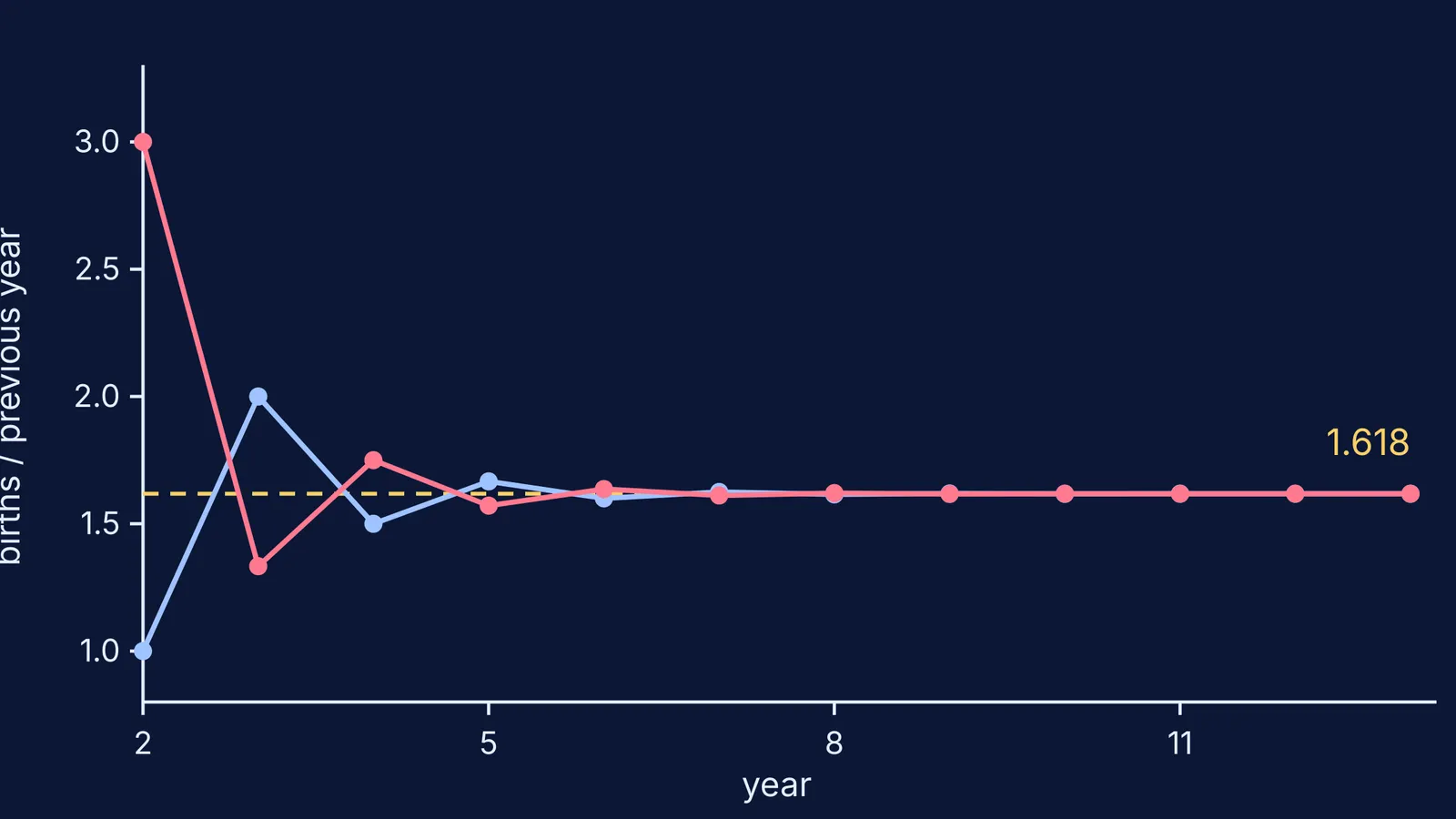
Start with one batch of newborns and yearly births run 1, 1, 2, 3, 5, 8, 13, 21. Start with 1 birth then 3, and they run 4, 7, 11, 18, 29, 47. By year 8, both are growing about 1.62 times a year.
Lotka's condition gives that number directly: 1 = 1/λ + 1/λ², so λ = (1 + √5)/2 ≈ 1.618 and r = ln 1.618 ≈ 0.48 per year. The stable age shares, from c(a) ∝ λ^(−a) p(a), are 1 : 0.309 : 0.095, or about 71% newborns, 22% one-year-olds and 7% two-year-olds.
The same idea explains how an age pyramid predicts population growth and decline.
How did Lotka describe energy flow in living things?
Lotka pictured all life together as "one great world-wide transformer", a "world engine" with "its firebox, so to speak in the sun" (book text). He wrote that 35 per cent of the Sun's energy reaching Earth is reflected and 65 per cent absorbed, and quoted an estimate that about 0.12 per cent is absorbed by green plants, "the gate of entrance" for the energy of life. These are 1920s figures: read them as history, not current data.
He argued that while energy runs "to waste", a species that captures more of it gains an advantage, so evolution may tend to increase the total energy flux. For details he pointed to his 1922 paper "Natural Selection as a Physical Principle" (PNAS, DOI record), but cautioned that "a prematurely enunciated maximum principle" can turn out wrong.
A chapter on species that depend on each other shows host–parasite equations giving "a periodic or oscillatory process" (book text). Watch that kind of rise and fall in the hare-lynx simulation of predator and prey cycles.
How can a Class 11 or 12 student use Lotka's ideas?
A checklist for any population equation:
Check units: r is per year, so a in e^(−ra) must be in years.
Try an extreme case: if no female lives to have daughters, R is 0 and the population dies out.
Run two starting populations through the rule and check they settle to one growth rate.
If the integral sign or e^(−ra) is what stops you, the Fermi Concept Library has its own lesson for every concept in mathematics and biology. The Fermi Simulation Lab has interactive simulations for ideas that are easier to see than to read.
The 1925 text is free on the Internet Archive; start with its chapter on the analysis of the growth function.