

On this page
When you flip a switch, the copper wires inside the wall do not carry electrical energy the way a pipe carries water. Conduction electrons drift through copper at a sluggish crawl, yet an electrical appliance activates almost instantaneously. In 1884, English physicist John Henry Poynting explained this puzzle in the Philosophical Transactions of the Royal Society by demonstrating that electrical energy does not flow inside the metal conductor at all. Instead, energy travels through the surrounding electromagnetic field in empty space or insulation, entering the wire from the outside.
Who was John Henry Poynting?
John Henry Poynting was born on 9 September 1852 in Monton, Lancashire. After studying physics at Owens College, Manchester, he entered Trinity College, Cambridge, graduating as Third Wrangler in the 1876 Mathematical Tripos, as chronicled by Sir J. J. Thomson in his Royal Society memoir (10.1098/rspa.1916.0041). At the Cavendish Laboratory, Poynting worked under James Clerk Maxwell. In 1880, he became the first Professor of Physics at Mason Science College (later the University of Birmingham), where he remained for 34 years until his death on 30 March 1914.
In 1884, Poynting published his landmark paper, "On the Transfer of Energy in the Electromagnetic Field" (10.1098/rstl.1884.0016), demonstrating that Maxwell's field equations require a local continuity law for energy. Oliver Heaviside independently derived the same energy flux relation in January 1885 while simplifying Maxwell's equations into modern vector form.
Why does energy flow outside the wire instead of inside?
Before Poynting's work, physicists assumed energy flowed inside metal conductors. Poynting proved that wires merely establish boundary conditions that guide the fields in the surrounding space.
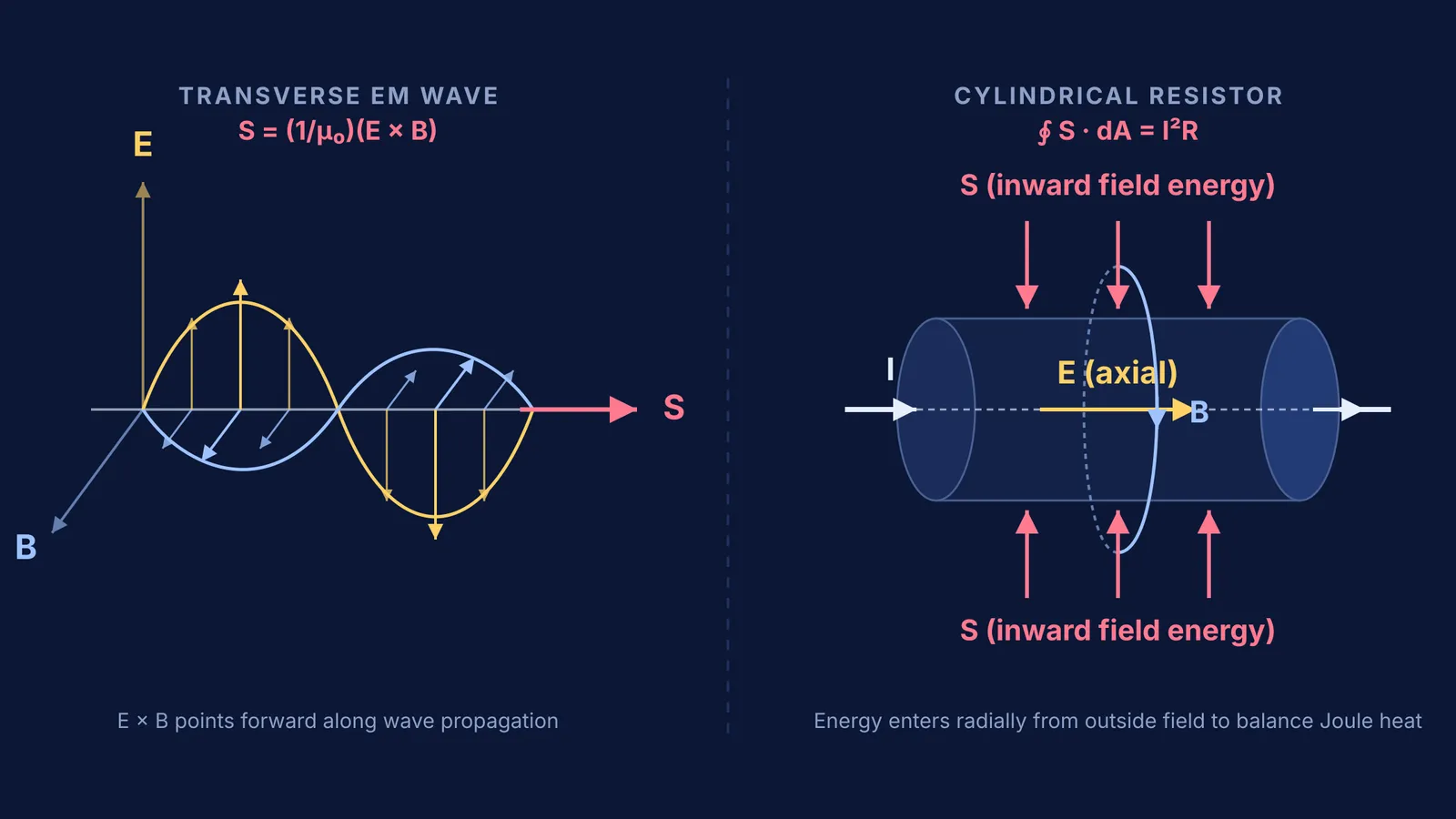
When a battery powers a circuit, surface charges create an electric field E, while current produces a circulating magnetic field B via Ampère's law. Poynting defined the directional energy flux density S:
S = (1 / μ₀) (E × B)
Here, μ₀ is the permeability of free space, and S measures power flux in watts per square metre, directed by the right-hand rule.
Near the battery, E × B points radially outward, pushing energy into the surrounding space. Along a zero-resistance wire, the parallel surface electric field vanishes, so no energy enters the conductor. At a resistor, however, an axial electric field drives current. The cross product of this axial field with the azimuthal magnetic field points radially inward through the surface, channeling energy from the field into the metal to become heat.
How do you calculate the Poynting vector in an electromagnetic wave?
In free space, electromagnetic waves transport energy without any wires. The electric field E and magnetic field B oscillate perpendicular to each other and to the propagation direction, as described in the NCERT Physics curriculum for Class 12.
Their cross product yields instantaneous energy flux along the propagation axis:
S = (1 / μ₀) E B
In vacuum, field amplitudes satisfy E = c B, where c is the speed of light (3 × 10⁸ metres per second). The average energy flux—wave intensity I—equals:
<S> = (1/2) ε₀ c E₀² = E₀ B₀ / (2 μ₀)
This energy carries momentum p = U / c, exerting radiation pressure. Poynting demonstrated between 1903 and 1911 how radiation pressure draws orbiting dust grains into the Sun (10.1098/rspa.2011.0573). Vector relationships become clearer when visualising the electric and magnetic fields of an EM wave, which explains why accelerated charges produce electromagnetic waves.
How do you prove energy conservation in a simple resistor?
The NCERT Physics curriculum demonstrates this balance for a cylindrical resistor of radius r and length L carrying current I with voltage V:
Surface electric field: Uniform along the axis with magnitude E = V / L.
Surface magnetic field: By Ampère's law, azimuthal field B = (μ₀ I) / (2π r).
Poynting vector: Mutually perpendicular fields yield inward flux S = (1 / μ₀) E B = (V I) / (2π r L).
Surface integral: Over curved area A = 2π r L, total power is P = S × A = [(V I) / (2π r L)] × (2π r L) = V I = I² R.
The field energy entering through the curved boundary equals Joule heating inside the resistor. This worked balance shows how Lenz's law follows from energy conservation at every electromagnetic interface.
How to explore electromagnetic fields deeply
Connecting charge motion, three-dimensional field vectors, and circuit laws requires building strong spatial intuition.
The Fermi Simulation Lab provides interactive simulations for the ideas that are easier to see than to read, letting you manipulate current directions, observe circulating magnetic fields, and track energy flux around circuit components in real time.
When working through challenging physics problems on radiation pressure, wave intensity, and circuit boundary values, the Fermi Problem Library offers worked problems with a step-by-step solver that explains the reasoning rather than printing an answer.
To connect Poynting's theorem with Maxwell's equations, capacitance, and induction, the Fermi Concept Library covers every concept in physics, chemistry, biology, mathematics and computing, each with its own lesson and its place in the map.


