

On this page
The CBSE Class 12 Physics syllabus asks you to understand the transverse nature of electromagnetic waves. Textbooks typically show this with a flat diagram: an electric wave oscillating up and down, and a magnetic wave oscillating in and out of the page.
But a 2D drawing forces your brain to flatten a 3D space. When an exam asks you to predict where the fields point if the wave changes direction, memorising a static image is not enough. You need to be able to rotate the wave in your head.
In a vacuum, these waves travel at the speed of light, carrying energy through space without needing any physical medium. This sets them apart from mechanical waves, which rely on vibrating particles to carry energy. The oscillating fields in an electromagnetic wave continuously sustain each other: a changing electric field creates a changing magnetic field, which in turn creates a changing electric field.
Why are electromagnetic waves hard to picture?
Every electromagnetic wave—whether it is visible light, a radio signal or an X-ray—consists of oscillating electric (E) and magnetic (B) fields, which determine the energy density and intensity of an EM wave.
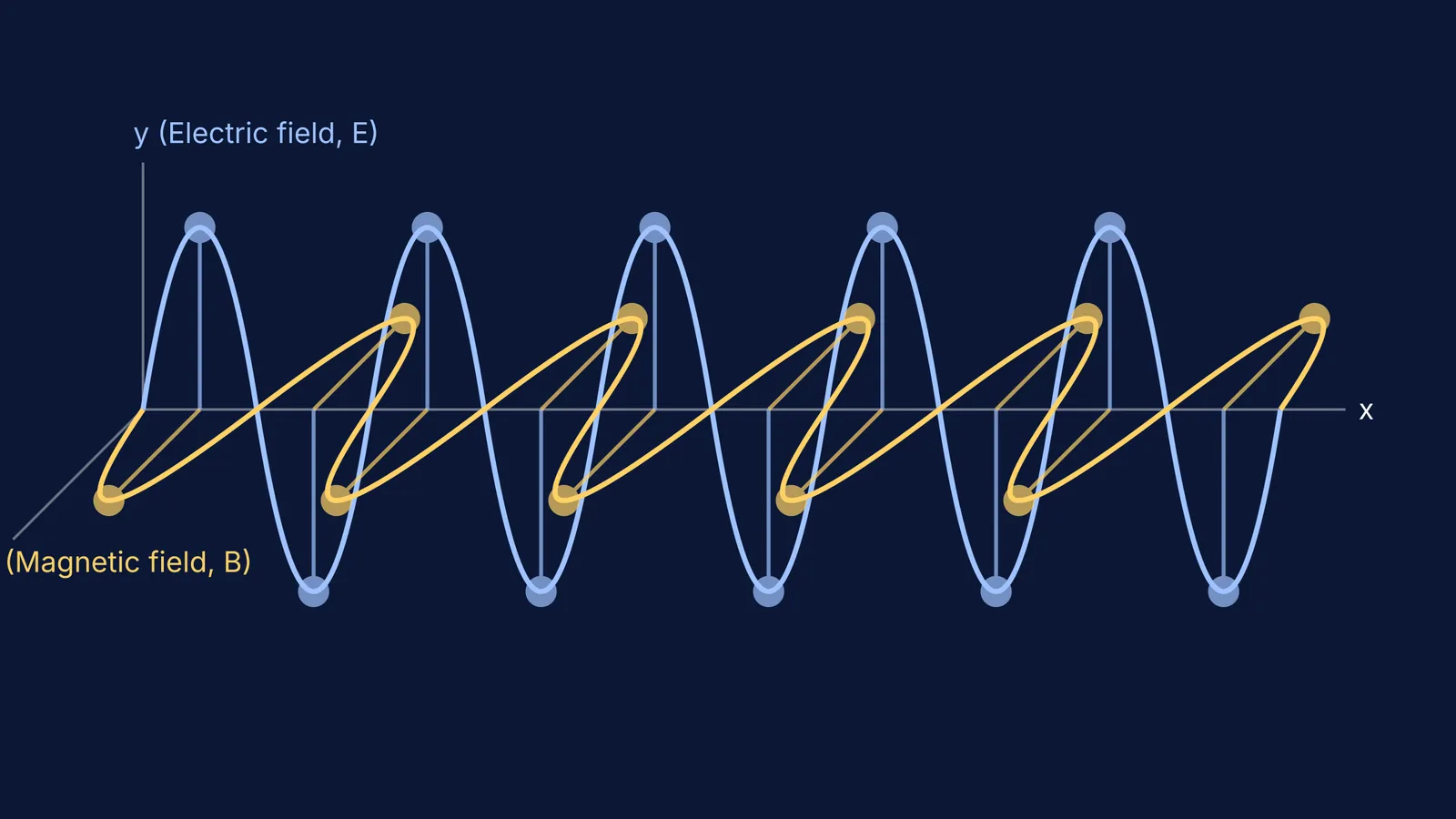
Unlike displacement and pressure waves in sound which push and pull in the same direction the wave travels, electromagnetic waves are transverse. The fundamental rule is that these fields are mutually perpendicular. The electric field, the magnetic field and the direction of propagation (the path the wave travels) all sit at 90° to each other.
If a wave travels forward along the x-axis, the electric field might oscillate up and down along the y-axis, while the magnetic field oscillates left and right along the z-axis. This is a straight-line oscillation, unlike the circulating E inside a solenoid produced by a changing magnetic field.
Drawing an electromagnetic wave's electric and magnetic fields in 3D on a flat page skews one of the axes. The magnetic field is typically drawn at a 45° slant to create a sense of perspective. While this convention is necessary on paper, it often tricks the eye. Students can misinterpret the slanted lines as acute or obtuse angles rather than a strict 90° perpendicular relationship. This optical illusion makes the vectors much harder to visualise.
How do you find the direction of the fields?
To predict where the fields point without a diagram, physicists use the vector cross product: the wave always travels in the direction of E × B.
You can find this using the right-hand rule. If you point the fingers of your right hand in the direction of the electric field and curl them towards the magnetic field, your thumb will point in the direction the wave is travelling.
Using the rule: point your thumb Down (the wave's path), and your fingers East (the electric field). To curl your fingers naturally, your palm must face North. That means the magnetic field points North.
How does polarisation change the fields?
So far, we have assumed the electric field always oscillates along a single, fixed axis (like the y-axis). This is known as plane-polarised light, and it is the easiest type of wave to draw.
Most natural light sources, such as the Sun or a standard light bulb, emit unpolarised light. In an unpolarised wave, the plane of the electric field constantly rotates randomly as the wave travels, pointing up, then diagonally, then sideways. However, the fundamental rule still applies at every single instant: wherever the electric field points, the magnetic field is always exactly 90° to it, and both are always 90° to the wave's path.
Do 3D models improve spatial reasoning?
If you struggled to picture that rotation, it is because spatial reasoning takes practice.
A 2013 meta-analysis of 217 studies in the *Psychological Bulletin* found that spatial training, such as manipulating 3D objects, improves spatial skills with an average effect size of 0.47 (10.1037/a0028446). This gain is roughly equivalent to a 7-point increase in a standard IQ score.
Instead of staring at a textbook, using the Fermi Simulation Lab allows you to grab the wave and rotate it. Viewing the wave from the front makes the 90° angle between the E and B fields obvious. Viewing it from the top shows exactly how the magnetic field travels along its own axis. A 2008 review in the *American Journal of Physics* found that well-designed interactive simulations can be engaging and effective tools for learning physics (10.1119/1.2815365).
When you are unsure how to apply the right-hand rule to a new problem, Fermi's AI tutor can work through the vectors with you. It checks your reasoning at each step before running the simulation, so you understand the physics behind the 3D shape.


