

On this page
If you hold a charged particle still, its electric field is static. If you push it at a steady speed, it produces a steady magnetic field. But the moment you change its speed or direction, it sends out an electromagnetic wave. This raises a fundamental question: why does acceleration cause radiation when constant velocity does not?
The answer lies in the ultimate speed limit of the universe. When a charge changes its state of motion, the electric field lines surrounding it cannot update instantly.
Why do accelerated charges radiate electromagnetic waves?
To see why a wave forms, picture a charge sitting still. Its electric field lines point straight outward in all directions. If you suddenly kick the charge so that it moves to the right, the field lines close to it update immediately, pointing away from its new position.
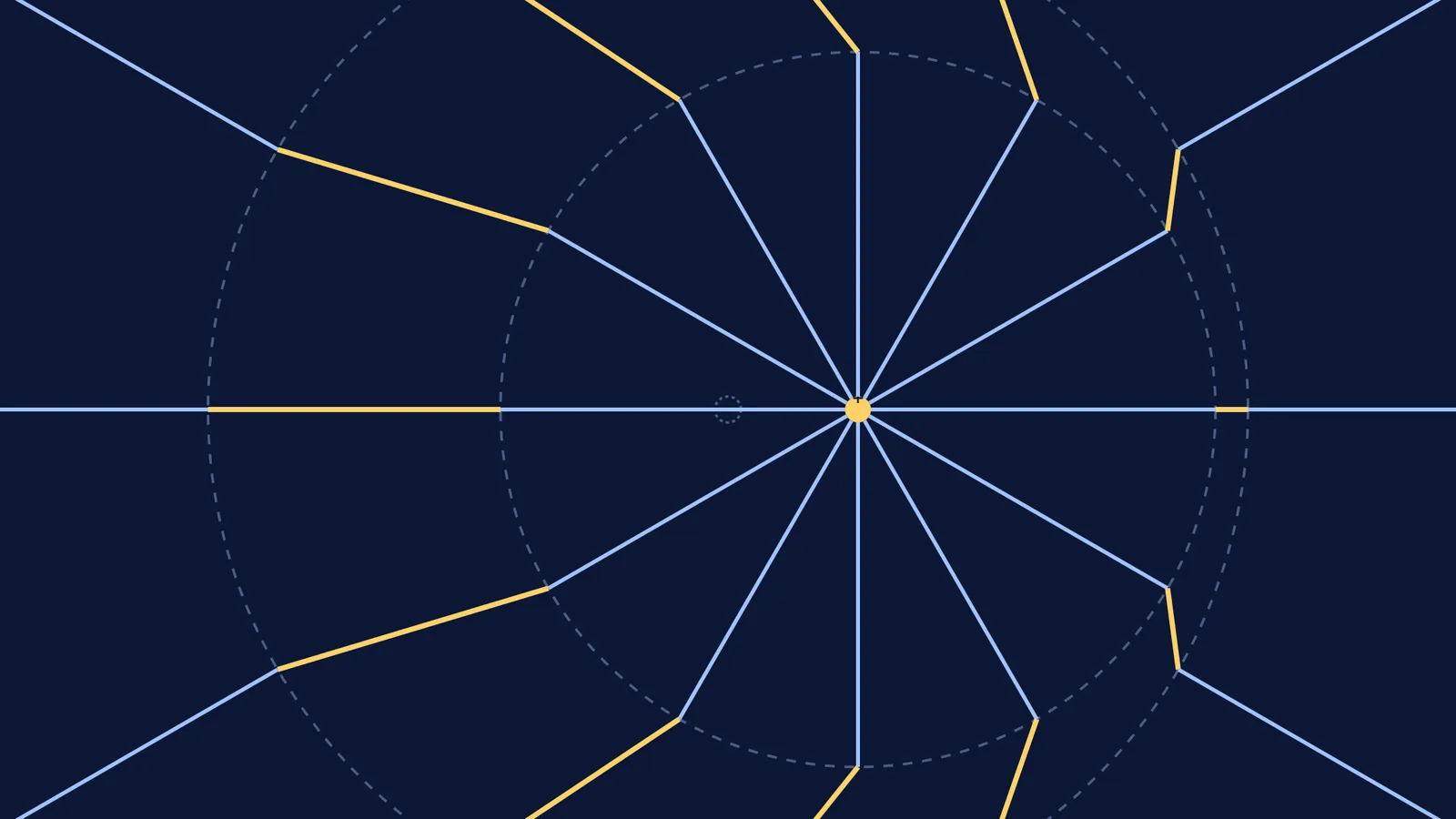
However, because information cannot travel faster than the speed of light, the field lines far away do not yet "know" the charge has moved. They continue to point toward the original location. J. J. Thomson's 1904 book *Electricity and Matter* provided the classic visual model for what happens next. Because the field lines must remain continuous, they form a "kink" or bend connecting the new inner field to the old outer field.
As time passes, this kink travels outward at the speed of light. Unlike the radial lines of a stationary charge, this kink has a transverse (perpendicular) component. This traveling transverse disturbance is the electromagnetic wave.
Why doesn't a constant velocity produce radiation?
If a charge is already moving at a constant velocity, its field is in a steady state of motion. From the perspective of the moving charge, the field is perfectly static and radial. To an observer standing still, the field lines appear "tilted" or swept forward, but they remain perfectly straight. There is no sudden break or kink because the motion is predictable and steady.
It is only when the velocity changes—an acceleration—that the field is forced to abruptly re-align across space, throwing off a ripple.
Why does the wave travel to infinity?
Static fields die out quickly. You cannot detect the electrostatic field of a simple charge from a few miles away. The radiation from an accelerated charge, however, can cross the universe.
The mathematics of Maxwell's equations show that radiated fields drop off as 1/r while static fields fall as 1/r². The energy density of a field is proportional to the square of the electric field strength. For a static field, this means the energy drops as 1/r⁴, fading rapidly into nothing. For the radiated wave, the energy drops as 1/r². When you multiply this by the surface area of a growing sphere (which expands as r²), the radius terms cancel out. A constant amount of energy is carried outward forever.
If you need to trace the mathematics of Maxwell's equations further, the Fermi Concept Library holds every concept in physics, chemistry, biology, mathematics and computing, each with its own lesson and its place in the map.
How do you spot an accelerating charge in problems?
When solving physics problems, you can tell if a system will radiate by looking for any change in velocity. Use this quick checklist:
Sitting perfectly still? No radiation.
Drifting in a straight line at constant speed? No radiation.
Moving in a circle at a steady speed? Yes, radiation. The direction is changing, which means it is accelerating toward the centre.
Speeding up or slowing down in a straight line? Yes, radiation.
Oscillating back and forth in a wire? Yes, the velocity is constantly changing, which is how an antenna broadcasts a radio signal.
If you find it hard to picture how these field lines bend in space, the Fermi Simulation Lab has interactive simulations for the ideas that are easier to see than to read. You can grab a charge, give it a kick, and watch the kink travel outward.
To build your intuition further, you can explore the Energy density in an electric field: u = ε₀E²/2 worked and see the exact numbers behind the Energy density and intensity of an EM wave, with worked numbers. For a look at the magnetic side of changing fields, read Faraday's law for a changing B: the circulating E inside a solenoid.


