On this page
In 1937, a British engineer named Alec Reeves was working in Paris on a problem every telephone company had. A voice sent over a long line picks up hiss and crackle, and each amplifier along the way makes the noise louder along with the speech. His answer was to stop sending the shape of the wave and send numbers instead, as bursts of current that are either on or off. That idea, pulse code modulation (PCM), is still the basis of digital phone calls and CD audio.
What did Alec Reeves invent in 1938?
Reeves was born in Redhill, Surrey, in 1902, studied at Imperial College London, and moved to the Paris laboratory of IT&T, where he came up with PCM in 1937, according to the IEEE's Engineering and Technology History Wiki. He filed the French patent on 3 October 1938, and the matching US patent 2,272,070, called "Electric Signaling System", was granted on 3 February 1942 (Google Patents).
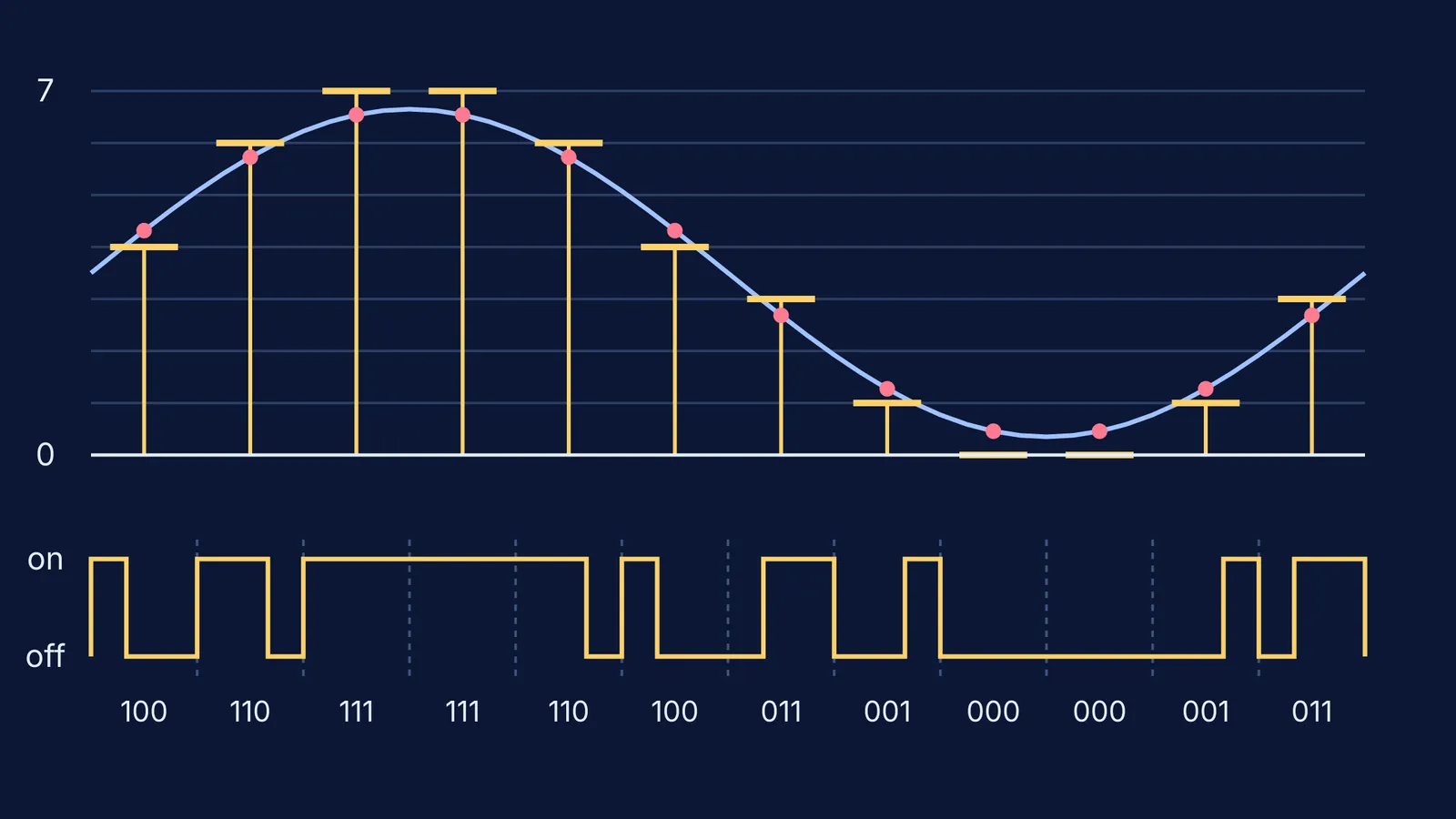
The patent describes a way to send speech "practically free from any background noise". The wave is checked at fixed instants, and each reading is replaced by the nearest of a fixed set of allowed amplitudes. In one version, five separate pulses, each either on or off, are combined to stand for 32 different amplitudes (US patent 2,272,070).
The idea came too early to be built cheaply. The circuits were too complex to build cost-effectively with the valves of the 1930s, and commercial PCM systems became practical only after the transistor, in the 1950s (Wikipedia summary of Reeves's career).
How does pulse code modulation work?
The US Library of Congress gives a one-sentence definition: PCM is a digital representation of an analog signal where the magnitude of the signal is sampled regularly at uniform intervals, then quantized to a series of symbols in a digital (usually binary) code (Library of Congress format description).
That is three steps:
Sample: measure the wave's height at evenly spaced instants.
Quantize: round each height to the nearest allowed level.
Code: write the level number in binary and send each digit as a pulse, on for 1 and off for 0.
How often you must sample is a separate question, which Harry Nyquist worked on. Our post on how Harry Nyquist found the sampling rate for digital audio covers that part.
How do you code one sample with Reeves's five pulses?
Use his five pulses, which give 2 x 2 x 2 x 2 x 2 = 32 levels, numbered 0 to 31.
Suppose a microphone voltage, at one instant, is 62% of the largest voltage you allow.
Scale it: 0.62 x 31 = 19.22. Round to level 19.
Write 19 in binary: 19 = 16 + 2 + 1, so the code is 10011.
Send it as five pulses: on, off, off, on, on.
The receiver reads 10011, turns it back into 19 and outputs 19/31 = 0.613 of full scale.
The rounding error here is 0.007 of full scale. It can never be more than half a step, which is 1/62, or about 1.6%, of full scale.
Why are on-off pulses better than a smooth wave?
Noise adds small random wiggles to whatever travels down a wire. If the signal is the wave itself, the wiggles become part of the sound, and an amplifier boosts them along with the voice. With pulses, the receiver only has to decide one thing: on or off. A pulse with a little noise on top is still clearly on, so a repeater can rebuild a clean pulse and pass it on. The ETHW notes that, with regenerative repeaters spaced along long routes, the noise could be made nearly non-cumulative (ETHW).
Where is pulse code modulation used today?
Phone calls: the ITU standard G.711 is titled "Pulse code modulation (PCM) of voice frequencies" (ITU-T G.711). It takes 8000 samples a second at 8 bits each, which is 64 kilobits a second (G.711 overview).
Audio CDs: they use 44.1 kHz sampling with 16-bit samples, two channels for stereo (Library of Congress). That works out to 44,100 x 16 x 2 = 1,411,200 bits every second.
Each extra bit doubles the number of levels: 5 bits give 32, 8 bits give 256, and 16 bits give 65,536. So CD audio has far finer steps than Reeves's five-pulse scheme.
For where the wave starts, read how a microphone turns sound waves into electric current. If this work interests you, see our guide to signal processing careers for ECE students.
The Fermi Simulation Lab has interactive simulations for ideas that are easier to see than to read. When a bit-rate numerical goes wrong, the Fermi Problem Library has a step-by-step solver that explains the reasoning rather than printing an answer.