On this page
In December 1979, while he was a young researcher at the Stanford Linear Accelerator Center (SLAC), Alan Guth sat at home in Menlo Park, California, and wrote two words at the top of a notebook page: "SPECTACULAR REALIZATION" (WBUR). "This was a eureka moment," Guth later told National Geographic.
What did Alan Guth propose in 1980?
Guth's paper, "Inflationary universe: A possible solution to the horizon and flatness problems", was received by Physical Review D on 11 August 1980 and published on 15 January 1981 (Guth 1981, Physical Review D). Its abstract says that if the young universe "supercooled" far below the temperature of a phase transition, "a huge expansion factor would then result from a period of exponential growth".
Cosmic inflation is a brief burst of exponential expansion in the first tiny fraction of a second of the universe's life, during which space doubled in size about every 10⁻³⁷ seconds (MIT News). Guth joined MIT that same year.
What problems does cosmic inflation solve?
Guth's paper starts from puzzles in the standard hot Big Bang picture (Guth 1981):
The horizon problem. The universe looks almost the same in every direction, yet in the standard model the early universe contained at least about 10⁸³ regions that had never had time to exchange even a light signal. How did they all reach the same temperature?
The flatness problem. Today's universe is close to the critical density that makes space flat. Guth calculated that, starting at a temperature of 10¹⁷ GeV, the initial expansion rate would need to be tuned to one part in 10⁵⁵ to end up like this.
Monopoles. The abstract adds that in grand unified models, supercooling is also relevant to the problem of monopole suppression.
Inflation handles the first two puzzles in one move. A patch small enough to have evened out its temperature gets stretched to cover everything we can see, and any curvature is stretched almost flat, the way a small patch of a giant balloon looks flat.
How fast did the universe expand during inflation?
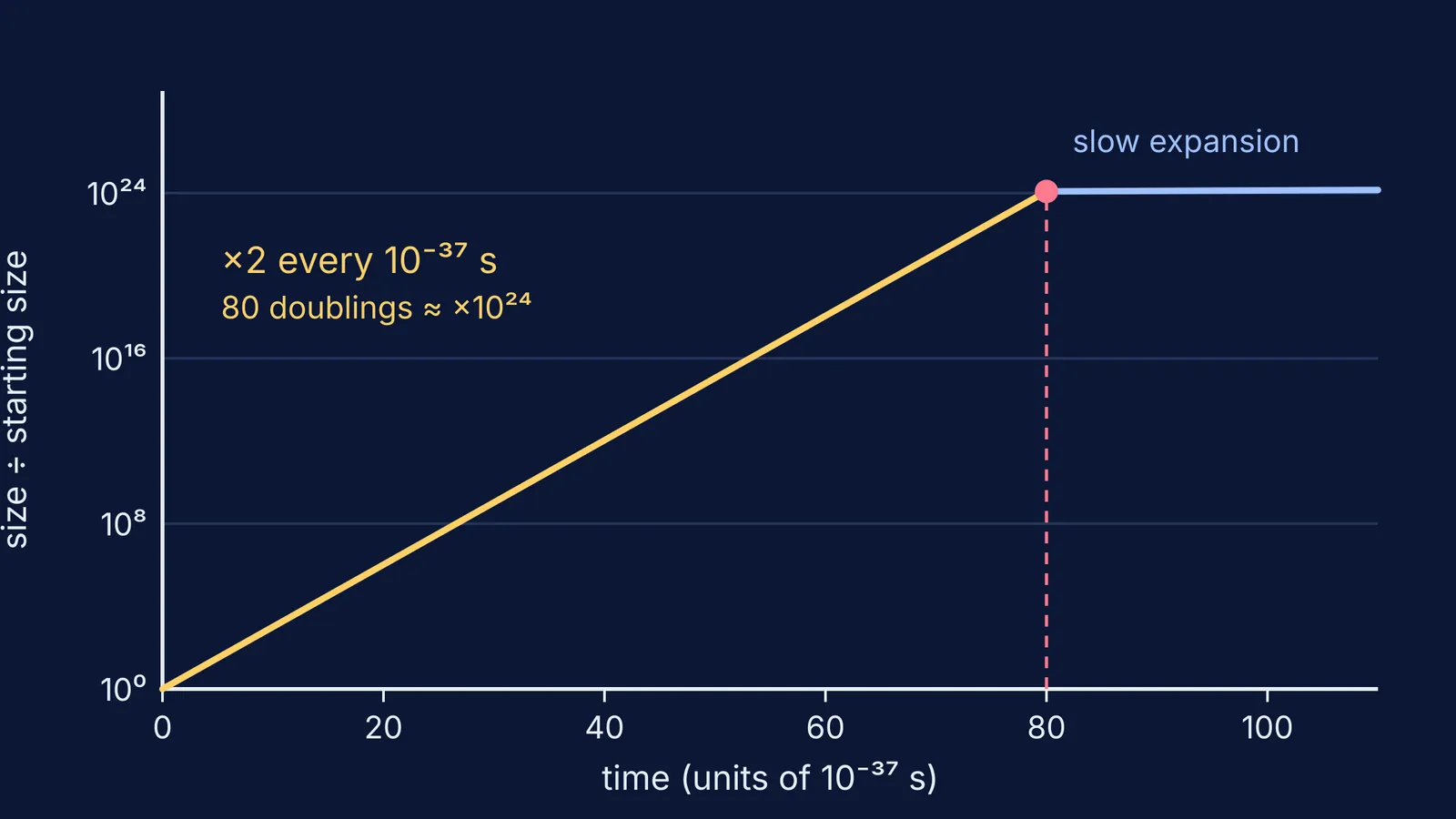
NASA's WMAP team describes inflation as the universe "growing by more than a trillion trillion fold in less than a trillionth of a trillionth of a second" (NASA WMAP). A trillion trillion is 10²⁴. You can check that this fits the MIT figure of one doubling every 10⁻³⁷ seconds with the kind of order-of-magnitude estimate that also helps in JEE physics:
Use the shortcut 2¹⁰ ≈ 10³ (1,024 is close to 1,000).
Growing by 10²⁴ means growing by 10³ eight times, so you need about 8 × 10 = 80 doublings. More exactly, 24 ÷ log₁₀2 ≈ 79.7.
Time taken: 80 × 10⁻³⁷ s = 8 × 10⁻³⁶ s.
Compare with NASA's limit of 10⁻²⁴ s. Our answer is far shorter, so the two descriptions agree.
This is a rough check of the stated rates, not a measurement; the diagram above plots the same 80 doublings.
Was Guth's first version of inflation right?
Not entirely, and Guth said so in the paper itself. His abstract ends: "Unfortunately, the scenario seems to lead to some unacceptable consequences, so modifications must be sought." The main trouble, he wrote, was the lumpiness produced by "the random nucleation of bubbles" as inflation ended (Guth 1981).
In 1982 Andrei Linde published a "new inflationary universe scenario" (Physics Letters B91219-9)), and Andreas Albrecht and Paul Steinhardt published their own version the same year (Physical Review Letters). In 2014 Guth shared the Kavli Prize in Astrophysics with Linde and Alexei Starobinsky (MIT News).
The evidence comes from the cosmic microwave background, the oldest light we can see. WMAP found that its tiny temperature ripples follow a bell curve with equal numbers of hot and cold spots, as the simplest version of inflation predicted (NASA WMAP). Combining Planck satellite data with galaxy-survey (BAO) measurements, the Planck team put the curvature of space at Ω_K = 0.001 ± 0.002, consistent with a flat universe (Planck 2018 results). These results fit inflation but do not pick out one exact model.
How do you explain cosmic inflation in one minute?
If a teacher or interviewer asks, try this script:
What: "Inflation is a tiny instant at the very start when the universe grew exponentially, doubling again and again."
Who and when: "Alan Guth proposed it in 1980; the paper came out in 1981."
Why: "It explains why distant parts of the sky have the same temperature and why space is so close to flat."
Evidence: "The ripples in the cosmic microwave background match what simple inflation predicts."
Honest limit: "Guth's first version had a flaw, and physicists still test which version matches the data."
If exponential growth or the expanding universe still feels slippery, the Fermi Concept Library gives each physics concept its own lesson and its place in the map, so you can fill the gap first.
For the longer story, read how Alexander Friedmann predicted an expanding universe, how Milton Humason measured galaxy redshifts, and how Wendy Freedman measures the Hubble constant.