On this page
Stereo sound, with the guitar a little to the left and the voice in the middle, builds on an idea Alan Blumlein filed for a patent on when he was 28. The neatest part was a single record groove that holds two separate channels, and you can decode it with two lines of maths.
Who was Alan Blumlein and what did he invent?
Blumlein was born on 29 June 1903 and died on 7 June 1942, aged 38, according to his Wikipedia biography. He was officially transferred to EMI's new laboratories at Hayes on 1 November 1931, and he received 128 patents in his career.
In early 1931, the biography says, he and Doreen Lane, who became his wife in 1933, were at the cinema. Early sound films had a single set of speakers, so an actor could stand on one side of the screen while the voice came from the other. Blumlein wanted the sound to follow the actor.
His application was dated 14 December 1931, and it was accepted on 14 June 1933 as UK patent 394,325, "Improvements in and relating to Sound-transmission, Sound-recording and Sound-reproducing Systems". The history of patent 394325 notes that it had about 70 claims, at a time when a typical patent had six.
The IEEE Milestone citation, dedicated on 1 April 2015 at Abbey Road Studios in London, lists a "shuffling" circuit, an orthogonal "Blumlein Pair" of microphones, two orthogonal channels in a single groove, a stereo disc-cutting head and a hybrid transformer.
How do two channels fit in one record groove?
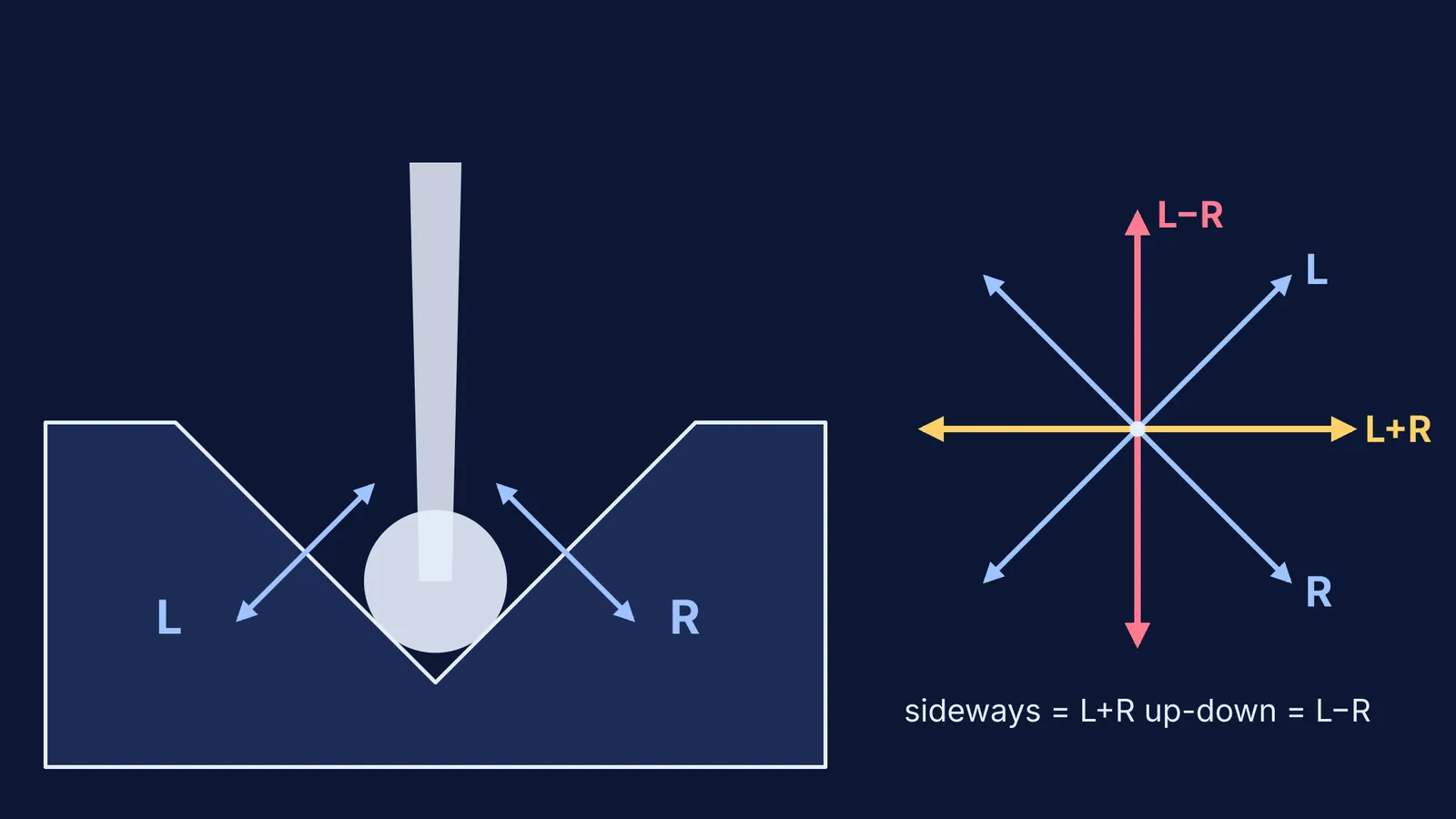
A record groove is a V-shaped cut. In Blumlein's design, as his biography describes it, each groove wall carries one channel, and the two walls are at right angles to each other and at 45 degrees to the vertical. This is why it is called the 45/45 system.
The right angle is the clever part. The left channel moves its wall along a line perpendicular to that wall, which runs parallel to the other wall, so neither signal disturbs the other. They are perpendicular vectors, like the x and y components in a forces problem, turned through 45 degrees.
Turn the axes back by 45 degrees and you get two motions: side to side, and up and down. The phonograph record article explains that one direction carries the sum of the two channels and the other the difference, and that record makers chose the horizontal direction for the sum.
How do you decode the two channels from the groove?
Let the sideways motion be S and the up-down motion be D. Dropping a constant factor of 1/√2 from the 45-degree turn, S = L + R and D = L − R. Adding and subtracting the two equations gets each channel back:
L = (S + D) / 2
R = (S − D) / 2
Suppose at one instant the left channel is at +3 units and the right at +1. The needle moves 3 + 1 = 4 units sideways and 3 − 1 = 2 units upward. A stereo player gets back L = (4 + 2) / 2 = 3 and R = (4 − 2) / 2 = 1. A mono player follows only the sideways 4, the sum.
Now try a sound that comes only from the left: L = +2, R = 0. Then S = 2 and D = 2, so the needle moves diagonally, along the left channel's own axis. A sound in the dead centre (L = R) gives D = 0, and the needle moves only sideways.
If resolving vectors still feels slippery, the Fermi Concept Library gives every concept in physics and mathematics its own lesson, so you can revise components first.
Why did stereo records take so long to arrive?
The patent's history explains: in the Great Depression, EMI cancelled its stereo research at the end of 1935 to focus on television, and records still needed long-playing, low-noise technology. Extended because of the war, the patent ran until 13 December 1953.
The first commercial stereo records came out in 1957, says the phonograph record article. On 25 March 1958 the US Recording Industry Association of America adopted the Westrex 45/45 system, patented independently of Blumlein, as its standard.
Blumlein did not live to see it. He was killed on 7 June 1942 when a Halifax bomber testing the H2S airborne radar crashed in Herefordshire, as his biography records.
What can a student take from Blumlein?
His method is a habit you can copy:
Start from a noticed annoyance: a voice from the wrong side of the screen.
Look for two quantities that do not interfere. Perpendicular directions are the classic answer.
Check the old case still works. The sum signal kept mono players useful.
For the sound side, read how a microphone turns sound waves into electric current, see where two speakers make sound loud or quiet, or try the human hearing range tone test.
For vectors and waves, which are easier to see than to read, the Fermi Simulation Lab has interactive simulations.