On this page
Around 912 CE, a mathematician in Egypt finished a book that changed what algebra was allowed to do. Abu Kamil Shuja ibn Aslam took al-Khwarizmi's rules and showed they still worked when the numbers were square roots like √5. Fibonacci later reused many of his problems, as T. C. Scott and P. Marketos describe.
Who was Abu Kamil?
Abu Kamil lived from about 850 to about 930 and was known as al-Hasib al-Misri, "the calculator from Egypt", according to the MacTutor biography of Abu Kamil. His surviving works include a Book on algebra and a Book on surveying and geometry written for land surveyors.
He credited al-Khwarizmi as "the one who was first to succeed in a book of algebra and who pioneered and invented all the principles in it."
What did Abu Kamil add to al-Khwarizmi's algebra?
Al-Khwarizmi (about 780 to 850) sorted quadratic problems into six standard forms, such as "squares and roots equal to numbers", with the famous example x² + 10x = 39, as the MacTutor biography of al-Khwarizmi sets out. His other great book is the subject of our piece on al-Khwarizmi, Hindu numerals and the word algorithm.
Abu Kamil kept that framework but widened what could go into it. He is considered the first mathematician to systematically accept irrational numbers, in the form of square roots or fourth roots, as both solutions and coefficients of quadratic equations, as the encyclopedia entry on Abu Kamil summarises. An irrational number is one that cannot be written as a fraction of two whole numbers; √2 and √5 are examples.
His Book on algebra has 69 problems, many adapted from al-Khwarizmi's 40 but solved differently, and he worked comfortably with powers up to x⁸, according to MacTutor. He called x⁶ "cube cube", a sign that he had begun to understand that multiplying powers means adding exponents.
How did Abu Kamil use algebra on a pentagon?
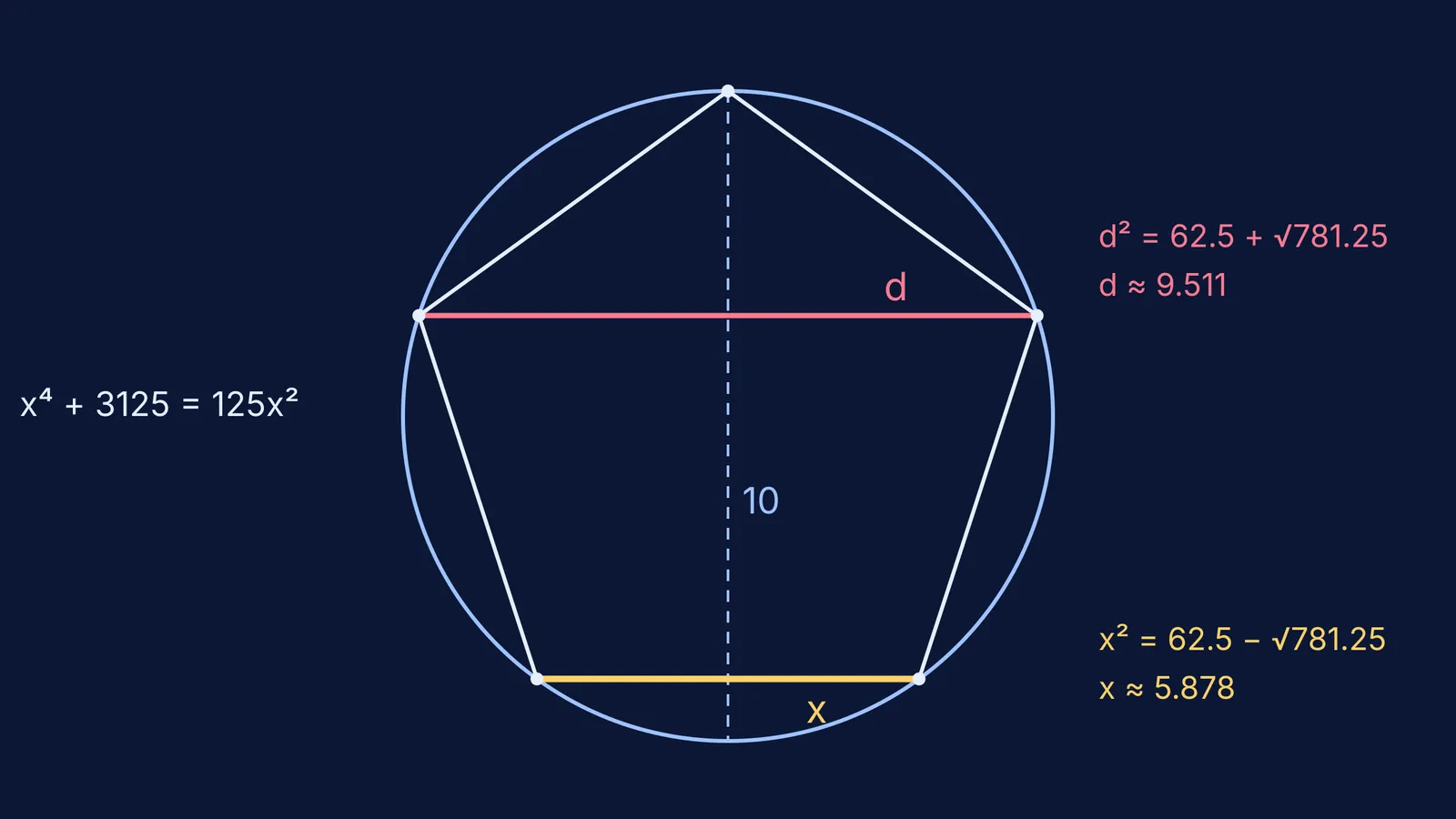
Part of his algebra deals with regular pentagons and decagons (MacTutor). In one problem he finds the side of a regular pentagon drawn inside a circle of diameter 10 using the equation x⁴ + 3125 = 125x² (encyclopedia entry). You can solve it with Class 10 tools:
Let y = x². The equation becomes y² − 125y + 3125 = 0, an ordinary quadratic.
Use the quadratic formula: y = (125 ± √(15625 − 12500)) / 2 = (125 ± √3125) / 2.
That is y = 62.5 ± √781.25, so x² is about 34.549 or about 90.451.
Take square roots: x ≈ 5.878 or x ≈ 9.511.
Neither is a fraction: the smaller one is exactly √(62.5 − √781.25), a root inside a root.
Check it with trigonometry: the side of a regular pentagon in a circle of radius 5 is 10 × sin 36° ≈ 5.878. The larger root, 10 × sin 72° ≈ 9.511, is not a mistake: it is the pentagon's diagonal. Divide the two and you get 1.618, the golden ratio, which our post on the Fibonacci ratio and the golden ratio shows visually.
How do you solve an equation with an irrational coefficient?
Try one we made up in Abu Kamil's spirit, with a surd as the coefficient of x: solve x² + 2√3·x = 9.
Half the coefficient of x is √3. Add its square, 3, to both sides: x² + 2√3·x + 3 = 12.
The left side is (x + √3)², so x + √3 = ±√12 = ±2√3.
So x = √3 or x = −3√3.
Check: (√3)² + 2√3 × √3 = 3 + 6 = 9. It works.
A checklist for any equation with surds:
Treat √3 as a number. Completing the square works as it does with 3.
Simplify as you go: √12 = 2√3.
Substitute your answer back in. Sign slips hide in surd arithmetic.
If completing the square feels shaky, the Fermi Concept Library has a lesson for every concept in mathematics, and the Fermi Problem Library has worked problems with a step-by-step solver that explains the reasoning rather than printing an answer.
How did Abu Kamil's algebra reach Fibonacci?
Fibonacci's Liber abaci appeared in 1202. Scott and Marketos summarise historian Roshdi Rashed's analysis: of some 90 algebra problems in Liber abaci, 22 were borrowed from al-Khwarizmi and 53 from Abu Kamil, sometimes with only small changes to the numbers. ETH Zurich's Fibonacci exhibition page on the sources of Liber abaci notes that many examples from al-Khwarizmi and Abu Kamil reappear in Fibonacci's works, and lists Abu Kamil's innovations, including powers above the square and equations with irrational coefficients.
A Hebrew translation by Mordecai Finzi followed in the 15th century (encyclopedia entry). Today you can read the book in Martin Levey's English edition, based on Finzi's Hebrew version and noted in Isis in 1967, or Roshdi Rashed's 2012 French edition.
Next time a quadratic hands you √5, treat it as Abu Kamil did: as a perfectly good answer. For another puzzle from the same tradition, read about Thabit ibn Qurra and amicable numbers.