

On this page
The modern world runs on algorithms and the digits 0 to 9, both of which trace their roots back to the 9th century. The Persian mathematician Muhammad ibn Musa al-Khwarizmi worked at the House of Wisdom in Baghdad during the Islamic Golden Age, an era of intense scientific translation and discovery. Scholars at the House of Wisdom gathered and synthesized knowledge from Greek, Indian and Persian sources. While Al-Khwarizmi did not invent the base-ten number system himself, he wrote the book that taught it to the West, changing mathematics.
What was Al-Khwarizmi's book on Hindu numerals?
Around 825 CE, Al-Khwarizmi wrote an influential treatise known in Arabic as *Kitāb al-Jamʿ wa-l-tafrīq bi-ḥisāb al-Hind*, or "The Book of Addition and Subtraction According to the Hindu Calculation" (Wikipedia).
The book codified the Hindu-Arabic numeral system, introducing the digits 1 through 9 and the concept of zero as a placeholder to the Islamic world. Before this, European and Middle Eastern mathematics relied heavily on Roman numerals and the abacus. Those systems made basic arithmetic cumbersome and advanced mathematics nearly impossible, because they did not use place value effectively.
Al-Khwarizmi's work provided the first systematic explanation of how to perform addition, subtraction, multiplication and division using these new numerals. He described specific, step-by-step procedures designed to be calculated on a "dust board" (*takht*). On a dust board, numbers were traced in fine sand and erased as the calculation moved forward, which required a clear sequence of steps rather than holding everything in your head.
How did Al-Khwarizmi's name become the word algorithm?
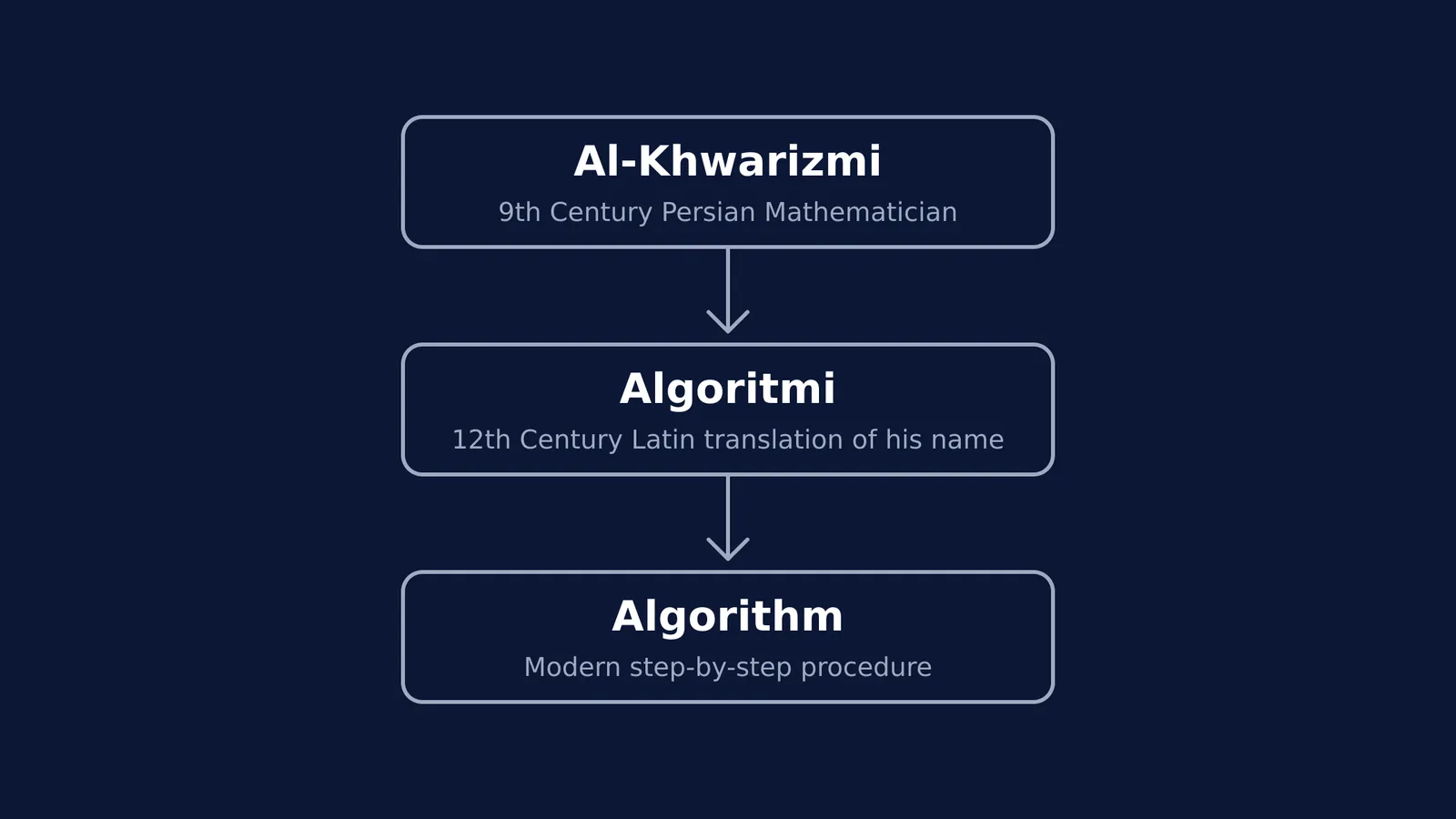
The original Arabic manuscript of the book was lost, but it survived through a 12th-century Latin translation titled *Algoritmi de numero Indorum* ("Al-Khwarizmi on the Hindu Art of Reckoning").
The translation introduced his methods to Europe, but it also started a linguistic chain reaction:
Latinization: The translators rendered Al-Khwarizmi's name into Latin as *Algoritmi* or *Algorismi*.
Algorism: The phrase *Dixit Algoritmi* ("Thus spake Al-Khwarizmi") commonly opened these translated manuscripts. In medieval Europe, the new method of calculating with these decimal numerals became known as "algorism", and a person who calculated this way was called an "algorist".
Algorithm: Over the centuries, a mistaken association with the Greek word *arithmos* (meaning number) shifted the spelling to "algorithm".
Today, an algorithm is no longer just a method for decimal arithmetic. It is defined as a finite, step-by-step procedure for solving a problem. If you study how Donald Knuth pioneered the analysis of algorithms, you can see how this mathematical concept became the foundation of modern computer science.
Why did positional numerals change mathematics?
A base-ten positional system means that a digit's value depends entirely on its place in a sequence (units, tens, hundreds). The Hindu-Arabic numeral system, which Al-Khwarizmi championed, made arithmetic efficient and scalable to very large numbers.
The transition from Roman numerals took centuries, but it laid the necessary groundwork for algebra, calculus and modern physics. Today, when you sit down to solve algebraic equations, you are using the precise tools he formalised. The Fermi Problem Library has worked problems with a step-by-step solver that explains the reasoning rather than printing an answer. This approach directly continues the tradition of clear, algorithmic problem-solving.
How to use algorithmic thinking for exams
You can apply Al-Khwarizmi's structured approach to your own exam preparation. When you face a new type of physics or maths problem, write down your own algorithm:
Identify the inputs: What numbers, constants or conditions are given in the question?
Define the outputs: What exact value or unit is the question asking for?
List the operations: Write down the exact sequence of formulas needed to bridge the gap between inputs and outputs.
Test the method: Try your steps on a simple, familiar version of the problem to see if they hold up.
When you solve numeric problems, write out your algorithmic steps clearly on paper. Like the dust-board calculations of the 9th century, keeping your working memory clear prevents silly mistakes. You can also read about Baudhayana and the rule of the diagonal in the Sulba Sutras to see how ancient Indian mathematics tackled geometry long before positional numerals became the global standard.


