On this page
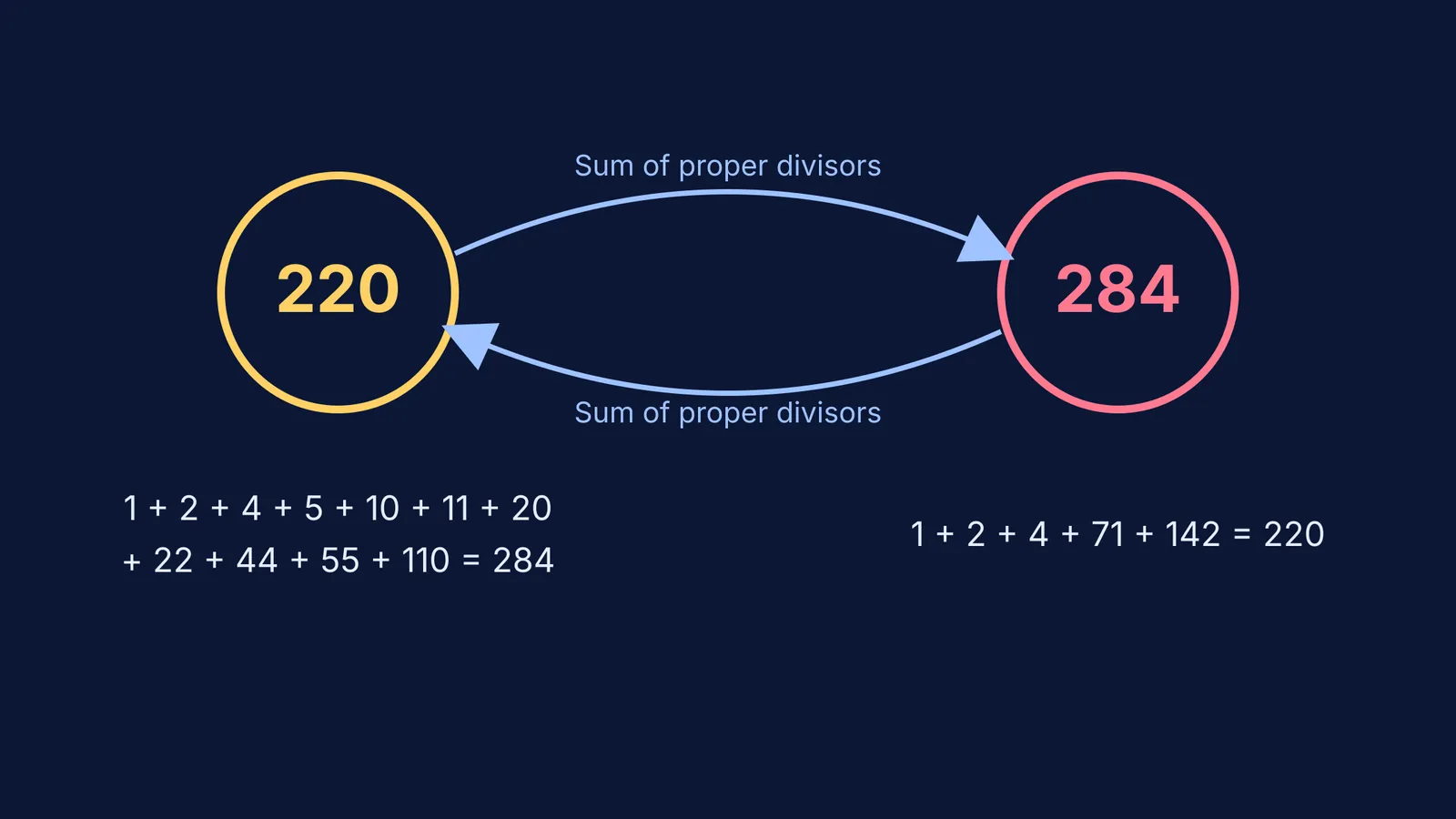
For centuries, the numbers 220 and 284 held a special place in mathematics. If you list the proper divisors of 220 (1, 2, 4, 5, 10, 11, 20, 22, 44, 55, and 110) and add them up, you get exactly 284. Conversely, the proper divisors of 284 (1, 2, 4, 71, and 142) add up to 220.
This pair was the only one known to the Greeks, and for over a millennium, no one could find another. That changed in the 9th century thanks to a Sabian scholar from Harran named Thabit ibn Qurra (826–901 AD). A native Syriac speaker fluent in Greek and Arabic, he worked as a money changer before being recruited to Baghdad by the Banū Mūsā brothers. He eventually became a court astronomer and a prolific mathematician. Among his many achievements, he formulated a systematic theorem to discover more of these rare, paired numbers.
What are amicable numbers?
Amicable numbers are two different integers related in such a way that the sum of the proper divisors of each is equal to the other number. The proper divisors are all the positive integers that divide evenly into the number, excluding the number itself.
Historically, these numbers were viewed with a sense of mysticism, often symbolising perfect friendship or harmony. The Pythagoreans were among the first to study them, attributing magical properties to the pair 220 and 284. Some ancient traditions suggested that if two people carried talismans bearing these numbers, it would guarantee an unbreakable bond of friendship. However, finding them requires serious mathematical legwork. Identifying the proper divisors of small numbers like 220 takes time, but testing numbers in the tens of thousands becomes nearly impossible without a formula.
Testing proper divisors by hand becomes tedious quickly. When you want to trace the logic of number properties rather than just calculate an answer, the Fermi Problem Library has worked problems with a step-by-step solver that explains the reasoning rather than printing an answer.
What is Thabit ibn Qurra's rule for amicable numbers?
In his *Treatise on the Derivation of the Amicable Numbers in an Easy Way*, Thabit ibn Qurra laid out a general theorem. Rather than guessing and checking, he created a clear mathematical pathway.
His rule states that for any integer n > 1, you calculate three specific values:
p = 3 × 2^(n-1) - 1
q = 3 × 2^n - 1
r = 9 × 2^(2n-1) - 1
If p, q, and r all turn out to be prime numbers (numbers divisible only by 1 and themselves), then you can form an amicable pair using these formulas: First number = 2^n × p × q Second number = 2^n × r
The rule is strict: if even one of p, q, or r turns out to be a composite number, the formula will not produce a valid amicable pair.
Let's test this practical rule with n = 2:
p = 3 × 2¹ - 1 = 5
q = 3 × 2² - 1 = 11
r = 9 × 2³ - 1 = 71
Since 5, 11, and 71 are all prime, the rule applies perfectly. We can now generate our amicable pair. The first number is 2² × 5 × 11. Since 2² is 4, we multiply 4 × 5 × 11 to get 220. The second number is 2² × 71, which equals 4 × 71, yielding 284. The rule seamlessly produces the classic pair.
Which amicable pairs were overlooked?
While Thabit's rule was mathematically rigorous, it did not immediately yield a flood of new numbers. Finding large primes without a calculator was laborious. It wasn't until the 13th century that the Persian mathematician Al-Fārisī proved Thabit's theorem and successfully applied it to discover the next pair: 17,296 and 18,416.
In the 16th century, the Iranian mathematician Muhammad Baqir Yazdi discovered an enormous pair: 9,363,584 and 9,437,056. These same two pairs were later famously rediscovered in Europe by Pierre de Fermat in 1636 and René Descartes in 1638 using Thabit's exact rule. By the 18th century, Leonhard Euler significantly generalised the rule and discovered 58 new pairs of his own, pushing the boundaries of what was known about divisor sums.
Curiously, all of these mathematicians missed a much smaller pair. In 1867, a 16-year-old named B. Nicolò I. Paganini discovered the amicable pair 1,184 and 1,210. This pair is the second smallest after 220 and 284, but because it cannot be generated using Thabit ibn Qurra's rule, it had hidden in plain sight for centuries. Today, computers have found over a billion amicable pairs, but Thabit's work remains a foundational algebraic breakthrough.
When learning to spot mathematical patterns, you don't have to struggle alone. Fermi's AI tutor works out what you already know and builds a plan for the session, writing on a board alongside you and checking your understanding as it goes.
To explore more mathematics history, read about S. S. Pillai and Waring's problem: why sixth powers need 73 or dive into Hemachandra's rules for counting the rhythms of Prakrit verse.