On this page
You clip in at a hill-station zip line, step off, and seconds later you are flying over the valley. Your top speed, where it happens and how hard the brake works all follow from Class 11 energy conservation.
How fast does a zip line go?
Start with the ideal case: no friction, no air. Mechanical energy, kinetic plus potential, stays constant unless non-conservative forces do work (OpenStax University Physics, section 8.3).
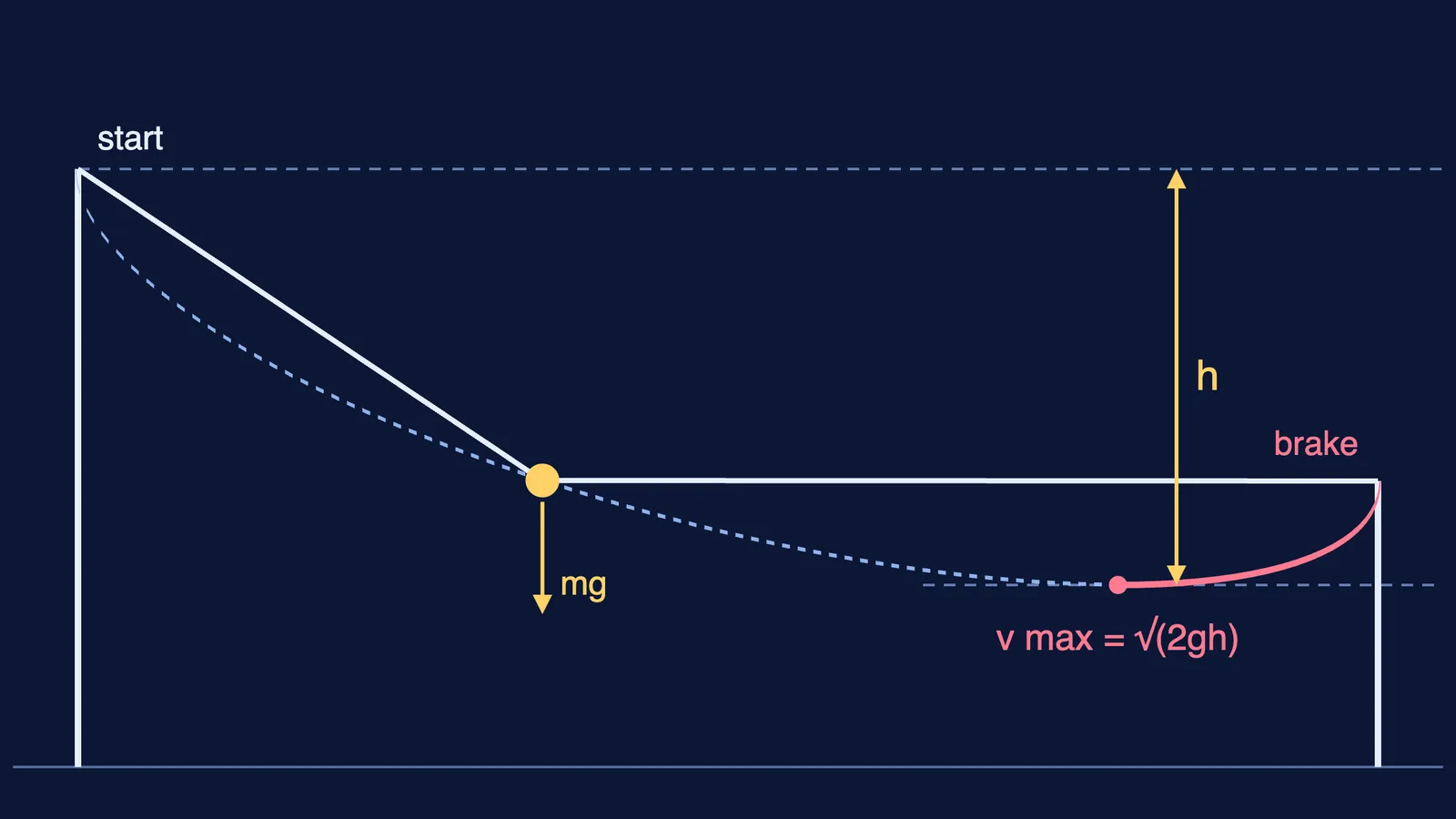
Every metre you drop turns potential energy mgh into kinetic energy ½mv², so starting from rest your speed after a drop h is v = √(2gh) (OpenStax College Physics, section 7.3). With friction negligible, the same section notes, speed depends only on starting speed and height, not on mass or path.
Only your depth below the start sets your speed. With no losses, the fastest point on a zip line is its lowest point.
Real rides are slower than √(2gh) because two forces take energy away. The trolley's wheels add friction, and air drag grows with the square of speed, F = ½CρAv² (OpenStax, section 6.4). With these losses, your speed peaks just before the lowest point, where the pull along the slope no longer beats them. Drag does not depend on your mass but your weight does, so a heavier rider with the same frontal area loses a smaller share of energy to drag and arrives faster.
Why does a zip line cable sag?
At the rider the cable bends into a V, and the two tensions must add up to hold the rider's weight, because the net force is zero (OpenStax, section 12.1). For a rider at the middle of a level span of length L with sag s, each side makes a small angle θ with tan θ = 2s/L, and the vertical balance 2T sin θ = mg gives T ≈ mgL/(4s).
Halve the sag and you double the tension; take the sag to zero and the tension heads to infinity. That is why one installer's guide asks for sag of at least 2% of the line's length, with a slope of 3% to 6% measured as drop ÷ cable length (Zip Line Gear). Sag protects the anchors, and it puts the lowest point before the end, so you finish by climbing a short hill.
Worked example: a 200 m line
Take anchors 200 m apart, the start 12 m above the end anchor (a 6% slope by the Zip Line Gear rule), and a 201.0 m cable. Under a rider its lowest point is 160 m along, 4 m below the end anchor and 16 m below the start. There it hangs 6.4 m (about 3%) below the anchor-to-anchor line, above the guide's 2% minimum. A 70 kg rider weighs about 686 N (g = 9.8 m/s²).
Top speed with no losses: v = √(2 × 9.8 × 16) ≈ 17.7 m/s, about 64 km/h, at the lowest point.
Climbing the last 4 m removes 2 × 9.8 × 4 = 78.4 m²/s² from v². With no losses you would still arrive at √(313.6 − 78.4) ≈ 15.3 m/s.
With friction and drag, suppose you reach the low point at 12 m/s. Then v at the end = √(144 − 78.4) ≈ 8.1 m/s. At 9 m/s you would arrive at about 1.6 m/s: small changes at the bottom matter a lot at the end.
Tension with the rider at mid-span, where it hangs 8 m below that line: T ≈ 686 × 200 ÷ (4 × 8) ≈ 4,300 N, about 6 times the rider's weight. A tighter cable with half that sag doubles it to about 8,600 N.
How does a zip line stop you at the end?
Braking is the work-energy theorem: the net work done on you equals the change in your kinetic energy (OpenStax, section 7.3). To stop, the brake must do negative work equal to ½mv².
At about 8 m/s our rider carries ½ × 70 × 64 = 2,240 J. Stopping over 4 m needs an average force of 2,240 ÷ 4 = 560 N, a little less than body weight. Stopping in 1 m needs 2,240 N, more than three times body weight.
The same guide says a line without an engineered braking system should not exceed a 3% slope (Zip Line Gear). Safety matters too: a study of US emergency-department records estimated 16,850 non-fatal zip line injuries from 1997 to 2012, with falls the most common cause at 77.3% (American Journal of Emergency Medicine, 2015). Always follow the operator's instructions.
How do you solve a zip line problem in an exam?
If a zip line turns up in a JEE Main or school exam problem, it comes down to four standard tools:
Speed at a point: energy conservation from the start height, not the slope.
Speed with losses: W_nc = Δ(K + U), with kinetic friction f = μN (OpenStax, section 6.2).
Cable tension: a free-body diagram at the rider, then ΣF = 0.
Stopping: average force = mv² ÷ (2d).
The same energy bookkeeping runs through the physics of a water slide and why roller coaster riders don't fall out of a loop; for slope components, see why normal force is mg cos θ on an incline.
The Fermi Simulation Lab has interactive simulations for ideas that are easier to see than to read. If you are not sure where to begin, Fermi's AI tutor works out what you already know and builds a plan for the session.