On this page
You put a block on a ramp and draw two arrows: weight straight down, normal force straight out of the surface. Then comes the question: why is the normal force mg cos θ, and not mg or mg sin θ? The answer is resolving the weight along the slope, plus one piece of geometry.
Why is the normal force mg cos θ on an incline?
The normal force is the push a surface gives perpendicular to the surface of contact; that is the definition in OpenStax University Physics Volume 1, section 5.6.
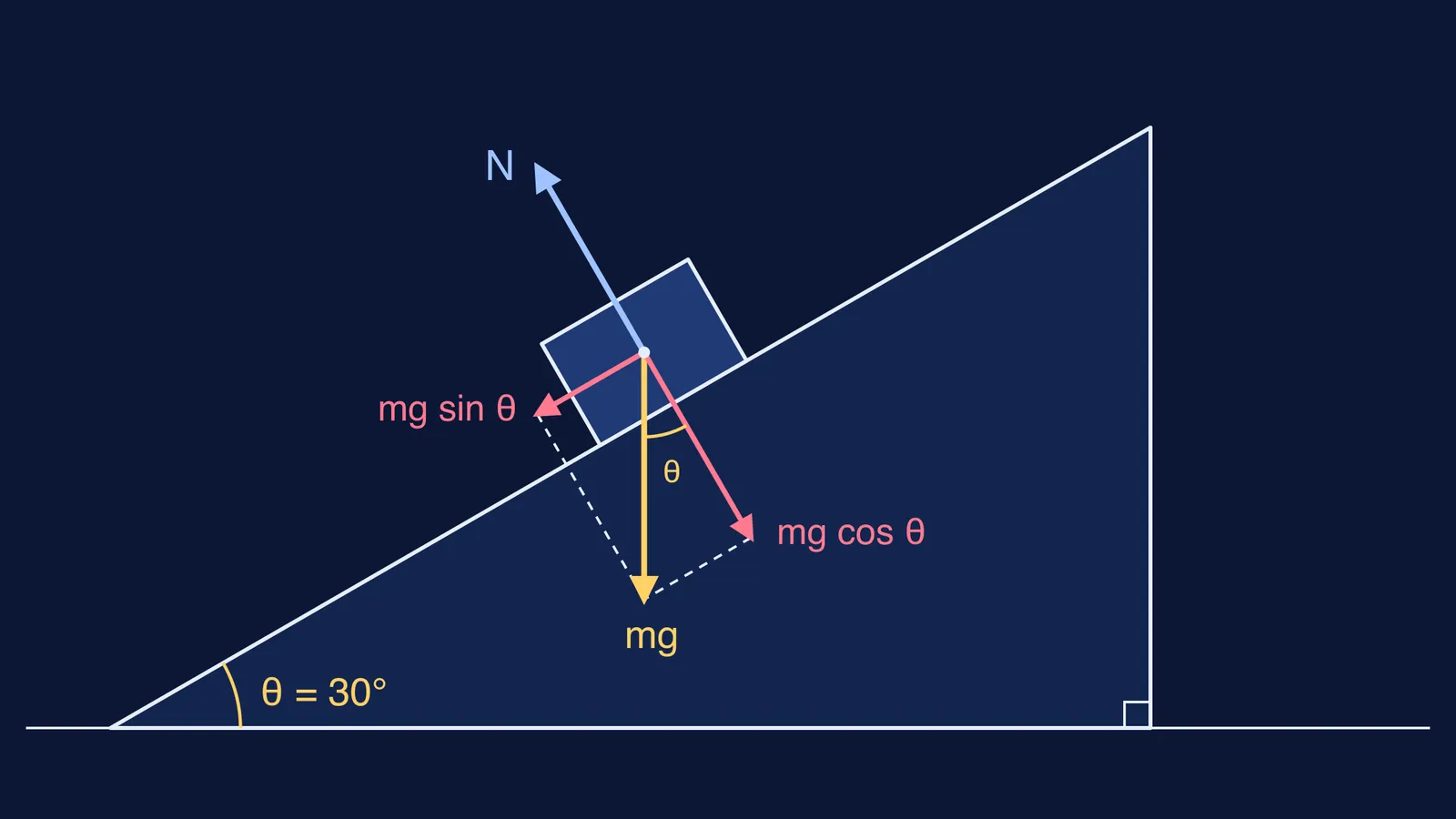
On a slope the weight still points straight down, but the surface is tilted. So split the weight into two perpendicular pieces:
Choose axes: x along the slope (pointing down it), y perpendicular to the slope.
Find the angle between the weight and the y axis. It equals θ, the angle of the incline.
The side next to that angle is the perpendicular component, mg cos θ. The side opposite it is the along-slope component, mg sin θ.
The block neither sinks into the ramp nor lifts off it, so Newton's second law perpendicular to the slope gives N − mg cos θ = 0.
So N = mg cos θ.
OpenStax resolves the weight the same way, mg sin θ along the slope and mg cos θ perpendicular to it, and notes that the normal force can be less than the weight on an incline (OpenStax 5.6).
Why is the angle in step 2 equal to θ? The weight is perpendicular to the ground; the y axis is perpendicular to the slope. Tilting a line by θ tilts its perpendicular by θ too, so the angle between them is θ.
Which part of the weight is sin θ and which is cos θ?
Swapping sin and cos is an easy slip, because both versions look reasonable on paper. Limiting cases catch it:
Put θ = 0°. The ramp is a flat table, so N must equal mg. Since cos 0° = 1, mg cos θ passes; mg sin θ would give zero.
Put θ = 90°. The ramp is a vertical wall, and the block falls past it without pressing on it. Since cos 90° = 0, N = 0, and the along-slope part becomes mg sin 90° = mg: free fall, as it should be.
For more on choosing axes, see our guide to resolving forces on an inclined plane without the sin-cos swap.
How do you solve a 30° block example step by step?
A 2.0 kg block sits on a smooth 30° ramp. Find the normal force and acceleration. Take g = 9.8 m/s² (OpenStax uses 9.80 m/s² in its incline example, OpenStax 5.6).
Weight: mg = 2.0 × 9.8 = 19.6 N.
Perpendicular component: mg cos 30° = 19.6 × 0.866 ≈ 17.0 N.
Along-slope component: mg sin 30° = 19.6 × 0.5 = 9.8 N.
Perpendicular to the slope the acceleration is zero, so N ≈ 17.0 N. That is about 87% of the weight, not all of it.
Along the slope the only force is 9.8 N, so a = 9.8 ÷ 2.0 = 4.9 m/s² down the slope, which is g sin 30°.
Now make the ramp rough, with a kinetic friction coefficient of 0.2. Kinetic friction is f = μN, so it depends directly on the normal force (OpenStax 6.2). Here f = 0.2 × 17.0 ≈ 3.4 N up the slope. The net force down the slope is 9.8 − 3.4 = 6.4 N, so a ≈ 3.2 m/s². Had you used N = mg, friction would come out at 3.9 N and the acceleration at 2.9 m/s²: wrong, but believable.
To see how angle and friction trade off, try the block on an incline simulation that shows when it starts to slide.
When is the normal force not mg cos θ?
N = mg cos θ holds only when the weight and the normal force are the only forces with parts perpendicular to the slope, and the block does not accelerate in that direction. It changes when:
you push the block horizontally or pull it at an angle, which adds a perpendicular part (worked through in normal force on an incline when you push horizontally);
the whole ramp accelerates, as in a lift or on a sliding wedge;
the surface is curved, so the block needs a centripetal acceleration.
The method stays the same: resolve every force perpendicular to the surface and set the sum equal to mass times the perpendicular acceleration.
If your components come out right but the final answer does not, the Fermi Problem Library has worked problems with a step-by-step solver that explains the reasoning rather than printing an answer, so you can find the faulty step. If tilted axes still feel slippery, the Fermi Simulation Lab has interactive simulations for ideas that are easier to see than to read.
Next time you meet a ramp, draw the triangle, then run the θ = 0 and θ = 90° checks before you move on.