

On this page
A common guess is that a heavier block on a ramp slips sooner, or slides down faster. A simulation lets you test both guesses in minutes: tilt the ramp slowly, watch for the moment the block lets go, then change the mass and try again.
What happens to a block on an incline as you tilt it?
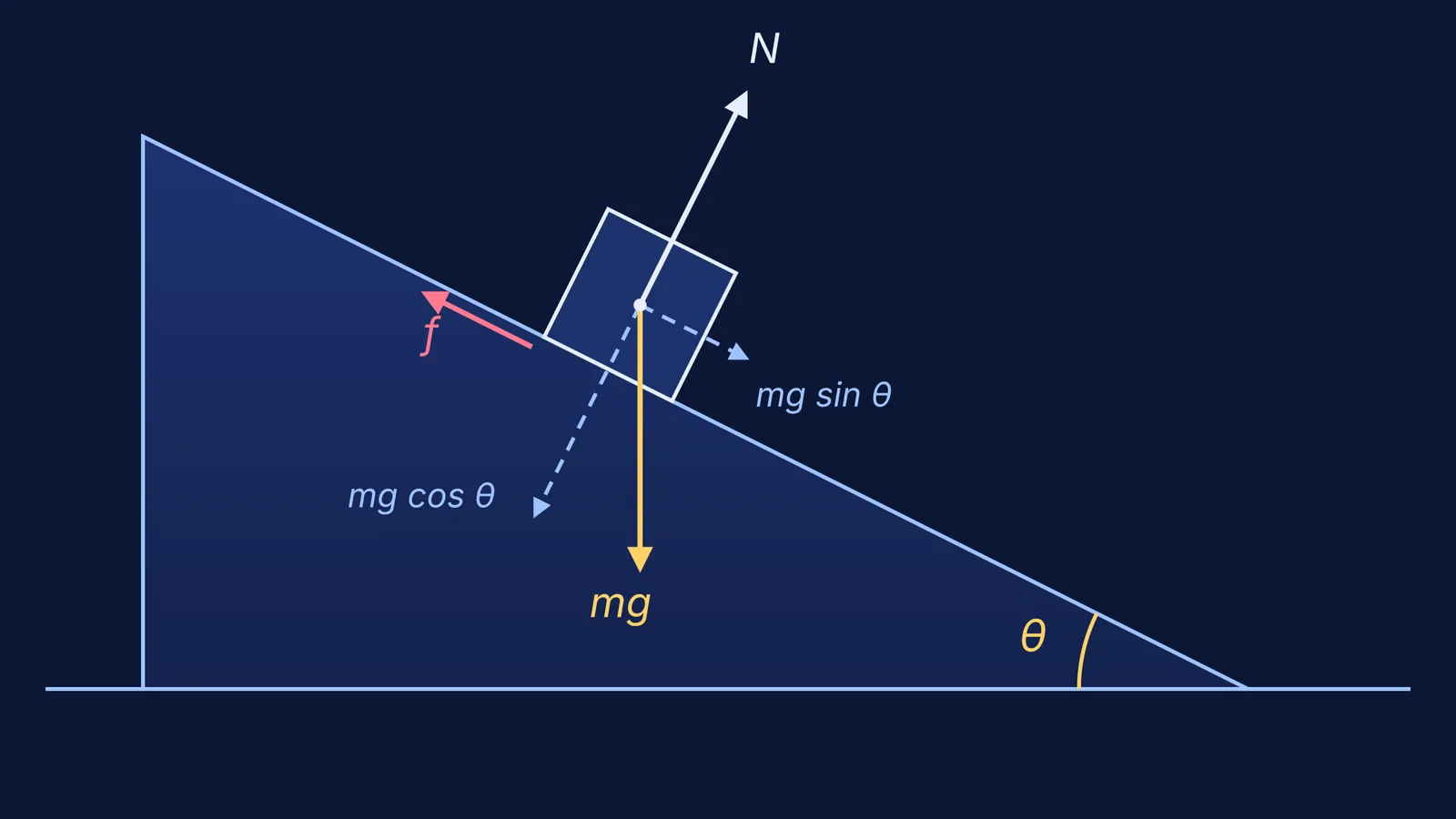
Three forces act on the block: its weight mg, the normal force N from the ramp, and friction f along the surface. Split the weight into two parts. The part pulling the block down the slope is mg sin θ, and the part pressing it into the ramp is mg cos θ, so N = mg cos θ.
Static friction grows to match whatever pull it has to resist, up to a limit. The OpenStax University Physics textbook writes this limit as fs ≤ μs N, where μs is the coefficient of static friction (OpenStax, Friction).
At a small angle, friction easily matches mg sin θ. As you tilt, mg sin θ rises and N falls: the friction you need goes up while the most you can get goes down. The block slips at the angle where they meet: mg sin θ = μs mg cos θ.
How is the angle of repose related to μ?
Divide both sides of that equation by mg cos θ and you get the key result: the block starts to slide at the angle where tan θ = μs. That critical angle is often called the angle of repose (or angle of friction), and it gives you a quick way to measure μs: tilt the ramp until the block slips, then take the tangent of the angle.
OpenStax gives these approximate static coefficients (OpenStax, Table 6.1). The angles next to them come from tan θ = μs:
Rubber on dry concrete: μs = 1.0, so the block slips at 45°.
Steel on steel (dry): μs = 0.6, so it slips at about 31.0°.
Wood on wood: μs = 0.5, so it slips at about 26.6°.
Steel on ice: μs = 0.04, so it slips at about 2.3°.
For a full derivation and exam-style questions, see our post on angle of repose and the tan θ = μ result.
Why doesn't acceleration depend on mass?
Once the block is moving, friction is kinetic, fk = μk N, and OpenStax derives the acceleration down the slope as a = g(sin θ − μk cos θ) (OpenStax, Friction). Mass has cancelled out: the downhill pull, the normal force and friction are all proportional to m, so doubling the mass doubles every force and leaves the acceleration unchanged.
Here is a worked check, using wood on wood (μk = 0.3 from the same OpenStax table), θ = 30° and g = 9.8 m/s²:
1 kg block: pull down the slope 4.90 N, normal force 8.49 N, friction 2.55 N, net force 2.35 N, so a = 2.35 m/s².
5 kg block: pull 24.5 N, normal force 42.4 N, friction 12.7 N, net force 11.8 N, so a = 2.35 m/s².
Five times the net force acts on five times the inertia, so the effects cancel. The same reasoning is why the angle of repose ignores mass. In real life this holds while μ is the same for both blocks and air resistance is small.
A simulation plan: five tests to run
Open a ramp simulation, such as one in the Fermi Simulation Lab, where interactive simulations show ideas that are easier to see than to read. Write each prediction down first. The friction values come from OpenStax Table 6.1.
Set μs = 0.5 and predict the slip angle. Tilt the ramp one degree at a time from 20°. It should hold at 26° and slip by 27°, since tan θ = 0.5 at about 26.6°.
Change the mass from 1 kg to 5 kg and repeat. The slip angle should not move.
Change the surface. With μs = 0.04 the block should go at about 2.3°, and with μs = 1.0 at 45°.
Once the block slides at 26.6° with μk = 0.3, the formula predicts a ≈ 1.75 m/s². Then lower the ramp while the block is moving: it keeps speeding up until θ drops below about 16.7°, where tan θ = 0.3.
Time a 2 m run from rest at 30° with μk = 0.3 for both masses. From s = ½at² with a = 2.35 m/s², both should take about 1.30 s.
If a result surprises you, redraw the free-body diagram. For the timing step, our worked example on time for a block to slide down a rough incline walks through the same calculation.
What to do next
The same ideas extend to stacked and pulled blocks. Our guide to static vs kinetic friction and blocks on blocks is a good next step. If you set up the equations but your numbers keep coming out wrong, the Fermi Problem Library has worked problems with a step-by-step solver that explains the reasoning rather than printing an answer.


