On this page
Most resistors drift as they warm up. A metal wire gains resistance, while carbon loses a little. That opposite behaviour is the whole trick behind a classic JEE and board question: join two resistors so that the pair's total resistance does not change with temperature. Here is the condition, a worked example and the mistake that costs marks in the parallel version.
What does temperature coefficient of resistance mean?
Near room temperature, resistance changes roughly linearly with temperature: R = R0[1 + α(T − T0)], where α is the temperature coefficient of resistance (HyperPhysics, resistance and temperature). A positive α means resistance rises when the material warms; a negative α means it falls.
On the HyperPhysics resistivity table, annealed copper has α of about +0.00393 per °C, while carbon (graphite) has α of about −0.0005 per °C.
If you want the reason metals behave this way, our post on why hot metals resist more walks through relaxation time and collisions.
How do you combine two resistors so resistance does not change with temperature?
Put them in series. Each resistor changes by its own amount when the temperature rises by ΔT:
Resistor 1 changes by R1α1ΔT.
Resistor 2 changes by R2α2ΔT.
In series the changes simply add, so the total changes by (R1α1 + R2α2)ΔT.
For the total to stay fixed, that bracket must be zero:
R1α1 + R2α2 = 0, so R1/R2 = −α2/α1.
This can only work if α1 and α2 have opposite signs. Two copper wires, or copper and nichrome, can never cancel, because both rise. At a glance: the material with the larger |α| gets the smaller resistance.
Worked example: copper and carbon for a 100 Ω total
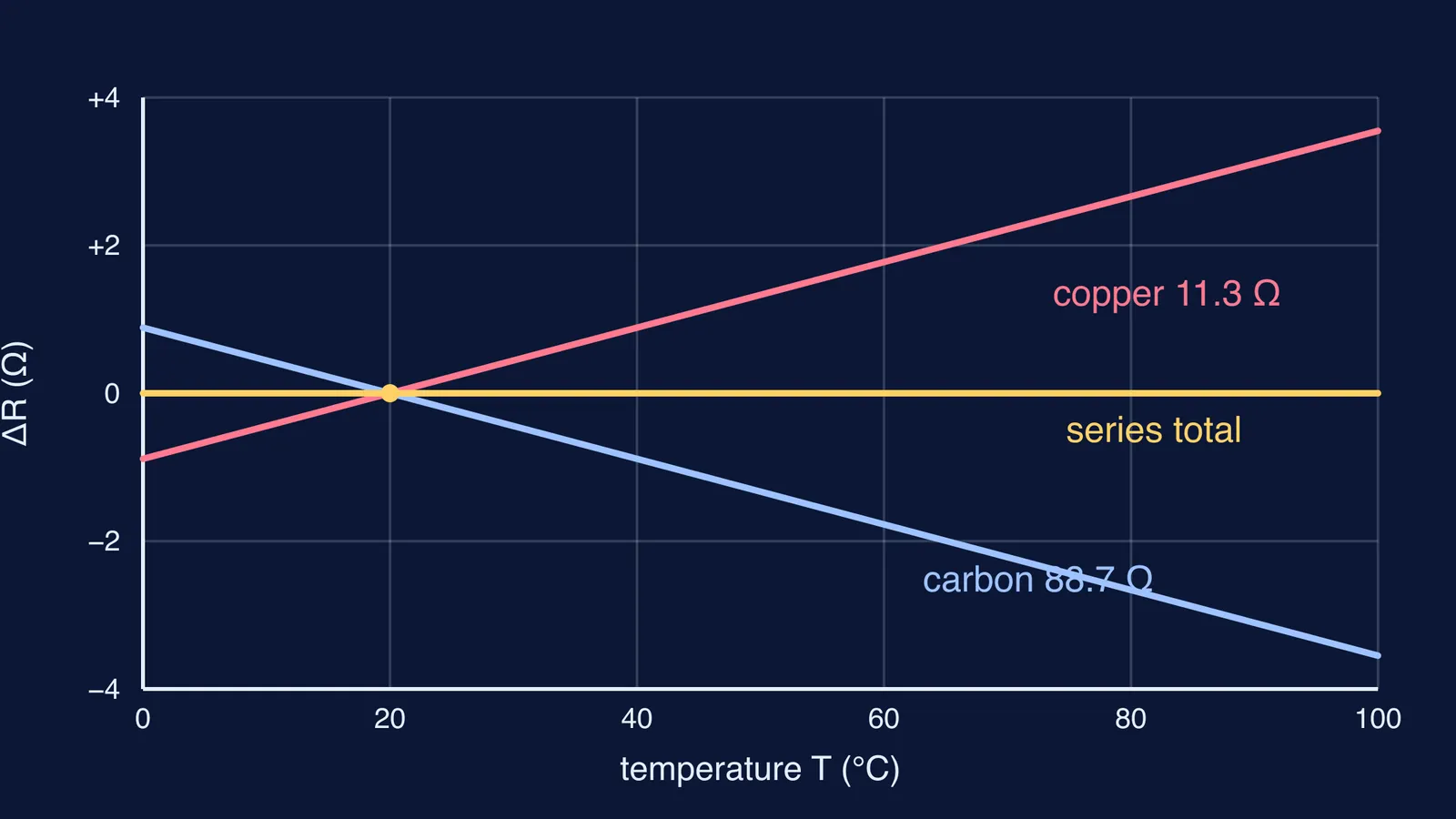
Suppose you need a 100 Ω pair that holds steady as it warms. Using the HyperPhysics resistivity table: copper α1 = +0.00393 per °C, graphite α2 = −0.0005 per °C.
Ratio: R1/R2 = 0.0005/0.00393 ≈ 0.127, so copper to carbon is about 1 : 7.86.
Total: R1 + R2 = 100 Ω, so R2 = 100/1.127 ≈ 88.7 Ω and R1 ≈ 11.3 Ω.
Check: R1α1 ≈ 11.3 × 0.00393 ≈ +0.0444 Ω per °C, and R2α2 ≈ 88.7 × (−0.0005) ≈ −0.0444 Ω per °C. They cancel.
Sanity test: warm the pair by 50 °C. Copper gains about 2.2 Ω, carbon loses about 2.2 Ω, and the total stays at 100 Ω.
Exam papers often round these numbers. With α1 = 4 × 10⁻³ per °C and α2 = −5 × 10⁻⁴ per °C, the ratio becomes exactly 1 : 8, so a 90 Ω total splits into 10 Ω and 80 Ω. If you want more questions of this type with each step explained, the Fermi Problem Library has worked problems with a step-by-step solver that explains the reasoning rather than printing an answer.
Does the same ratio work in parallel?
No, and this is where many answers go wrong. In parallel you add conductances, 1/R1 + 1/R2. For small ΔT, each 1/R changes by about −(α/R)ΔT, so the combination stays steady when α1/R1 + α2/R2 = 0, which rearranges to:
R2α1 + R1α2 = 0, so R1/R2 = −α1/α2.
The ratio has flipped. With copper and carbon in parallel, copper now needs the larger resistance, about 7.86 times the carbon one. There is a second difference too: within the linear model the series condition cancels the change exactly, while the parallel condition only cancels it to first order, so it holds for small temperature changes.
Where does this idea run out?
The linear formula is an approximation for temperatures around room temperature (HyperPhysics, resistance and temperature), and α itself drifts as the temperature moves far from the reference. So a copper and carbon pair stays steady over a modest range, not from freezing to red heat.
That is why precision standard resistors usually skip the pairing altogether and use a single alloy whose α is already tiny: manganin's is about 0.000002 per °C, roughly two thousand times smaller than copper's (HyperPhysics resistivity table). Our explainer on why manganin and constantan are used in standard resistors covers that choice. The opposite case, where resistance changes a lot with heat, is in why a bulb's resistance is higher when hot.
A four-line checklist for exam answers
Write R = R0(1 + αΔT) for each resistor before combining anything.
Confirm the two α values have opposite signs; if not, say no combination works.
Use R1α1 + R2α2 = 0 for series and R2α1 + R1α2 = 0 for parallel.
Check by multiplying each resistance by its own α (series) or dividing α by R (parallel): the two results must be equal in size and opposite in sign.
If the idea of α itself still feels shaky, the Fermi Concept Library gives every concept in physics its own lesson and shows where it sits in the map, so you can fill the gap before your next test.