

On this page
A standard resistor must have the same resistance today, tomorrow and on a hot afternoon. Your NCERT Class 12 physics textbook says manganin and constantan change their resistivity very little with temperature, and are "thus widely used in wire bound standard resistors" (NCERT Physics Part I, Chapter 3, section 3.8). Here are the numbers behind that answer, and one detail most guides skip.
What makes a material good for a standard resistor?
Three properties matter most:
A very small temperature coefficient of resistance, so the value hardly moves when the room, or the current, warms the wire.
A high resistivity, so a short, compact coil gives the resistance you need.
A small thermoelectric voltage against copper, because the coil is joined to copper terminals, and stray voltages at those joints spoil precise measurements.
NCERT writes ρT = ρ0[1 + α(T − T0)], where α is the temperature coefficient of resistivity (NCERT Chapter 3). A standard resistor needs α close to zero.
How small is the temperature coefficient of manganin and constantan?
For comparison, the standard temperature coefficient of annealed copper at 20 °C is 0.00393 per °C, a value adopted by the International Electrotechnical Commission in 1913 (NBS Handbook 100, Copper Wire Tables).
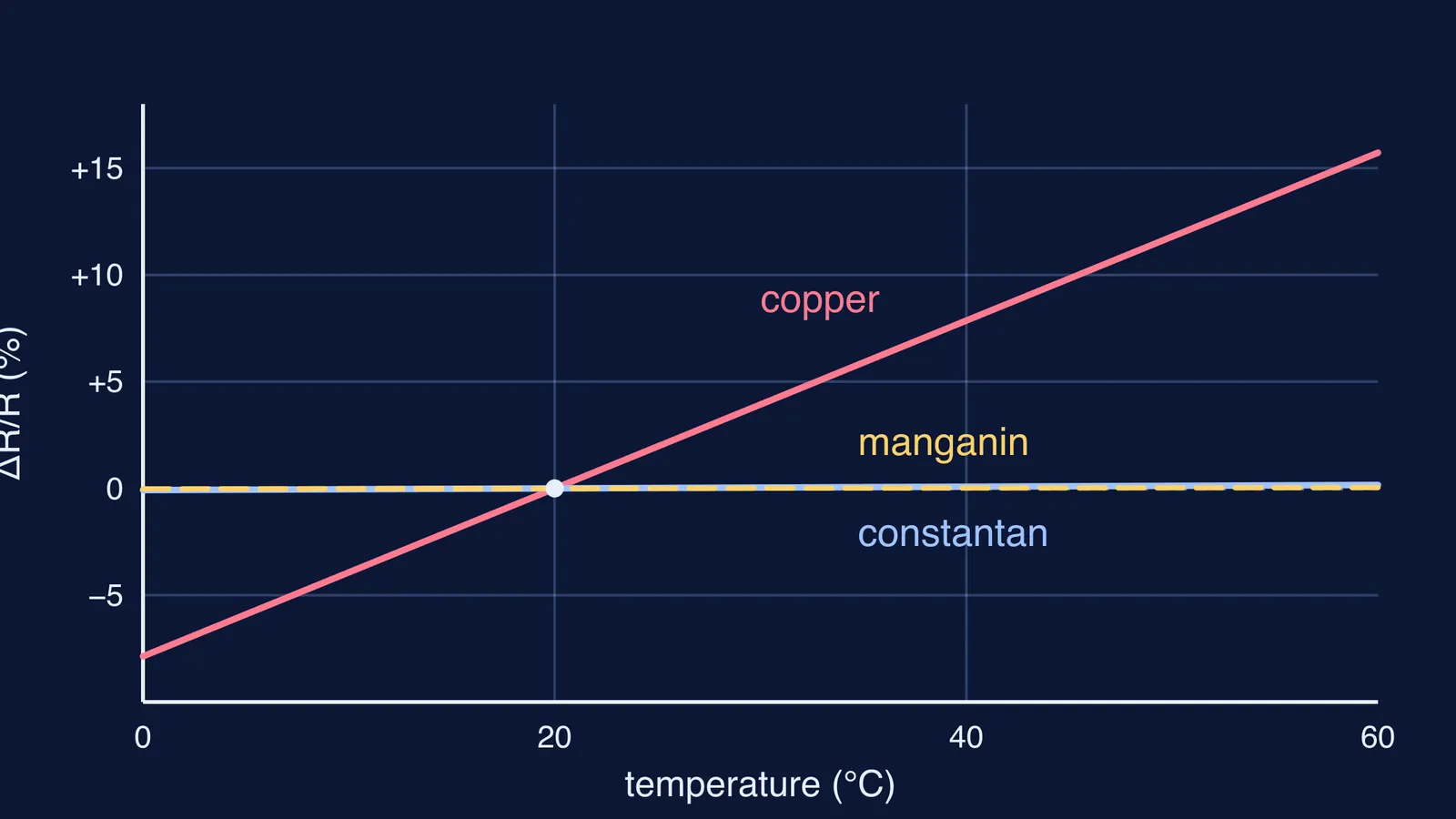
Manganin, an alloy of copper with about 12% manganese and 2% nickel, has a temperature coefficient of ±10 × 10⁻⁶ per K between 20 and 50 °C (Isabellenhütte MANGANIN data sheet). Its resistance curve is a gentle hump near room temperature rather than a straight line.
Constantan, about 44% nickel and 1% manganese with the rest copper, is normally supplied with a coefficient within ±40 ppm per K. Its manufacturer's ideal curve is close to 2 ppm per K between 20 and 60 °C (Isabellenhütte ISOTAN data sheet).
Worked example: warm a 1 Ω coil by 10 °C. Use R = R0(1 + αΔT) with the sourced values above.
Copper: 1 × (1 + 0.00393 × 10) = 1.0393 Ω, a change of 3.9%.
Manganin, worst case: 1 × (1 + 0.000010 × 10) = 1.0001 Ω, a change of 0.01%.
Constantan, worst case of the usual grade: 1 × (1 + 0.000040 × 10) = 1.0004 Ω, a change of 0.04%.
Copper drifts about 390 times more than manganin for the same warming. For a material whose resistance rises sharply when hot, see our post on why a bulb's resistance is higher when it is hot.
If ρT = ρ0[1 + α(T − T0)] feels memorised rather than understood, the Fermi Concept Library gives every physics concept its own lesson and its place in the map.
Why does high resistivity matter?
Resistance is R = ρl/A (NCERT Chapter 3), so a high ρ means less wire for the same resistance. Copper's standard resistivity is 1.7241 µΩ·cm at 20 °C (NBS Handbook 100); manganin's is 43 µΩ·cm (MANGANIN data sheet) and constantan's is 49 µΩ·cm (ISOTAN data sheet).
For wire 0.5 mm across (cross-section 0.196 mm²), the data sheets list 2.19 Ω per metre for manganin and 2.50 Ω per metre for constantan. So 1 Ω needs about 0.46 m of manganin or 0.40 m of constantan, but R = ρl/A gives about 11.4 m of copper.
If both work, why is manganin chosen for precision standards?
Where two different metals meet, a temperature difference produces a small voltage. Against copper, manganin produces about 1 µV per K, while constantan produces about 40 µV per K (MANGANIN and ISOTAN data sheets). Isabellenhütte, which makes both alloys, says this high voltage makes its constantan unsuitable for precision resistors and recommends manganin or two of its other alloys instead. That same large voltage is why constantan is used in thermocouples.
History backs this up. From 1901 to 1990, the US legal ohm was maintained by groups of manganin resistance standards, and ten Thomas-type manganin resistors served as the US standard of resistance from 1939 until the quantum Hall effect replaced them in 1990 (NIST Special Publication 958). A 1934 Bureau of Standards paper by Frank Wenner and James L. Thomas showed that even in a low-valued manganin standard, the copper terminals can shift its temperature coefficient (Journal of Research, Vol. 12).
Standard resistors are used in null methods; see how the Wheatstone bridge balance condition is derived and comparing EMFs with a potentiometer.
How should you write it in a board or JEE answer?
Name both properties: high resistivity and very low temperature coefficient. Students often write only one.
Say what follows: resistance stays nearly constant as temperature changes.
For a 3-mark answer, add ρT = ρ0[1 + α(T − T0)] and say α is very small for these alloys.
Do not write "low resistivity". That describes copper connecting wires.
If you have space, add that manganin's tiny thermoelectric voltage against copper makes it the usual choice for precision work.
To practise questions on temperature dependence of resistance, the Fermi Problem Library has worked problems with a step-by-step solver that explains the reasoning rather than printing an answer.


