On this page
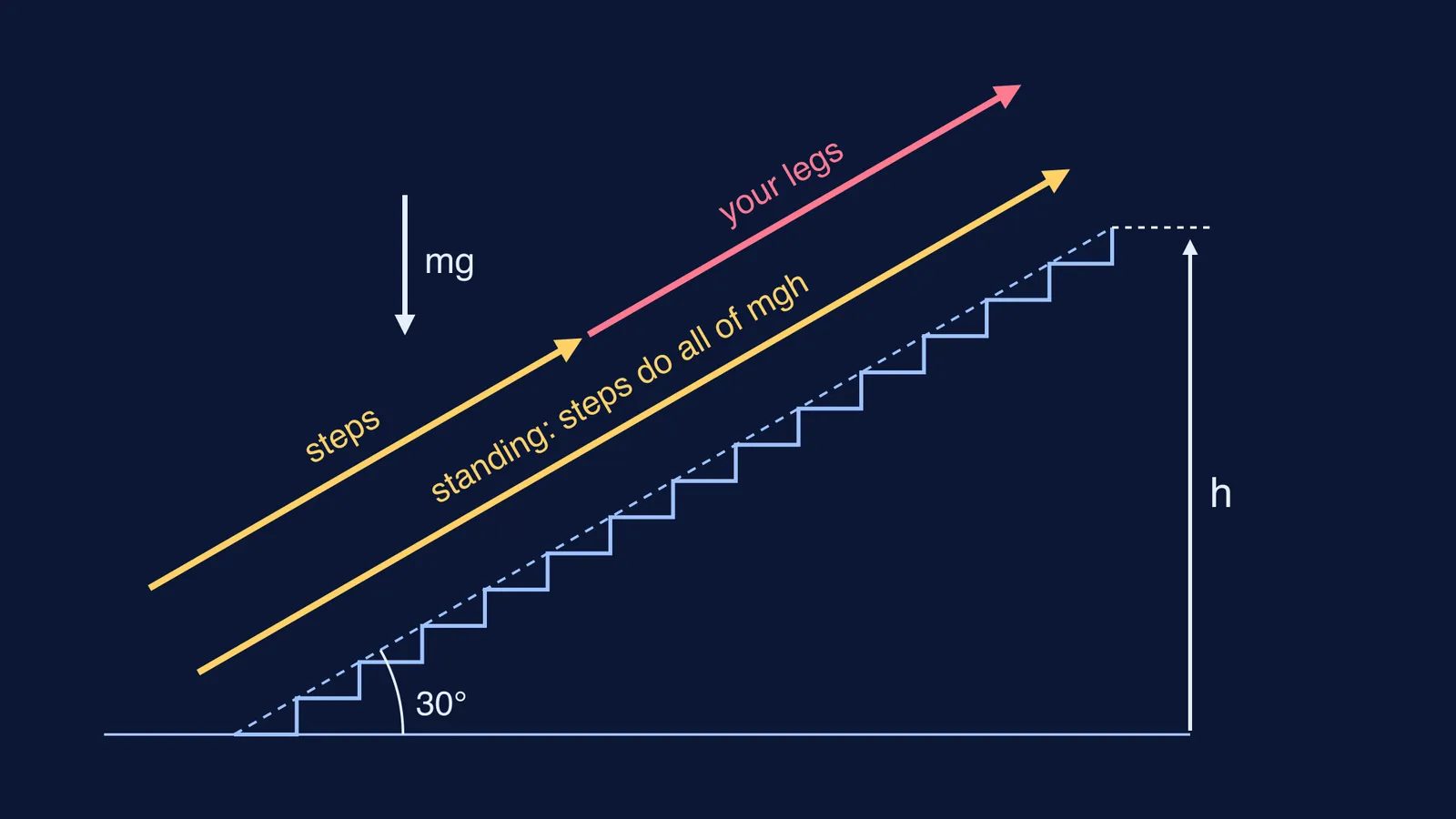
Ride an escalator up one floor and you gain height h, so something has to supply the energy mgh. Whether that is the motor or your legs depends on whether you walk, and on which frame you do the sums in. It is a common exam question, and it gets easy once you track three things: the force, the body it acts on, and how far the point where it pushes actually moves.
Who does the work when you stand still on an escalator?
Work is force times displacement along the force, W = F·d, as defined in NCERT Class 11 Physics, Chapter 5: Work, Energy and Power. The work done by gravity near the Earth's surface depends only on the change in height, W = −mg(y_B − y_A), as OpenStax University Physics, section 7.1 derives.
So, seen from the ground, gravity does −mgh on you whether you stand, walk or run up. Your speed barely changes, so by the work-energy theorem the total work on you is zero. Something must do +mgh.
When you stand still, that something is the step. It pushes up on your feet with a force that averages mg, and your feet rise the full height h with it. The steps do all of mgh. Your legs do nothing, because no part of you moves relative to the step.
What changes when you walk up a moving escalator?
Say the steps move at speed v along a slope of length L, and you walk at speed u relative to the steps. Your speeds add, as in escalator time problems, so you reach the top in time t = L/(u + v), sooner than before.
The step still pushes with an average force of mg, but its point of contact, your foot on the step, only travels as far as the step does: v·t along the slope. That splits the job:
Work by the steps: mgh·v/(u + v)
Work by your muscles, from your body's internal energy: mgh·u/(u + v)
Work by gravity: −mgh, as before
A force does work only through the displacement of what it acts on. NCERT's Example 5.3 shows this with a skidding cycle: the road does −2000 J of work on the cycle, but the cycle does zero work on the road, because the road does not move. The same chapter explains where your share comes from: push hard on a wall and you do no work on it, yet your muscles use up internal energy and you get tired.
Worked example: a 60 kg student on a 12 m escalator
Take g = 10 m/s², as the NCERT chapter does in its examples, and use its power formula P = F·v. A 60 kg student rides a 12 m escalator inclined at 30°, so h = 12 × sin 30° = 6 m and mgh = 60 × 10 × 6 = 3600 J. The steps move at 0.5 m/s.
Standing: t = 12/0.5 = 24 s. Steps do 3600 J, legs 0 J, gravity −3600 J.
Walking at 0.5 m/s relative to the steps: t = 12/1.0 = 12 s. Steps do 3600 × 0.5/1.0 = 1800 J, legs 1800 J, gravity −3600 J.
Motor power spent on this student: P = mg × v sin 30° = 600 × 0.5 × 0.5 = 150 W, the same in both cases.
Motor energy spent on this student: 150 × 24 = 3600 J standing, 150 × 12 = 1800 J walking.
The motor pushes just as hard each second; you simply get off sooner. The real motor also drives the step chain and the handrail, as how an escalator moves people explains, so these numbers are only the part spent lifting you.
Does the work done by gravity depend on the frame?
Yes. Redo the example in the frame of the steps, which move at constant velocity and so form an inertial frame. NCERT's Points to Ponder note that the work-energy theorem holds in all inertial frames.
Standing, you do not move in this frame, so gravity does zero work and so do the steps. Walking, you move 6 m up the steps in 12 s and rise 3 m: gravity does −1800 J, your legs +1800 J, the steps nothing.
Gravity's work changed with the frame; your legs did 1800 J in both. Each bookkeeping sums to zero, so both are right.
How do you answer escalator work questions in an exam?
State the frame, usually the ground.
Write gravity's work as −mg times the rise in that frame.
For each contact force, use the displacement of the contact point, not of your centre of mass.
Find the time from the relative speeds, then the distance each contact point moves.
Check that these works, plus your muscles' share, add up to the change in kinetic energy, which is zero at steady speed.
Step 3 is the easiest to get wrong; it is one of the work-energy mistakes that quietly cost marks. If you keep landing on the wrong split, the Fermi Problem Library has worked problems with a step-by-step solver that explains the reasoning rather than printing an answer. If frame-dependent work still feels slippery, the Fermi Concept Library gives each physics concept its own lesson and its place in the map.
Next time you ride an escalator at a metro station, work out your own share before you reach the top.