

On this page
Next time you ride an escalator at a metro station or a mall, look down. The step under your feet climbs a slope but never tilts, and near the top it melts into a flat floor. Those two details explain most of the machine.
How does an escalator work?
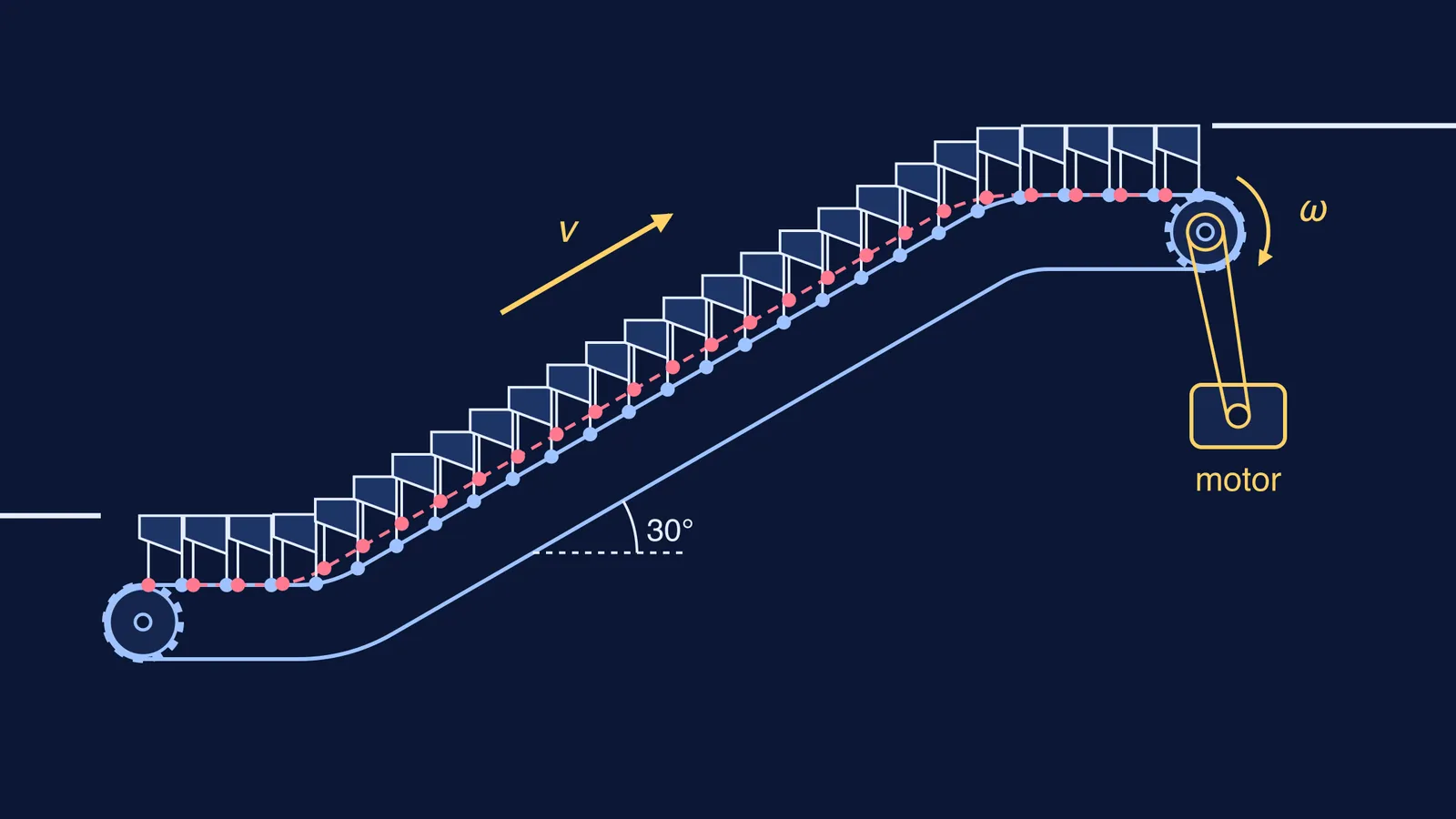
An escalator is "a motor-driven chain of individually linked steps on a track", in the words of the Wikipedia article on escalators. The main motor and drive gear usually sit under the top landing, and a return gear sits under the bottom landing (same source). The step chain is a closed loop round these two gears, like a bicycle chain stretched along a slope.
The motor turns the drive gear at the top.
The gear's teeth pull the step chain, so the whole loop moves at one speed.
Steps fixed to the chain carry you up the visible side, wrap round the drive gear, run back underneath and come up again round the return gear.
The handrail is pulled along its own track by a chain connected to the main drive gear, which keeps it at the same speed as the steps (Wikipedia).
Why do escalator steps stay level, then go flat?
Each step has two sets of wheels on two different tracks: one guides the front wheels (the step-wheel track) and another guides the back wheels, according to the Wikipedia escalator article. On the slope, the tracks hold the back of each step at the height that keeps its tread level. Near the top and bottom the tracks converge, so the steps lie flat one after another and can travel round the bend (same source).
The flat stretch is there for your feet. The KONE escalator planning guide says escalators must have at least two horizontal steps at both landings for a vertical rise up to 6 m, and three above that.
Where do gears and circular motion come in?
For most of its length the chain moves in a straight line. At each end it wraps round a gear, and there every link moves in a circle. The chain's speed v and the gear's angular speed ω are linked by v = ωr, where r is the gear's radius. Our post on how bicycle gears make climbing easier uses the same relation, and how to find speed in uniform circular motion covers the basics.
How fast is an escalator, and why 30 or 35 degrees?
Escalators move at 0.3 to 0.9 metres per second and typically rise at 30 or 35 degrees, says the Wikipedia escalator article. The KONE planning guide lists standard speeds of 0.5, 0.65 and 0.75 m/s. It calls 35 degrees the most compact choice, but says it is allowed only below 6 m of vertical rise and at no more than 0.5 m/s.
Worked example: how long does a 5 m escalator ride take?
Take a 30 degree escalator with a 5 m rise, moving at 0.5 m/s, one of the standard speeds in the KONE planning guide.
Length along the slope: 5 ÷ sin 30° = 10 m.
Ride time: 10 m ÷ 0.5 m/s = 20 s.
Your vertical speed: 0.5 × sin 30° = 0.25 m/s.
Floor space: 5 ÷ tan 30° ≈ 8.7 m of horizontal run, against 5 ÷ tan 35° ≈ 7.1 m at 35 degrees.
Drive gear: assume a radius of 0.35 m (a practice value, not a real specification). Then ω = 0.5 ÷ 0.35 ≈ 1.4 rad/s, about 14 turns a minute.
Power for one 60 kg rider: 60 × 9.8 × 0.25 ≈ 150 W.
A single-width escalator at about 0.5 m/s can move about 2,000 people an hour if riders stand in single file, according to the Wikipedia escalator article. Lifting 2,000 riders of 60 kg through 5 m in an hour takes 2,000 × 60 × 9.8 × 5 ÷ 3,600 ≈ 1,600 W. A real escalator needs more, because friction and motor losses come on top.
Textbooks also ask how long it takes to walk up a moving escalator; our guide to escalator problems: time to walk with or against it works through them. For more practice, the Fermi Problem Library has worked problems with a step-by-step solver that explains the reasoning rather than printing an answer.
What can you check on your next ride?
Test the KONE planning guide figures yourself.
Count the flat steps at the bottom before the staircase forms. Two or three?
Time one step from the bottom comb plate to the top one, estimate the length, and work out the speed.
Rest your hand on the handrail and watch a mark on the step beside you. Do they stay together?
Guess the angle: closer to 30 or 35 degrees? Does the rise look under 6 m?
If the two-track idea is still hard to picture, the Fermi Simulation Lab has interactive simulations for ideas that are easier to see than to read; predict what will happen before you press play.


