

On this page
Uniform circular motion is a short section of the new Class 9 science book, and it mixes two ideas students often confuse: speed and velocity. In NCERT's *Exploration* textbook it is section 4.4.1 of Chapter 4, Describing Motion Around Us (NCERT Class 9 Science, Chapter 4).
What is the formula for speed in uniform circular motion?
NCERT defines uniform circular motion as motion in a circular path at constant speed (NCERT Class 9 Science, Chapter 4). In one revolution the object covers the circle's circumference, 2πr, in a time T. So its speed is:
v = 2πr/T, where r is the radius of the circle and T is the time for one full round (the time period).
Strictly, this is an average speed. Because the speed is the same at every point in uniform circular motion, it is also the speed at any instant.
Why is uniform circular motion accelerated if the speed is constant?
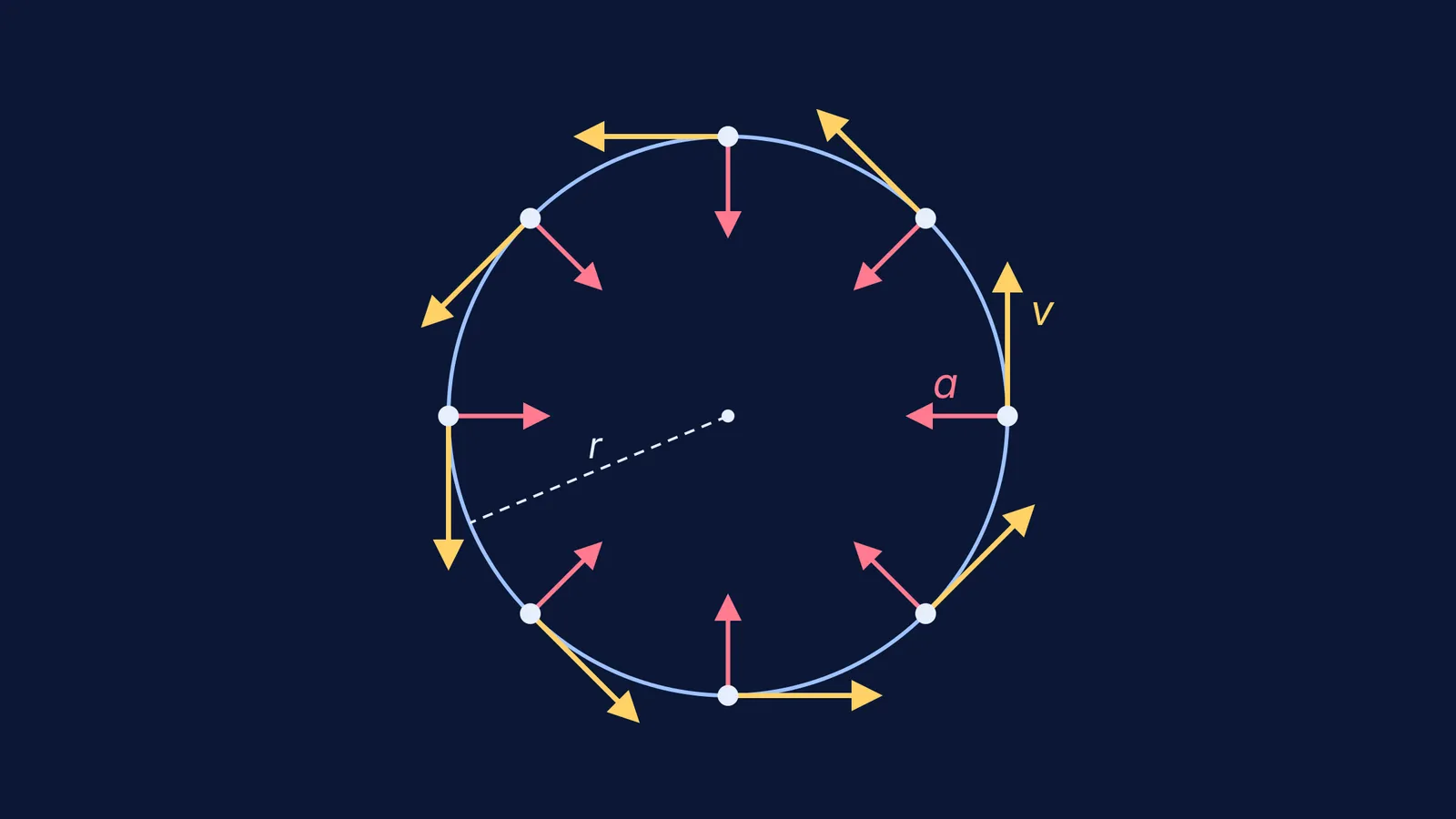
Velocity has both a size and a direction. Acceleration is any change in velocity, and velocity changes if its size changes, its direction changes, or both. NCERT puts it in one line: in uniform circular motion, the object is accelerated because the direction of its velocity keeps changing (NCERT Class 9 Science, Chapter 4).
The book builds the picture with an athlete. On a rectangular track the runner turns 4 times per lap, and on a hexagonal track 6 times. Keep adding sides and the track becomes a circle, where the direction changes all the time and the velocity at each point runs along the tangent. In its marble activity, lifting the ring makes the marble go off in a straight line, in the direction it was moving at that instant.
Later you will learn that this acceleration points towards the centre and that its direction keeps turning (see why centripetal acceleration is not constant). For Class 9, one line is enough: constant speed, changing direction, so changing velocity, so acceleration.
How do you calculate speed in circular motion, step by step?
Use the same four steps on every problem:
Find r, measured from the centre of the circle.
Find T, the time for one full round, and convert it to seconds.
Find the distance for one round: 2πr.
Divide: v = 2πr/T. Write the unit, then check that the size makes sense.
Example 1: the tip of a clock's minute hand. NCERT's own end-of-chapter question uses a minute hand 7 cm long (NCERT Class 9 Science, Chapter 4). Here is that hand for one full hour.
r = 7 cm, T = 60 minutes = 3,600 s
Distance per round = 2 × 3.14 × 7 cm ≈ 44 cm
v = 44 cm ÷ 3,600 s ≈ 0.012 cm/s, about one-eighth of a millimetre every second
Now give the clock a 7 cm second hand. It covers the same 44 cm in 60 s, so its tip moves at about 0.73 cm/s. Both hands are the same length, but one has a period 60 times shorter, so its tip is 60 times faster. To compare the hands by angle instead, see angular speed of clock hands.
Example 2: the International Space Station. NASA says the station orbits Earth about every 90 minutes and makes 16 orbits in 24 hours (NASA, Space Station Facts and Figures). It flies at an altitude of between 370 and 460 km (NASA, ISS reference guide). Earth's mean radius is 6,371 km (NASA Earth Fact Sheet).
r = 6,371 km + about 400 km ≈ 6,771 km (from Earth's centre, not its surface)
T = 90 minutes = 5,400 s
2πr ≈ 2 × 3.1416 × 6,771 km ≈ 42,500 km
v ≈ 42,500 km ÷ 5,400 s ≈ 7.9 km/s, or roughly 28,000 km/h
NASA gives the station's speed as five miles per second, about 8 km/s (NASA, Space Station Facts and Figures), so the answer checks out. Using 400 km as the radius would give about 0.47 km/s, which is far too slow. To see why a satellite moving this fast keeps going round instead of falling, read how satellites stay in orbit.
Which mistakes cost marks in circular motion questions?
Using the diameter instead of the radius in 2πr.
Leaving T in minutes or hours while asking for m/s.
Measuring a satellite's radius from the surface instead of the centre.
Writing that the body is "not accelerating because its speed is constant".
If an answer comes out wrong and you can't see why, the Fermi Problem Library has worked problems with a step-by-step solver that explains the reasoning, so you can find the step where your method went wrong.
Now try NCERT's question on the minute hand from 6 PM to 7:30 PM. Hint: that is one and a half rounds, so the tip ends on the opposite side of the clock face.


