

On this page
What is angular speed and how is it calculated?
When an object moves in a circle, its angular speed (ω, the Greek letter omega) measures how fast its angle changes. Unlike linear speed, which measures the physical distance covered per unit of time (such as metres per second), angular speed measures the angle swept out per unit of time.
In physics and mathematics, we usually measure angles in radians rather than degrees because it simplifies the calculus of rotating systems. One complete circle is 360°, which is equivalent to exactly 2π radians. According to the standard definitions of rotational kinematics, if an object takes a time T (known as its time period) to complete one full revolution, its average angular speed is given by the formula:
ω = 2π / T
To find the angular speed of any clock hand in radians per second (rad/s), you only need to know how many seconds it takes to complete one full 360° turn around the clock face. Since the hands of a clock move at a constant rate, their average angular speed is equal to their instantaneous angular speed.
What is the angular speed of the second hand?
The fastest-moving hand on a standard clock is the second hand. It sweeps through a full circle every minute, returning to the 12 o'clock position after 60 ticks on the clock face.
Time period (T): 1 minute, which is equal to 60 seconds.
Formula: Substituting this into our equation gives ω_s = 2π / 60.
Simplifying the fraction by dividing the top and bottom by 2 yields the angular speed: ω_s = π / 30 rad/s
In decimal form, this angular speed is approximately 0.1047 rad/s. Because it completes a full turn the fastest, it has the largest angular speed of the three hands.
What is the angular speed of the minute hand?
The minute hand moves much slower than the second hand, taking a full hour to complete one revolution of the clock face.
Time period (T): 1 hour, which consists of 60 minutes.
In seconds: To keep our units consistent in rad/s, we must convert this time to seconds. Multiplying 60 minutes by 60 seconds per minute gives a period of 3,600 seconds.
Formula: Substituting this into the angular speed equation gives ω_m = 2π / 3600.
Simplifying the fraction yields the exact angular velocity: ω_m = π / 1800 rad/s
This works out to roughly 0.001745 rad/s.
What is the angular speed of the hour hand?
The hour hand is the slowest of the three. It completes a full 360° sweep once every 12 hours on a standard 12-hour clock face (note that it does not take 24 hours for a full revolution, but 12).
Time period (T): 12 hours.
In seconds: We convert 12 hours to minutes by multiplying by 60, and then to seconds by multiplying by 60 again. This gives 12 × 3,600 = 43,200 seconds.
Formula: Plugging this period into our equation gives ω_h = 2π / 43200.
Simplifying this fraction yields the angular velocity: ω_h = π / 21600 rad/s
As a decimal, it is an extremely slow 0.000145 rad/s.
How do you find the linear speed of a clock hand's tip?
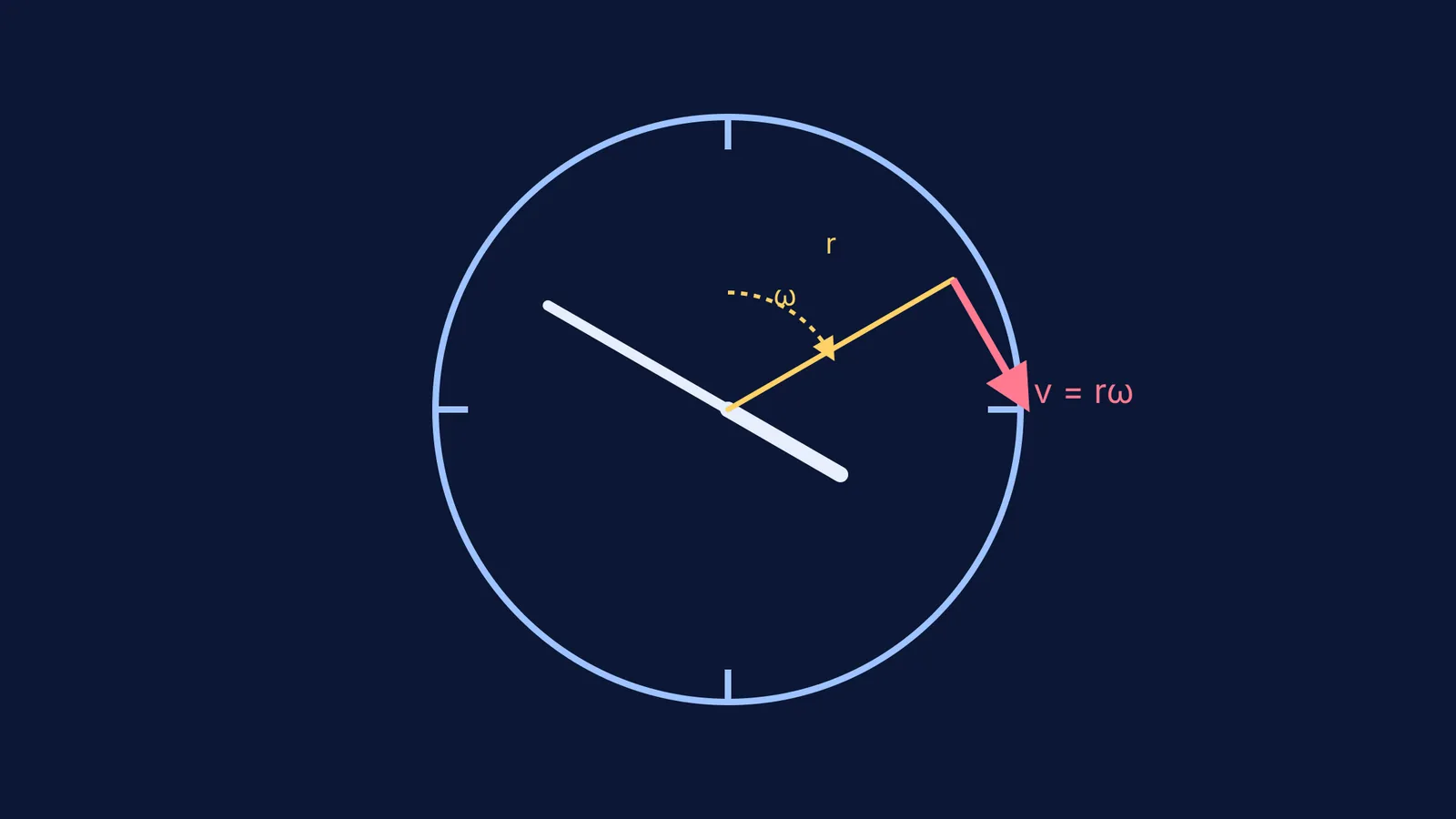
While every point along a rigid clock hand shares the exact same angular speed ω, they do not share the same linear speed v. A point at the tip of the hand travels along a much larger circular path than a point near the centre pivot. Because it has to cover a greater distance in the same amount of time, the tip must physically move faster.
The relationship between linear speed (v), the radius of the circular path (r), and the angular speed (ω) is given by the formula v = r × ω.
Here, r is the distance from the centre of the clock to the specific point on the hand you are measuring. For example, if a clock's second hand is 15 cm (0.15 m) long, the linear speed of its tip is: v = 0.15 m × (π / 30 rad/s) ≈ 0.0157 m/s (or 1.57 cm/s).
If you were to measure a point halfway down that same second hand (r = 0.075 m), its linear speed would be exactly half that of the tip.
A step-by-step checklist for clock-hand problems
When you encounter rotational motion questions involving clocks in your exam preparation, follow this consistent routine to avoid silly mistakes:
Identify the specific hand: Read the question carefully to note whether it asks for the hour, minute, or second hand.
State the period in seconds: Always convert to the standard SI unit of time. Remember T = 60 s for the second hand, 3,600 s for the minute hand, and 43,200 s for the hour hand.
Calculate the angular speed: Use the formula ω = 2π / T to get the answer in rad/s. Leave the answer as a fraction of π unless a decimal is explicitly requested.
Calculate the linear speed (if required): Multiply your ω value by the hand's length r. Ensure the length is converted to metres to get your final velocity v in m/s.
If you are working through rotational kinematics and want to practice more challenging scenarios, the Fermi Problem Library has worked problems with a step-by-step solver that explains the reasoning rather than printing an answer.
For more related mechanics ideas, look at Pendulum clock losing time in summer: thermal expansion of the rod or see how areal velocity works in Kepler's second law from angular momentum: areal velocity worked. You might also find it helpful to read about the Seconds pendulum: how its period changes with length and g.


