

On this page
The escalator problem shows up in Class 11 relative motion, in JEE Main practice sets and in aptitude tests. It looks like a puzzle, but one rule from relative motion solves every version: "with", "against" and "count the steps".
Why do you add speeds when you walk on a moving escalator?
Your speed relative to the ground is your speed relative to the moving stairs plus the stairs' speed relative to the ground. OpenStax University Physics states the general rule: "The velocity of a particle relative to S is equal to its velocity relative to S′ plus the velocity of S′ relative to S." The same section works a train example: a person walking 2 m/s towards the back of a train moving 10 m/s east moves 8 m/s east relative to Earth.
On an escalator, write w for your walking speed relative to the steps and u for the escalator's speed.
Walking with the escalator: ground speed = w + u
Walking against it: ground speed = w − u (you only get anywhere if w is bigger than u)
Standing still on it: ground speed = u
Real escalators move at roughly 0.3 to 0.9 metres per second, according to the Wikipedia article on escalators. That is slower than a brisk walk, which is why walking against one is tiring but possible.
How long does it take to walk up a moving escalator?
Most exam questions give you times, not speeds.
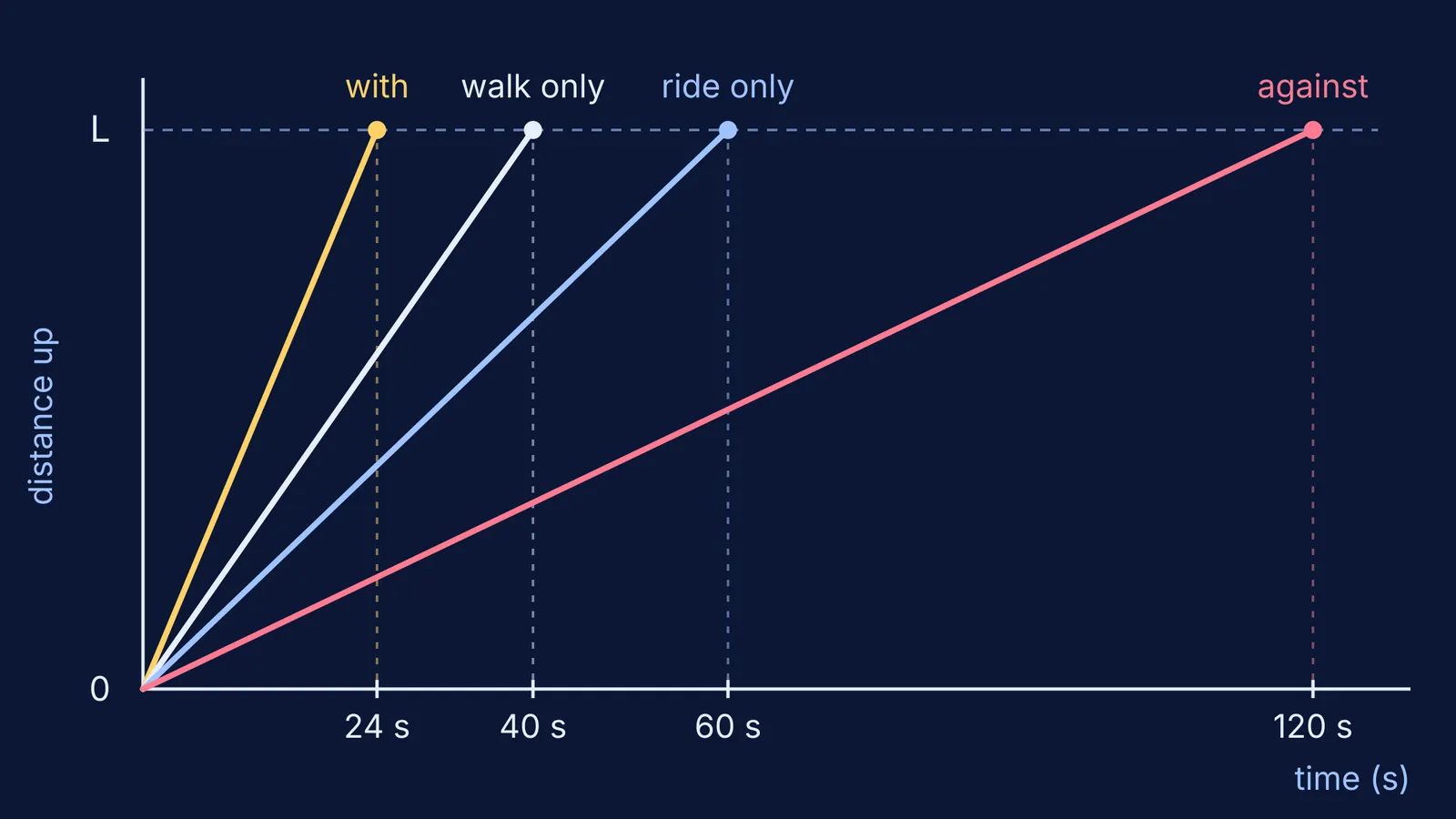
Problem. An escalator carries a person standing still to the top in 60 s. On a stopped escalator, the person walks up in 40 s. How long does it take if they walk up while it moves? And how long to walk up the down escalator?
Call the length L. Then u = L/60 and w = L/40.
With the escalator: speed = L/40 + L/60 = 5L/120 = L/24. Time = L ÷ (L/24) = 24 s.
Against the escalator: speed = L/40 − L/60 = L/120. Time = 120 s.
The L cancels every time, so you never need the real length. The shortcut is to add the reciprocals: 1/t = 1/40 + 1/60, so t = (40 × 60)/(40 + 60) = 24 s. Going against it, 1/t = 1/40 − 1/60, so t = (40 × 60)/(60 − 40) = 120 s.
As a check, give it a real length. If L = 30 m, the escalator moves at 0.5 m/s, inside the 0.3 to 0.9 m/s range given by Wikipedia, and you walk at 0.75 m/s.
How do you count the steps on a moving escalator?
The trickier version asks how many steps are visible when the escalator is stopped. You know how many steps you counted, not how long it took.
Problem. Walking up a moving "up" escalator, you count 20 steps. Walking up the "down" escalator at the same pace (same steps per second), you count 60 steps. How many steps are visible, N?
The idea: measure everything in steps. Let r = u/w, the escalator's speed as a fraction of yours.
Going with it, you take 20 steps, and in the same time the escalator brings 20r steps up to you. So N = 20 + 20r.
Going against it, you take 60 steps while the escalator carries 60r steps away. So N = 60 − 60r.
Set them equal: 20 + 20r = 60 − 60r, so 80r = 40 and r = 0.5.
N = 20 + 10 = 30 steps.
A quick check: 30 sits between 20 and 60, as it must, because the escalator helps you in one case and works against you in the other. If you solve the general case, N = 2 × 20 × 60 / (20 + 60). That is the harmonic mean of the two counts.
A three-step checklist for any escalator question
Name the speeds relative to something: your speed relative to the steps, the steps' speed relative to the ground.
Add for "with", subtract for "against", then divide distance by speed. If you only have times, add or subtract 1/t.
Sanity-check: walking with it must be faster than either motion alone; walking against it must be slower than walking on a stopped escalator.
The same rule handles boats in rivers and rain seen from a moving car; our guide to relative velocity in river and rain problems applies it in two dimensions. If "speed" and "velocity" still blur together, read average speed vs average velocity first. For a harder test of the same idea, try closest approach in relative motion.
If you keep getting the setup wrong, the Fermi Problem Library has worked problems with a step-by-step solver that explains the reasoning rather than printing an answer. If the reference-frame idea itself is shaky, the Fermi Concept Library gives every physics concept its own lesson.
Try it yourself: change the walking time to 30 s, predict the "with" and "against" times, then check them with 1/t.


