On this page
Blow up a balloon and the rubber is not the only thing you push. The gas inside also shoves the surrounding air out of the way, and moving that air takes work. Class 11 and JEE problems ask for exactly this number: the work done by the gas against the atmosphere.
What is the work done by a gas against the atmosphere?
The work done by a gas is the integral of pressure over volume change, W = ∫p dV, and at constant pressure it reduces to W = p(V₂ − V₁), as OpenStax University Physics derives. When that constant pressure is the pressure of the open air outside, the work done against the atmosphere is W = P_atm ΔV.
One standard atmosphere is exactly 101,325 Pa, a defined value listed by NIST.
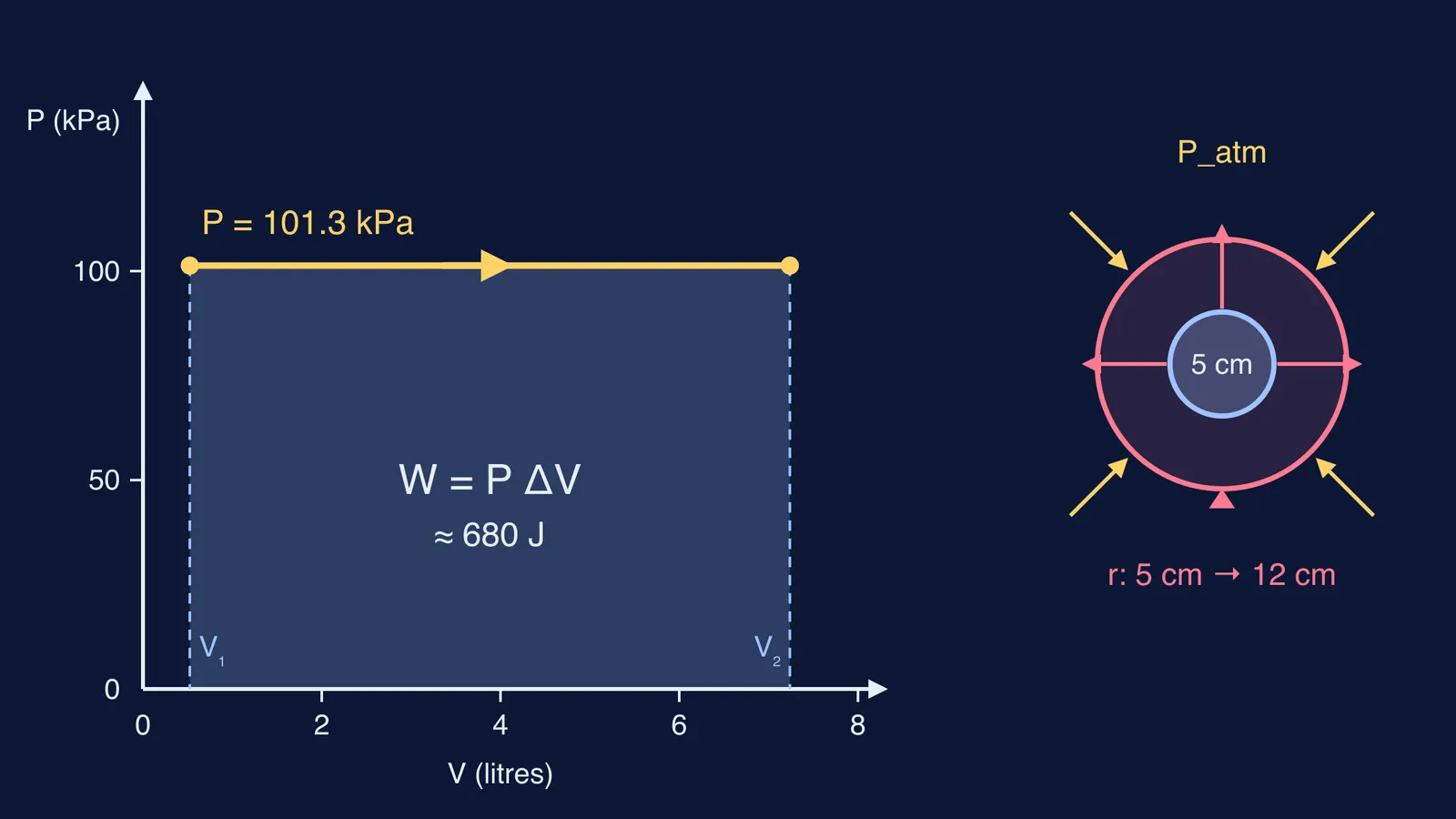
The atmosphere is so large that one balloon growing does not change its pressure, so P_atm really is constant through the whole expansion. Plot the outside pressure against the balloon's volume and you get a horizontal line; the work is the rectangle under it, height P_atm and width ΔV.
Why use the outside pressure, not the pressure inside the balloon?
Because the question is about the work done on the air outside. The gas inside a balloon sits at a slightly higher pressure than the air, since the stretched rubber squeezes it. Part of the gas's work goes into stretching the rubber; the rest pushes back the atmosphere. Only that second part is P_atm ΔV.
This is the most common slip in exams: you read the gas's own pressure from the question and multiply it by ΔV. If a question gives a gauge reading for the balloon, remember that gauge pressure is measured relative to the surrounding air, as our post on gauge pressure vs absolute pressure explains, so the pressure you need for work against the air is still the atmospheric one.
Worked example: how much work does an inflating balloon do?
A party balloon grows from a radius of 5 cm to 12 cm in open air at one standard atmosphere, 101,325 Pa (NIST). Treat it as a sphere and assume the air outside stays at that pressure.
Initial volume: V₁ = (4/3)π(0.05 m)³ = 5.24 × 10⁻⁴ m³, about 0.52 L.
Final volume: V₂ = (4/3)π(0.12 m)³ = 7.24 × 10⁻³ m³, about 7.24 L.
Change in volume: ΔV = 6.71 × 10⁻³ m³.
Work against the atmosphere: W = 101,325 Pa × 6.71 × 10⁻³ m³ ≈ 680 J.
The radius rises only 2.4 times, but the volume rises about 14 times, because volume goes as r³. If you let ΔV grow in step with the radius, your answer comes out far too small.
A unit shortcut saves time in a paper. A litre is a cubic decimetre, 10⁻³ m³ (NIST), so 1 L·atm = 101.325 J. A gas that pushes out 3.0 L against 1 atm does about 304 J of work.
Is the work done by the gas positive or negative?
It depends on whose bookkeeping you use. In physics, work done by the gas is positive for expansion and negative for compression (OpenStax University Physics), so the balloon's W = +680 J. Chemistry texts count work done on the system as positive, so the same expansion is written w = −P_ext ΔV = −680 J (OpenStax Chemistry 2e).
Both describe the same energy leaving the gas. Write down which convention your question uses before you put a sign on the answer. The same P ΔV term is why ΔH and ΔU differ at constant pressure, which we work through in why ΔH equals heat at constant pressure. For a case where work alone changes a gas's temperature, see can temperature rise without heat.
A four-step check for any expansion question
Name the outside pressure. Open air gives P_atm. A free piston of mass m and area A resting on the gas gives P_atm + mg/A. A vacuum gives zero, so a free expansion into vacuum does no work.
Ask whether that pressure stays constant during the change. If it does, W = P_ext ΔV. If it does not, go back to W = ∫p dV.
Convert to SI: pascals times cubic metres gives joules. Litres times atmospheres times 101.325 also gives joules, since 1 atm is 101,325 Pa (NIST).
Fix the sign for your convention: physics or chemistry.
The step students skip is the first one. Before you touch a formula, point at the thing doing the pushing back and say its pressure out loud.
To practise that habit, the Fermi Problem Library has worked problems with a step-by-step solver that explains the reasoning rather than printing an answer, so you can practise picking the right pressure. If p dV itself feels shaky, the Fermi Concept Library gives each physics concept its own lesson.
Next time you blow up a balloon, you can put a number on the air you moved.