On this page
Most vital organs sit deep inside the body. The testes do not, and why they don't is a common exam question. The short answer is temperature. A complete answer explains which temperature, why it matters, and how the scrotum keeps it there.
Why are the testes located outside the body?
The line to learn comes from the NCERT Class 12 Biology chapter on human reproduction. It says the testes are situated outside the abdominal cavity, within a pouch called the scrotum.
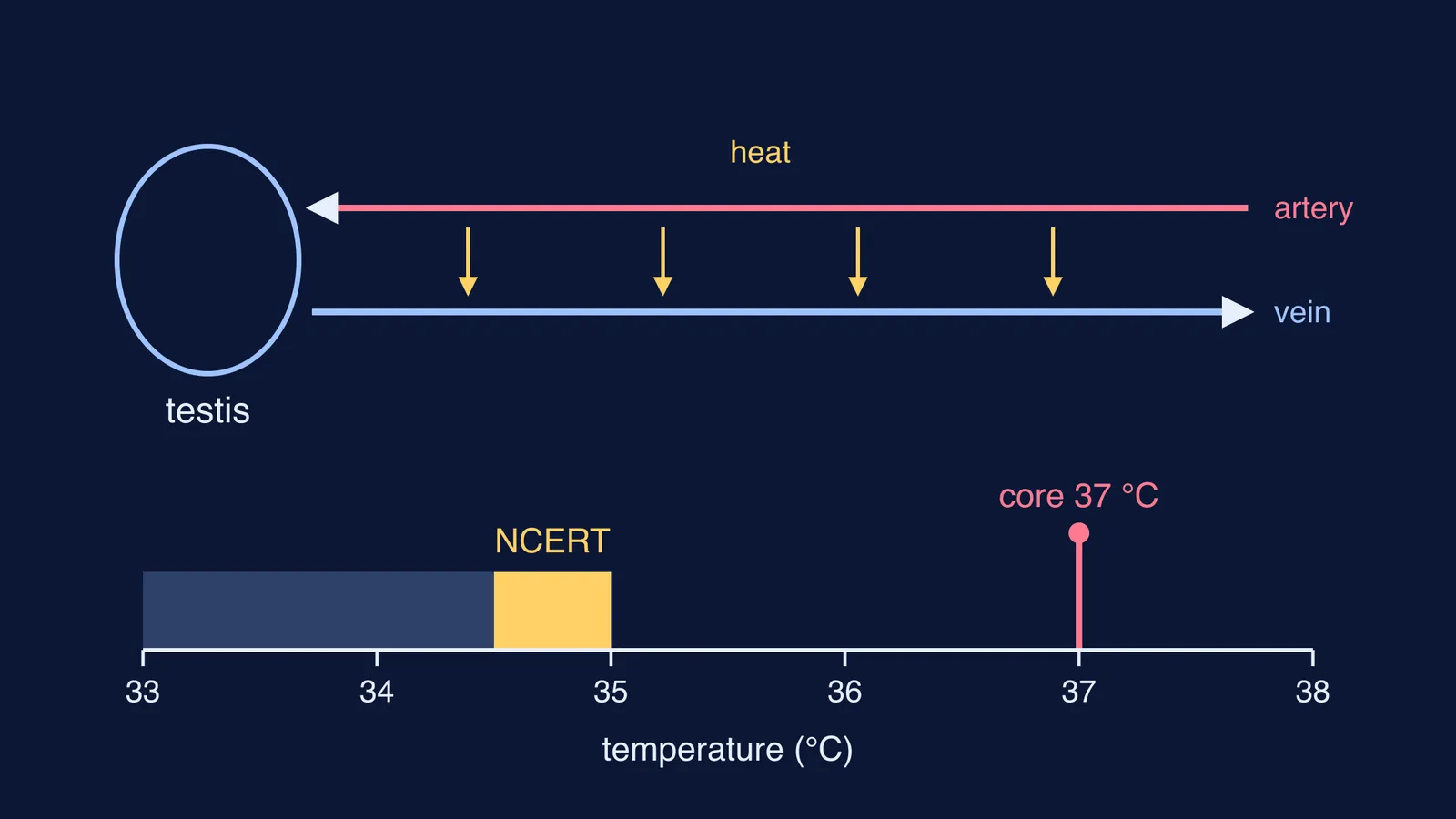
NCERT states that the scrotum helps keep the testes 2–2.5 °C lower than the normal internal body temperature, and that this low temperature is necessary for spermatogenesis (NCERT Class 12 Biology, Chapter 2).
Spermatogenesis is the formation of sperm. In the same chapter, NCERT explains that sperm are made in the highly coiled seminiferous tubules, where male germ cells (spermatogonia) undergo meiotic divisions and Sertoli cells provide them with nutrition. If those words are hazy, revise the difference between Sertoli and Leydig cells and how to draw the TS of a seminiferous tubule first.
Why does sperm formation need a cooler temperature?
The germ cells dividing inside the tubules are sensitive to heat. A 2023 review in Frontiers in Cell and Developmental Biology, by De Toni and colleagues, sums up the evidence. It reports a large body of evidence that acute heat stress harms testis function, particularly sperm production and hormone production, in both animal and human studies.
The same review reports that in animal studies, heat stress is linked to germ cell apoptosis (programmed cell death), cell cycle arrest and oxidative stress (De Toni et al., 2023). In plain words, too much heat damages the cells that become sperm.
You will see a different number in other books. The De Toni review gives the testes an average temperature about 2–4 °C below the core (De Toni et al., 2023), and the OpenStax Anatomy and Physiology textbook says sperm production proceeds more efficiently when the testes are 2 to 4 °C below core body temperature.
How does the scrotum keep the testes cool?
Position. Hanging outside the abdominal cavity, the testes are away from the heat of the body core (NCERT).
Muscles. OpenStax describes two muscles, the dartos in the scrotal wall and the cremaster around each testis. In the cold they contract together, pulling the testes closer to the body and shrinking the scrotum's surface to hold in heat. When it gets warmer, the scrotum relaxes, the testes move farther from the body and the larger surface loses heat (OpenStax).
Blood-vessel heat exchange. The artery that carries blood to the testis loops in close contact with the pampiniform plexus, the network of veins carrying blood away. The De Toni review gives arterial blood entering at about 37 °C and venous blood leaving at an average of 35 °C, so warm incoming blood can pass heat to the cooler outgoing blood (De Toni et al., 2023). The review also mentions widening of scrotal blood vessels and sweating.
Point 1 is the NCERT line. Points 2 and 3 show you understand how the cooling actually happens.
How do you write this answer in a board exam?
Short answer (two or three lines): The testes lie outside the abdominal cavity in the scrotum. The scrotum keeps the testes 2–2.5 °C below normal internal body temperature. This lower temperature is necessary for spermatogenesis.
Longer answer (one paragraph): The testes are situated outside the abdominal cavity in a pouch called the scrotum. Spermatogenesis in the seminiferous tubules needs a temperature 2–2.5 °C lower than normal internal body temperature, and the scrotum helps maintain it. In cold conditions the scrotal muscles contract and pull the testes closer to the body. In warm conditions the scrotum relaxes, and the testes hang lower and lose heat. Arterial blood going to the testes is also cooled by the veins leaving them (pampiniform plexus).
Before you hand in, check for these slips:
Writing “higher” instead of “lower”, or giving the temperature of the testes as 2–2.5 °C.
Saying the scrotum makes sperm. The testes make sperm; the scrotum houses them.
Leaving out the word spermatogenesis. It is the reason the answer exists.
Drawing a diagram with the scrotum unlabelled. Practise with this male reproductive system labelling guide.
If this still feels like a fact to memorise rather than a reason you could rebuild, the Fermi Concept Library gives every biology concept its own lesson and its place in the map, so you can see how spermatogenesis links to the structures around it.
What if a testis has not come down into the scrotum?
The NHS says undescended testicles are common in young boys and often move into place on their own in the first 12 weeks after birth. When they don't, a child is referred to a specialist, and surgery is usually done when the child is around 1 year old. If you are worried, ask a doctor rather than relying on a textbook.
For exam practice, try writing the longer answer from memory, then check it against the NCERT line above.