On this page
A dry almond is thirsty. Its thin brown skin (the seed coat, which processors call the pellicle) grips the kernel tightly. Leave it in water overnight and the kernel and skin take up water and swell, the skin loosens, and by morning a pinch usually pops the kernel out.
Why do almonds peel easily after soaking overnight?
Almond factories use a hot, fast version of the same effect. In a review of tree-nut processing, Chang Chen and Zhongli Pan describe how soaking or steaming almonds at high temperature makes the pellicle swell and crack, after which soft rubber rollers rub it off (Chen and Pan, IntechOpen, 2022). Your kitchen soak uses cooler water and much more time to loosen the skin.
A 2008 study of almond mechanics lists the steps kernels can go through after harvest, including wetting them in water for about 13 hours and peeling them while wet (Khazaei, 2008). That is about one night, which fits the everyday experience that badam soaked before bed peels easily at breakfast.
What is imbibition, and where does osmosis come in?
Imbibition is the uptake of a liquid by solid colloids, such as dry seeds or dry wood, which swell as they take it in (Imbibition, Wikipedia). Proteins imbibe strongly, which is why the same article notes that protein-rich pea seeds swell more than starchy wheat seeds. Almonds are rich in protein too: the 2008 study cites a protein content of 15.64% for almond kernels (Khazaei, 2008).
Osmosis is the net movement of water through a selectively permeable membrane, from a region of higher water potential to one of lower water potential (Osmosis, Wikipedia). The difference exam questions test: imbibition needs no membrane, because the dry material itself pulls water in, while osmosis needs one, such as a cell membrane. In a dry almond, imbibition probably does most of the early work, with osmosis mattering more once water reaches cells with working membranes. Our explainer on why dry seeds and wood swell with water goes further.
How much water does an almond take in overnight?
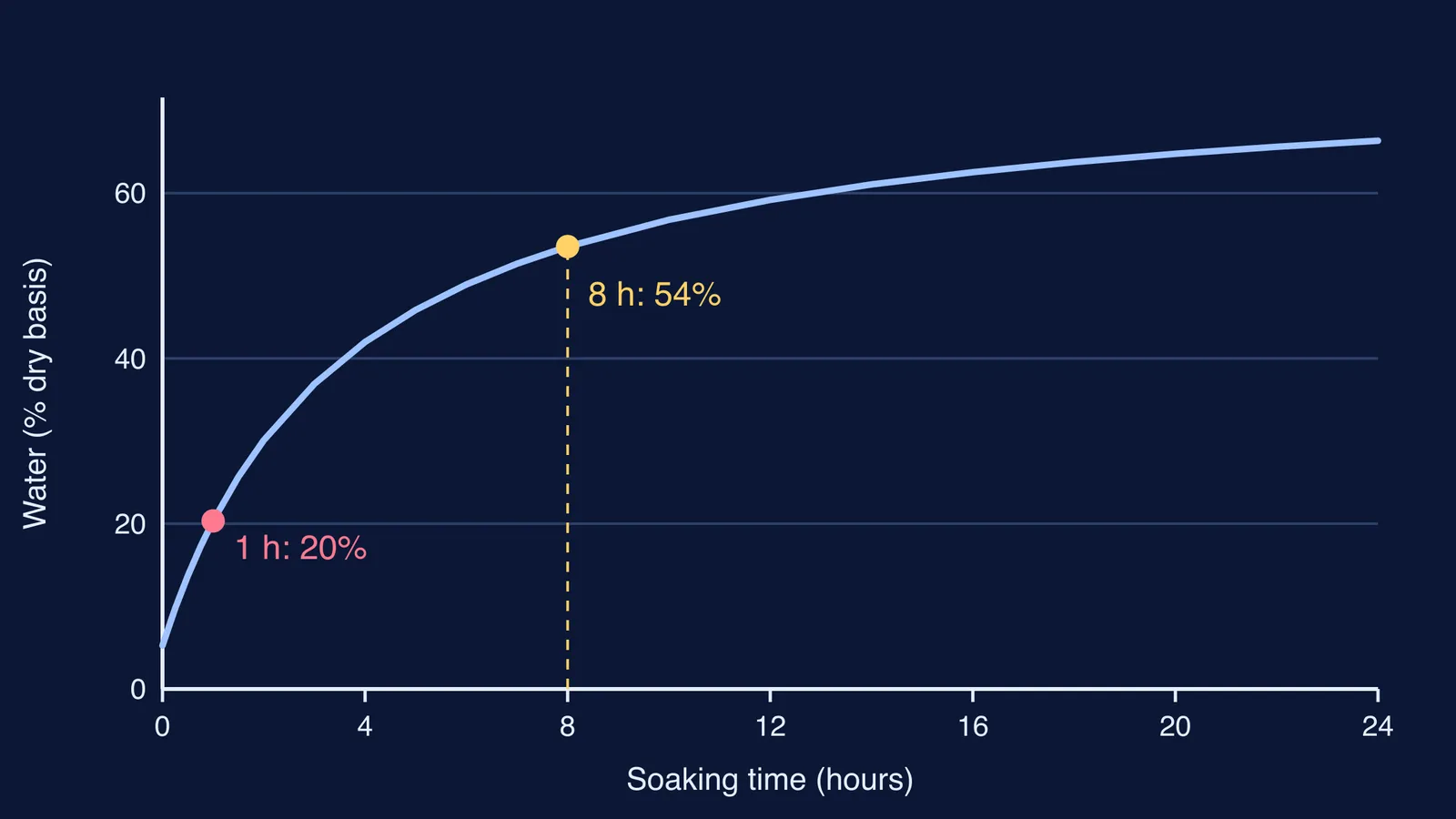
In the 2008 study, J. Khazaei soaked 20 g batches of almond kernels in 150 ml of distilled water held at 27 °C and weighed them again and again (Khazaei, 2008). Moisture rose from 5.26% to 22.1% (dry basis) in the first hour, and the rate of uptake was highest at the start. The paper fits the data with Peleg's equation: moisture = 5.26 + t ÷ (3.1271 + 0.0142 t), with t in minutes.
Here is a worked example using those numbers. "Dry basis" means water as a percentage of the dry matter, not of the total weight.
Take 100 g of almonds at 5.26% moisture (dry basis). That is about 95.0 g of dry matter and 5.0 g of water.
After 1 hour, at the measured 22.1%, the water is 0.221 × 95.0 = 21.0 g. The almonds now weigh about 116 g.
After 8 hours (480 minutes), the equation gives 5.26 + 480 ÷ 9.94, or about 53.5%. The water is 0.535 × 95.0 = 50.9 g, so the almonds weigh about 146 g.
So an overnight soak makes almonds roughly 45% heavier, and about a third of that gain comes in the first hour. Your almonds will differ with variety, size and temperature. A similar steep-then-flat curve explains why soaking dal cuts cooking time.
Does warm water peel almonds faster than cold water?
Probably, but it has not been measured for almonds in the sources here. In a study that soaked corn and soybeans at 25, 35, 45, 55 and 65 °C, the absorption rate was greater at higher temperatures and during the first phase of soaking (Miranda and others, Acta Scientiarum Technology, 2019). Those were grains and beans, not almonds, so treat it as a prediction and test it.
You need 20 similar almonds, two identical bowls, a kitchen scale and a timer.
Split the almonds into two groups of 10 and weigh each group.
Bowl A: fridge-cold water, kept in the fridge. Bowl B: warm tap water that feels comfortable on your hand, left on the counter. Same volume in both.
Write your prediction: which bowl peels cleanly first, and when?
At 30 minutes, 1, 2, 4 and 8 hours, lift each group out, pat it dry, weigh it and put it back.
Each time, peel one almond per bowl and score it 0 (skin will not move), 1 (peels with a fingernail) or 2 (slips out when pinched).
Work out percentage gain: (new mass − starting mass) ÷ starting mass × 100.
Change only the water temperature, and do not use boiling water without an adult nearby.
The same weighing method gives you the percentage of water absorbed by raisins. And if imbibition, osmosis and diffusion still blur together, the Fermi Concept Library has its own lesson for every concept in biology, so you can check each definition against the others.
Soak tonight, weigh tomorrow, and see whether your warm bowl wins.