

On this page
The raisin practical is one of the friendliest experiments in Class 9 biology. With a few raisins, water and a balance, you get a measurement, a percentage calculation and the idea of osmosis, all of which turn up in viva questions.
What do you need for the raisin experiment?
Published lab write-ups list much the same kit. The CBSE Tuts write-up of the Class 9 practical asks for five raisins, a beaker, filter paper, a weighing balance, a weight box and a watch glass, while StudyRankers' lab record uses ten raisins, a bowl, blotting paper, an electronic balance and a petri dish.
5 to 10 dry raisins, clean and whole
A beaker or bowl of plain water
A weighing balance (a digital one makes reading easier)
Filter paper or blotting paper
A watch glass or petri dish to weigh the raisins in
How do you do the raisin experiment step by step?
Weigh the dry raisins together and write down the mass as W1.
Put them in the water so that every raisin is fully under the surface.
Leave them to soak. Write-ups differ on how long: StudyRankers' lab record soaks them for 2 hours, while the CBSE Tuts version leaves them in the water until the next day. Use whatever time your teacher gives you, and record it.
Lift the raisins out and roll them gently on filter paper to remove the water clinging to the surface.
Weigh the swollen raisins straight away and write down the mass as W2.
Blot carefully: surface water was never absorbed, and leaving it on makes your answer too high.
How do you calculate the percentage of water absorbed?
The formula used in the StudyRankers lab record is percentage of water absorbed = (W2 − W1) ÷ W1 × 100, where W1 is the dry mass and W2 is the soaked mass.
Here is a worked example with sample readings (your own will differ):
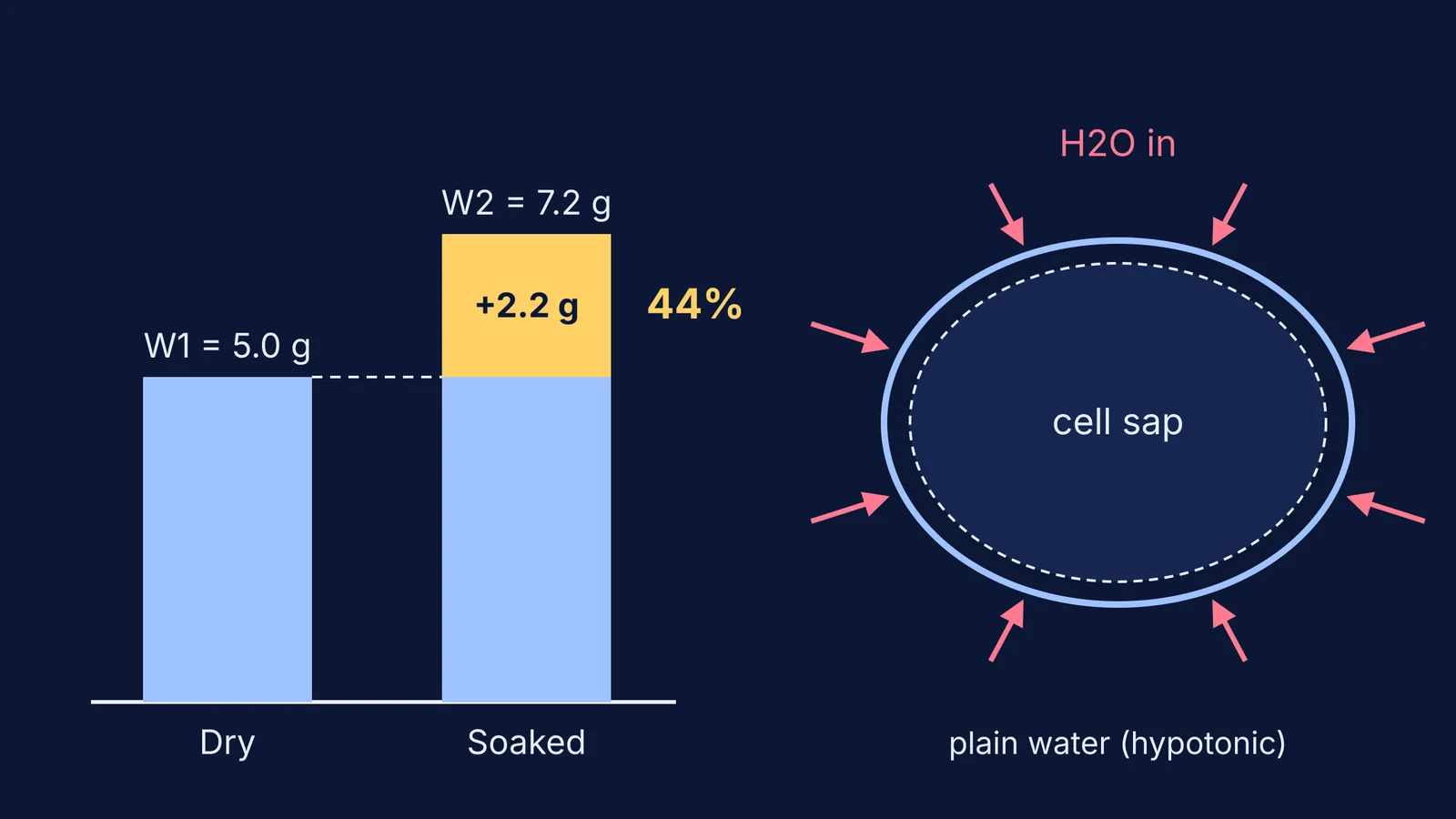
Mass of dry raisins, W1 = 5.0 g
Mass of soaked raisins, W2 = 7.2 g
Mass of water absorbed = W2 − W1 = 7.2 − 5.0 = 2.2 g
Percentage absorbed = 2.2 ÷ 5.0 × 100 = 44%
This is the same kind of mass percentage you meet in chemistry, so if the fraction still feels shaky, our post on mass percentage of a solution in Class 9 goes through it step by step. If you want more numericals like this, the Fermi Problem Library has worked problems with a step-by-step solver that explains the reasoning rather than printing an answer.
Why do raisins swell in water?
A raisin is a dried grape whose cells still hold concentrated dissolved sugars. The NCERT Class 9 lab manual defines osmosis as the movement of water from a region of its higher concentration to a region of its lower concentration across a selectively permeable membrane (NCERT Laboratory Manual, Experiment 20).
The same manual says endosmosis, the entry of water into a cell, happens when the cell is placed in a hypotonic solution. Plain water is hypotonic compared with the raisin's cell sap, so more water moves in than out, and the raisin plumps up.
The NCERT Class 9 textbook chapter The Fundamental Unit of Life makes the same point in Activity 5.4: dried raisins or apricots gain water and swell in plain water, but lose water and shrink in a concentrated sugar or salt solution (NCERT chapter, hosted copy). Some lab write-ups also use the word imbibition for dry plant material taking up water and swelling (CBSE Tuts), so be ready to use both terms.
If hypotonic and hypertonic keep getting mixed up, the Fermi Concept Library gives each concept in biology its own lesson. For the history, read how Jean-Antoine Nollet first saw osmosis with a pig's bladder.
What can go wrong, and what will the examiner ask?
Check these before you write your result:
Raisins not fully under the water, so some cells never soaked
Surface water not blotted off, so W2 is too high
Raisins squeezed while blotting, so absorbed water is pushed out and W2 is too low
Broken or damaged raisins, which can let water and sugars leak through the tear
Practise answering these out loud:
Why do you blot the raisins before the second weighing?
Why do you divide by the dry mass and not the soaked mass?
What would happen to raisins kept in strong salt water?
Is plain water hypotonic or hypertonic compared with the cell sap?
For tips on staying calm when the examiner asks, see our guide to speaking confidently in your viva.


