

On this page
Concentration questions in Class 9 are easy once you know which number goes on the bottom of the fraction. A common slip is dividing by the water instead of the whole solution.
What is the concentration of a solution in Class 9?
In the new NCERT Grade 9 science textbook, Exploration, concentration is "the amount of solute dissolved in a given amount of solvent or solution" (NCERT Exploration, Grade 9, Chapter 5). The solute is the substance that gets dissolved and the solvent is the substance that dissolves it: in sugar water, sugar is the solute and water is the solvent.
The chapter gives three percentage methods: mass by mass (% m/m), mass by volume (% m/v) and volume by volume (% v/v). This guide focuses on the first two. If solutes and solvents still feel shaky, start with our Class 8 guide to solutes, solvents and solutions.
How do you calculate mass by mass percentage?
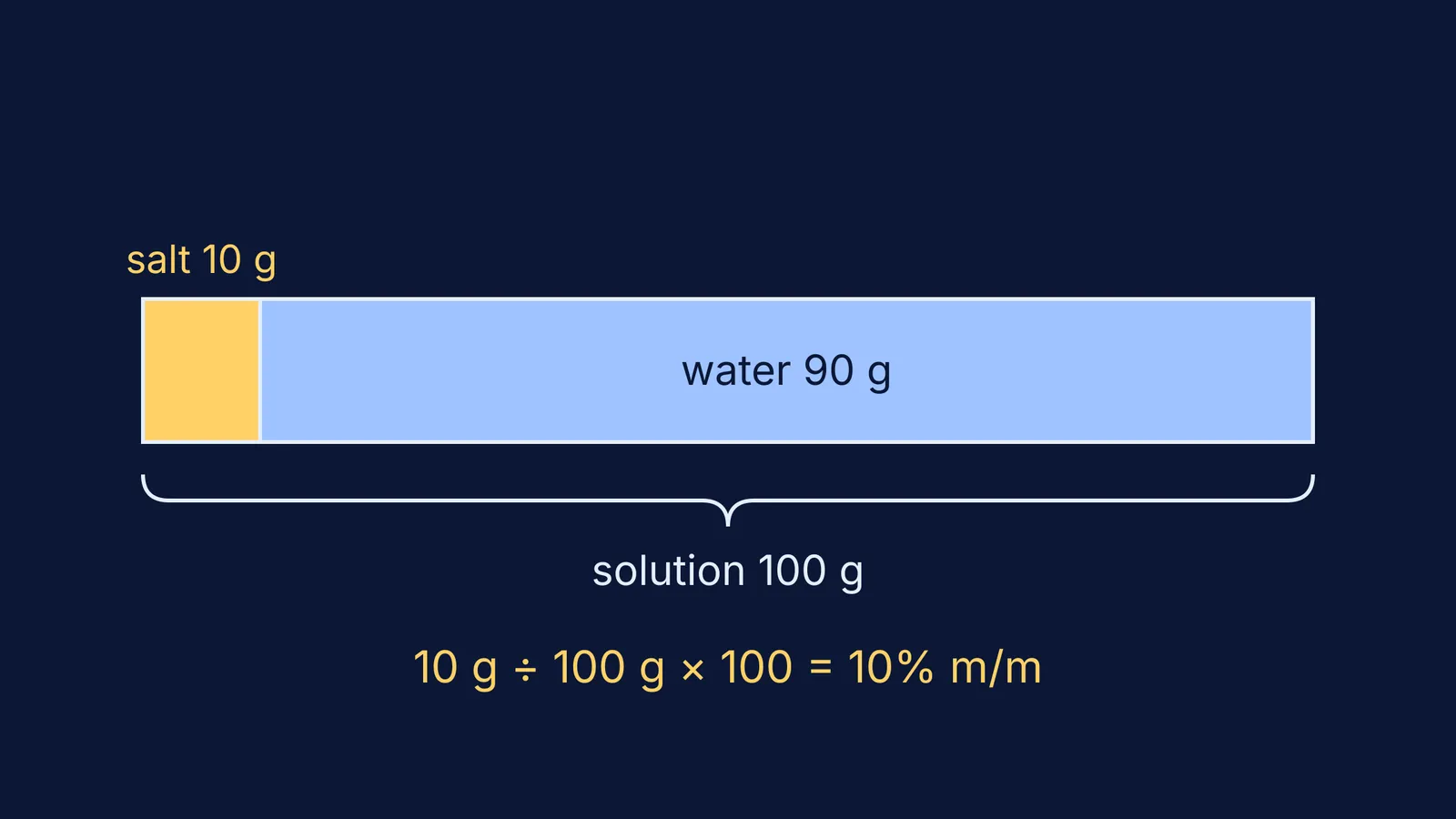
Mass by mass percentage = (mass of solute ÷ mass of solution) × 100, and it tells you how many grams of solute are present in 100 g of solution (NCERT, Chapter 5).
The mass of the solution is the solute plus the solvent. NCERT's own example dissolves 10 g of salt in 90 g of water: the solution weighs 100 g, so the concentration is 10% m/m.
Worked example, salt water: you dissolve 25 g of salt in 225 g of water. What is the mass by mass percentage?
Solute (salt) = 25 g. Solvent (water) = 225 g.
Mass of solution = 25 g + 225 g = 250 g.
Mass by mass percentage = 25 ÷ 250 × 100 = 10% m/m.
Divide by the water instead and you get 11.1%, a wrong answer that looks plausible.
Run it backwards: to make 200 g of a 5% m/m salt solution, you need 5% of 200 g = 10 g of salt, and 200 − 10 = 190 g of water, not 200 g.
How do you calculate mass by volume percentage?
Mass by volume percentage = (mass of solute ÷ volume of solution) × 100, and it tells you how many grams of solute are present in 100 mL of solution (NCERT, Chapter 5). NCERT says this method is used where measuring the volume of a liquid is easier than weighing it, as in medicines and laboratories. So 5 g of glucose made up to 100 mL is 5% m/v.
NCERT also notes that a hospital saline drip is usually 0.9% m/v sodium chloride, meaning 0.9 g of salt in 100 mL of solution (NCERT, Chapter 5). So a 500 mL bottle holds 0.9 × 5 = 4.5 g of salt.
Worked example, sugar syrup: you dissolve 150 g of sugar in water and make the syrup up to 500 mL in a measuring jug. What is its mass by volume percentage?
Solute (sugar) = 150 g.
Volume of solution = 500 mL (the final syrup, not the water you started with).
Mass by volume percentage = 150 ÷ 500 × 100 = 30% m/v.
The trap: if a question says "150 g of sugar is added to 500 mL of water", the syrup is no longer exactly 500 mL, because dissolved sugar changes the volume. Look for "to make" or "made up to" before you divide.
Which method should you use, m/m or m/v?
Based on the definitions in NCERT Chapter 5:
Solute and solvent both given in grams: mass by mass. Add them to get the mass of the solution.
Solute in grams, final solution in millilitres: mass by volume.
Both liquids in millilitres, such as NCERT's 1 mL of pesticide in 100 mL of spray (1% v/v): volume by volume, the third method.
The question says % w/w: treat it as % m/m. NCERT notes the two are numerically equal.
What mistakes cost marks in concentration questions?
Before you write the final answer, check three things:
Did I divide by the solution, not the solvent?
Are the top and bottom in the units the method needs (g over g, or g over mL)?
Did I multiply by 100 and write the label: % m/m, % m/v or % v/v?
Try one from the textbook's Pause and Ponder box: a talcum powder contains 4% m/m zinc oxide, so how much zinc oxide is in 300 g of it (NCERT, Chapter 5)? Using the definition, 4 g in every 100 g gives 4 ÷ 100 × 300 = 12 g.
If you keep reaching for the wrong formula, the Fermi Problem Library has worked problems with a step-by-step solver that explains the reasoning rather than printing an answer. For a refresher on the idea itself, the Fermi Concept Library gives each chemistry concept its own lesson.
The same solute-over-whole-solution habit carries into molarity later, as in our guide to mixing and diluting solutions to find the final molarity. For what else changed in the new textbook, see the new NCERT Class 9 books explained.


