

On this page
If you leave a potato slice in salty water, it shrinks. If you place red blood cells in pure water, they swell and burst. Today, these are classic classroom demonstrations of osmosis, the movement of a solvent through a semipermeable membrane. But before the invention of modern cell biology, the first person to scientifically record this phenomenon was a French clergyman and physicist in the 18th century.
In 1748, Jean-Antoine Nollet, also known as Abbé Nollet, was performing experiments with natural membranes. Interested in physical phenomena, he devised a setup that would accidentally uncover one of the most vital processes in nature.
What did Abbé Nollet discover in 1748?
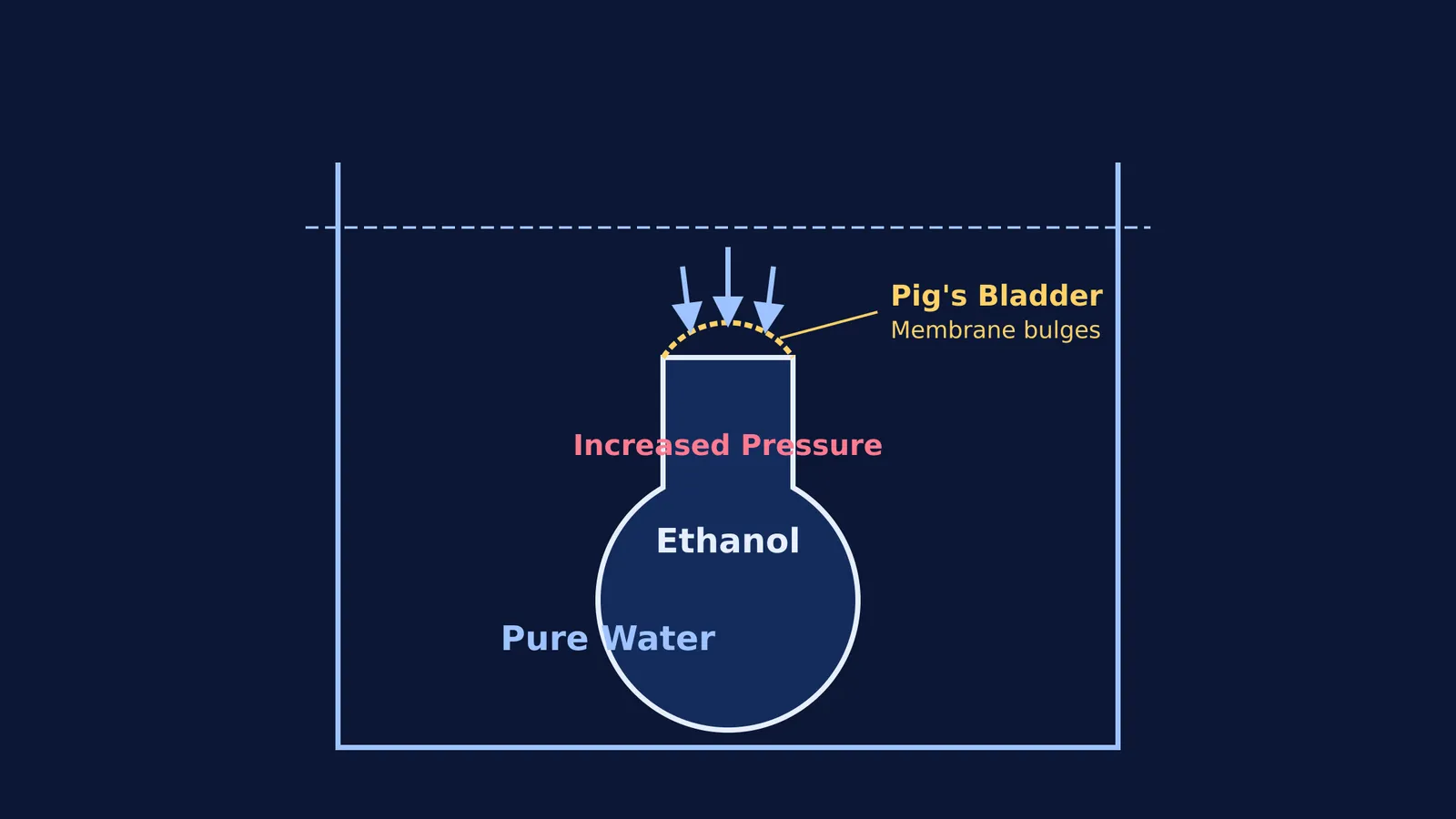
Nollet filled a glass flask with ethanol (then often called "spirits of wine") and sealed its mouth tightly with a piece of pig's bladder. He then submerged the sealed flask into a container of pure water.
According to his records, after five or six hours, the flat pig bladder began to bulge outwards, becoming noticeably convex. The pure water had passed through the natural membrane into the alcohol-filled flask, increasing the internal pressure. When Nollet pricked the swollen membrane with a needle, the built-up hydrostatic pressure caused the liquid to shoot out in a jet rising more than a foot into the air.
Without realising the full biological implications, Nollet had demonstrated that the pig's bladder was semipermeable. It allowed smaller water molecules to pass through easily while preventing the larger ethanol molecules from escaping at the same rate.
How does osmosis work in biological cells?
What Nollet observed with a pig's bladder is happening in your body right now. Every cell is wrapped in a phospholipid bilayer—a selectively permeable membrane that behaves just like Nollet's bladder.
Osmosis is a passive process. Solvent molecules move spontaneously from a region of high water potential (a lower solute concentration, like pure water) to a region of low water potential (a higher solute concentration, like ethanol or salty cytoplasm) in a drive to equalize concentrations. This creates osmotic pressure. In plants, the osmotic entry of water raises turgor pressure against the cell wall, which is what keeps leaves firm and stems upright.
If visualising how solvent molecules cross a membrane is difficult, the Simulation Lab provides interactive simulations for the ideas that are easier to see than to read. You can adjust solute concentrations on either side of a membrane and watch the net flow of water change in real time.
How do you calculate osmotic pressure?
To understand the immense forces Nollet witnessed, you can calculate osmotic pressure (π) using the formula π = iCRT.
Worked Example: Finding the pressure of a solution Imagine the ethanol solution in a flask had an effective concentration of 0.5 M (moles per litre) at a room temperature of 298 K (25 °C).
Identify the variables: Concentration (C) = 0.5 mol/L. Temperature (T) = 298 K. The ideal gas constant (R) is 0.0831 L·bar/(K·mol). For ethanol, the van 't Hoff factor (i) is 1, because it does not dissociate into ions.
Apply the formula: π = 1 × 0.5 × 0.0831 × 298
Calculate the result: π = 12.38 bar
A pressure of 12.38 bar is roughly 12 times normal atmospheric pressure. It is no wonder Nollet's pig bladder bulged outwards and produced a strong jet of liquid!
Why do we study osmotic pressure today?
The principles Nollet observed more than 270 years ago are now central to both biology and chemistry. Osmotic pressure is a colligative property, meaning it depends on the number of solute particles in a solution, not on their chemical identity.
Because it produces such a large and measurable physical force, osmotic pressure is incredibly useful. For instance, chemists rely on osmotic pressure to find the molar mass of large macromolecules like proteins and polymers. Decades after Nollet, Wilhelm Pfeffer and the first measurement of osmotic pressure built on this work by inventing highly selective synthetic membranes, turning a curiosity into a quantitative science.
If you get stuck on colligative properties or calculating concentrations, Fermi's AI tutor teaches rather than answers. It holds a line of reasoning across a whole session, notices where a student is stuck, and decides whether to explain, ask, or show.
Today, engineers even run the process in reverse. By applying a pressure greater than the natural osmotic pressure to a salty solution, they force water backward through a membrane, leaving the salt behind. This process, reverse osmosis, is how we desalinate seawater into clean drinking water worldwide—all thanks to a curious physicist and a pig's bladder.


