On this page
Through a school spectroscope, glowing hydrogen shows a few coloured lines: red, blue-green and violet. Hydrogen emits many more, but most lie outside the light your eyes detect. What decides it is the level the electron falls to.
Which wavelengths can the human eye see?
NASA Science states that the human eye can typically detect wavelengths from 380 to 700 nanometres (NASA Science: Visible Light). To compare it with energy levels, turn it into photon energy.
Photon energy is E = hc/λ, and with the CODATA 2022 values published by NIST, hc comes to 1239.84 eV nm (NIST: Planck constant in eV, NIST: speed of light). Rounded, that gives the exam shortcut: E in eV = 1240 / λ in nm.
Red edge: 1240 / 700 = 1.77 eV
Violet edge: 1240 / 380 = 3.26 eV
How do you find the wavelength range of each series?
Hydrogen's energy levels are E = −13.6/n² eV, where 13.6 eV is the Rydberg energy that NIST lists as 13.605693 eV (NIST: Rydberg constant times hc in eV). If the minus sign puzzles you, read why hydrogen's electron energy is negative first.
A drop from level n₂ down to level n₁ releases a photon of energy E = 13.6 × (1/n₁² − 1/n₂²) eV. Every series has two ends:
Longest wavelength: the smallest drop, from n₁ + 1 to n₁.
Shortest wavelength (series limit): the drop from very far away (n₂ → ∞), where E = 13.6/n₁².
Worked example, the first Balmer line (3 → 2): E = 13.6 × (1/4 − 1/9) = 13.6 × 5/36 = 1.89 eV. Then λ = 1240 / 1.89 = 656 nm. Red, inside the window. For the other end, see the series limit in the hydrogen spectrum.
Lyman, Balmer and Paschen: where does each series fall?
Both ends of each series, from the 13.6 eV Rydberg energy (NIST: Rydberg energy in eV) and hc = 1240 eV nm:
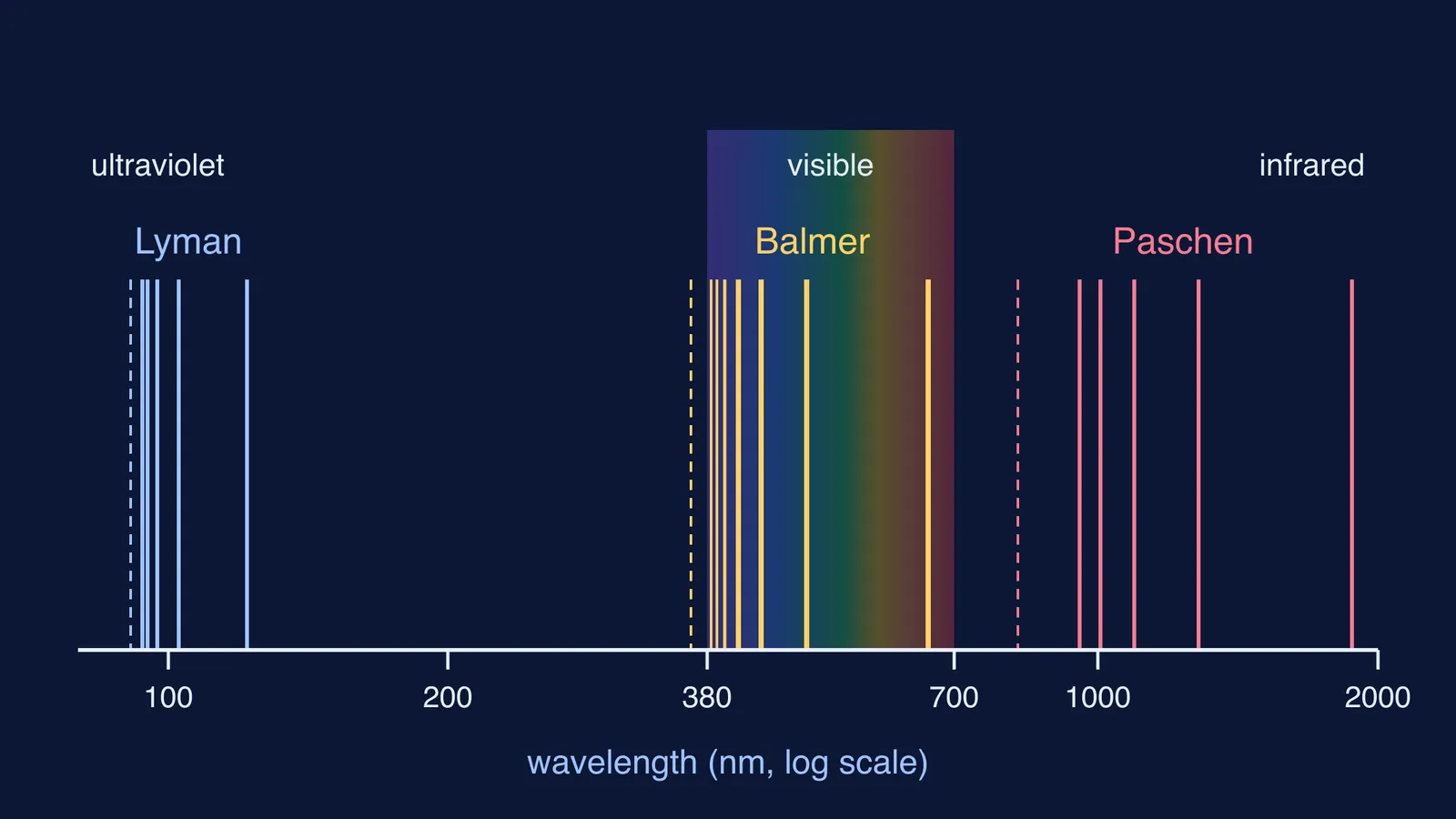
Lyman (down to n = 1): 10.20 eV (2 → 1, 121.6 nm) to 13.60 eV (limit, 91.2 nm). All ultraviolet.
Balmer (down to n = 2): 1.89 eV (3 → 2, 656.5 nm) to 3.40 eV (limit, 364.7 nm). Starts in the red, ends in the near ultraviolet.
Paschen (down to n = 3): 0.66 eV (4 → 3, 1875.6 nm) to 1.51 eV (limit, 820.6 nm). All infrared.
The four Balmer lines you see in a spectroscope, line by line:
3 → 2: 1.889 eV, 656.5 nm (red)
4 → 2: 2.550 eV, 486.3 nm (blue-green)
5 → 2: 2.856 eV, 434.2 nm (violet-blue)
6 → 2: 3.022 eV, 410.3 nm (violet)
These match the measured hydrogen wavelengths in NIST's Handbook of Basic Atomic Spectroscopic Data: 656.28, 486.13, 434.05 and 410.17 nm in air, with Lyman-alpha at 121.567 nm and Paschen-alpha at 1875.1 nm (NIST: hydrogen strong lines). The gaps, well under 1 nm, come from rounding, air-versus-vacuum wavelengths and details the simple model leaves out.
So why is only the Balmer series visible?
Set each series against the 1.77 to 3.26 eV window from NASA's 380 to 700 nm range (NASA Science: Visible Light):
Lyman is too energetic. Even its smallest drop, 2 → 1, gives 10.2 eV, more than three times the violet edge.
Paschen is too weak. Even its largest drop gives only 1.51 eV, below the 1.77 eV red edge. Series ending on n = 4 and above are weaker still.
Balmer straddles the window. Its range, 1.89 to 3.40 eV, overlaps 1.77 to 3.26 eV. The first lines sit inside it; the higher lines crowd towards 3.40 eV and slip past the violet edge.
So, precisely: Balmer is the only hydrogen series with visible lines, but not every Balmer line is visible. By the same formula, 9 → 2 gives 383.7 nm, just inside 380 nm; 10 → 2 gives 379.9 nm, just outside. As 380 nm is a typical limit, both are borderline.
How can you check any series in two minutes?
For any "visible, UV or IR?" question:
Write the window once: 1.77 to 3.26 eV (NASA: 380 to 700 nm).
For a series ending on n₁, find the smallest drop: 13.6 × (1/n₁² − 1/(n₁ + 1)²).
Find the series limit: 13.6/n₁².
If both numbers sit above 3.26 eV, the series is ultraviolet; if both sit below 1.77 eV, it is infrared; if the range overlaps the window, some lines are visible. Convert with λ = 1240/E, and keep λ in nm, not ångström.
If the 1/n² step is what slows you down, the Fermi Concept Library gives each concept in physics and chemistry its own lesson. For practice, the Fermi Problem Library has worked problems with a step-by-step solver that explains the reasoning rather than printing an answer.
Next, see why hydrogen has many spectral lines with only one electron.