On this page
A whistle on a string whirled in a horizontal circle is a common JEE Main and board-exam question. The trap is that the whistle's speed never changes, yet the pitch you hear rises and falls once per turn. The Doppler shift depends on direction, not just speed, and once you see that, the answer takes two lines.
What does a listener hear from a whistle rotated in a circle?
For a source moving straight towards a still listener, the heard frequency is f = f0·v/(v − u), and for a source moving straight away it is f = f0·v/(v + u), where v is the speed of sound and u the source's speed (OpenStax University Physics, Doppler effect).
A whirled whistle moves along a tangent, which usually points neither towards you nor away from you. What matters is the radial velocity, u cos θ, where θ is the angle between the source's velocity and the line from the source to the observer (Wikipedia, Doppler effect). So the general rule for a moving source and a still listener is f = f0·v/(v − u cos θ).
The speed u = ωr is fixed, so only cos θ changes around the circle, swinging between +1 and −1.
Where on the circle are the maximum and minimum frequencies emitted?
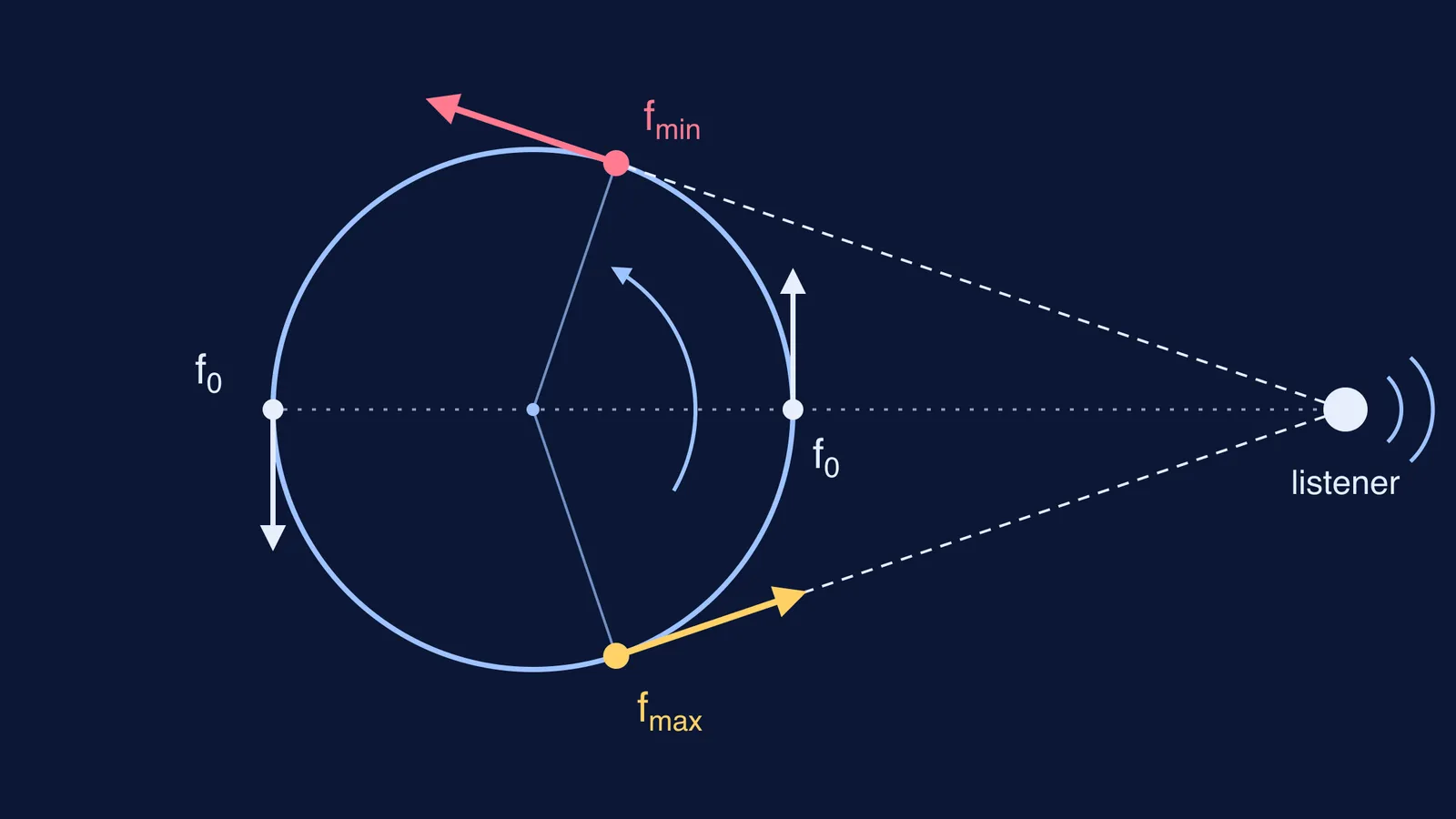
Picture the circle from above, with you standing some way off to one side.
Highest pitch: emitted where the whistle's velocity points straight at you (θ = 0). The line from you touches the circle there as a tangent, so these are the two points where your line of sight just grazes the circle. On one of them the whistle is coming towards you.
Lowest pitch: emitted at the other tangent point, where the velocity points straight away from you (θ = 180°).
No shift: at the points of the circle nearest to and farthest from you, the velocity is at right angles to your line of sight, so cos θ = 0 and you hear exactly f0.
If you are very far away, compared with the radius, the two tangent points sit at opposite ends of the diameter that is perpendicular to your line of sight. That is the usual textbook case.
Sound takes time to travel, so you hear the highest note a moment after the whistle passes that point, but it is emitted at the tangent point.
A worked example: 500 Hz whistle at 400 rpm
Say a whistle of frequency 500 Hz is tied to a string 1.2 m long and whirled at 400 revolutions per minute. Take the speed of sound in air at 20 °C as 343 m/s (OpenStax, Speed of sound).
Angular speed: 400 rev/min is 400/60 rev/s, so ω = 2π × 400/60 ≈ 41.9 rad/s.
Whistle speed: u = ωr = 41.9 × 1.2 ≈ 50.3 m/s.
Maximum: f = 500 × 343/(343 − 50.3) ≈ 586 Hz, emitted where the whistle heads straight at you.
Minimum: f = 500 × 343/(343 + 50.3) ≈ 436 Hz, emitted at the opposite tangent point.
Nearest and farthest points: 500 Hz exactly.
Notice the answers are not symmetric about 500 Hz. The rise is 86 Hz and the fall is 64 Hz, because u sits in the denominator. If an option shows about 500 ± 73 Hz, it came from the approximate formula f ≈ f0(1 ± u/v) and is a distractor.
How do you check the answer, or run it backwards?
Divide the two results: fmax/fmin = (v + u)/(v − u). Rearranged, u = v(fmax − fmin)/(fmax + fmin). With 586 and 436 Hz this gives about 50.3 m/s, matching step 2. Some papers give you the two heard frequencies and ask for the speed or rpm, and this one line does it.
A quick self-check list before you mark the answer:
Did you use ωr in m/s, not rpm?
Did you put u in the denominator (moving source), not the numerator (moving listener)?
Did you name the emission points as tangent points, not the nearest and farthest points?
Is your maximum above f0 by more than your minimum is below it?
If the source-versus-listener formula still trips you up, our explainer on why a moving source and a moving observer give different pitch works through it. The straight-line version of this problem is in train whistle Doppler shift as it passes, and the direction of the velocity on a circle is drawn out in which way velocity and acceleration point in circular motion.
Where to practise next
The same geometry turns up with a source on a rotating disc or a siren on a roundabout. The Fermi Problem Library has worked problems with a step-by-step solver that explains the reasoning rather than printing an answer, so you can see which velocity component goes into the formula at each step.
If the idea of a radial velocity component is still shaky, the Fermi Concept Library gives each physics concept its own lesson, so you can fix the gap before your next mock.