On this page
A YDSE question says the slits are made wider and asks what happens to the fringes. Most wrong answers come from mixing up two lengths: the slit width a (how wide each opening is) and the slit separation d (the distance between the two openings). They control different things.
Does fringe width change when slit width is increased?
No. For small angles, the mth bright fringe sits at y = mλD/d from the centre, as derived in OpenStax University Physics Volume 3, section 3.2. The gap between neighbouring bright fringes, the fringe width, is therefore λD/d.
Slit width a does not appear in that formula. Change λ, D or d and the fringes move; change a and every bright fringe stays where it was.
What does increasing slit width actually change?
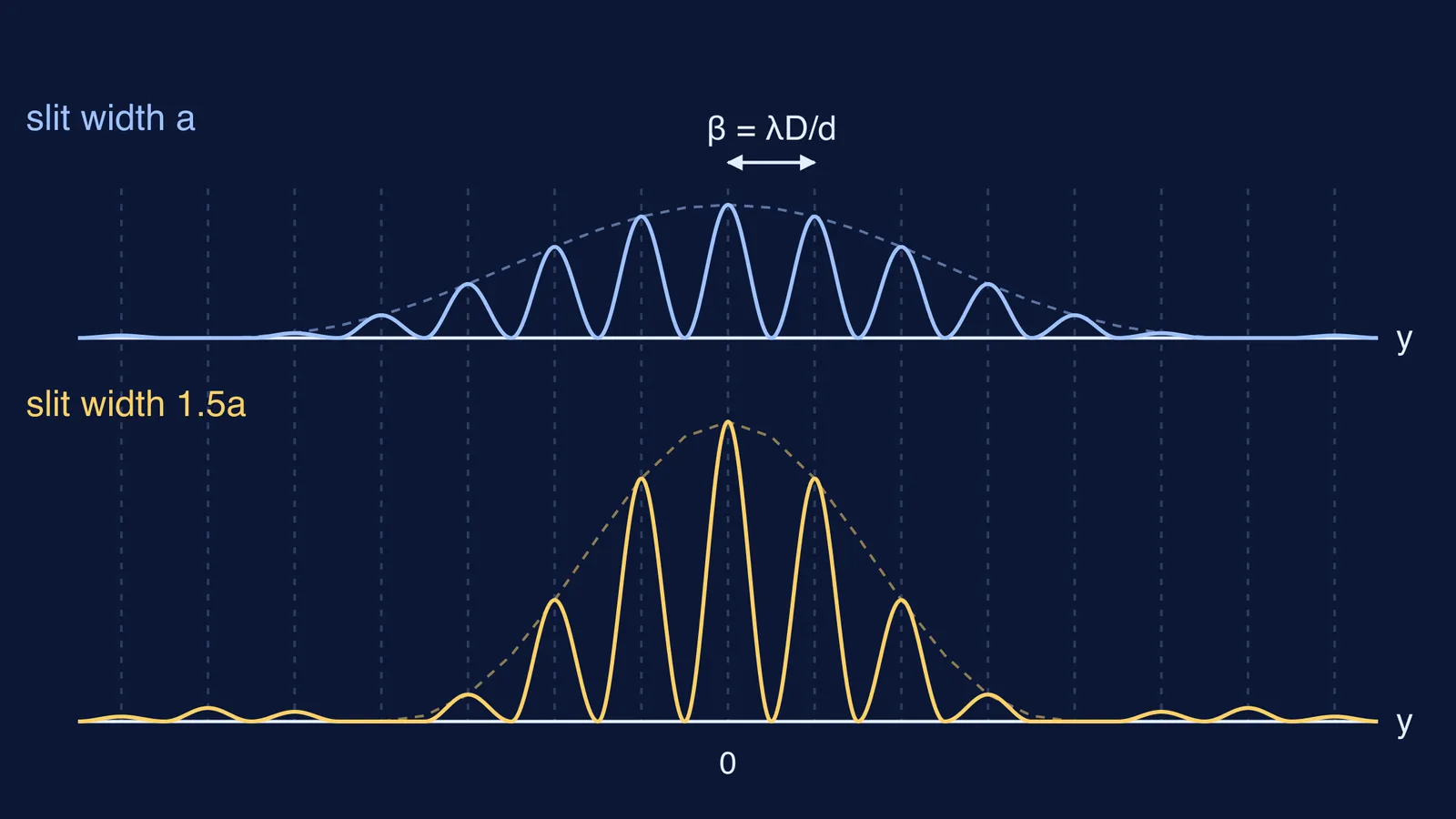
Each slit also diffracts light like a single slit. OpenStax describes the result this way: the pattern of two slits of width a separated by d is the interference pattern of two point sources separated by d multiplied by the diffraction pattern of a slit of width a (OpenStax, section 4.3). The single-slit part acts as an envelope over the fringes.
Widen both slits and three things happen:
More light passes through each opening, so the fringes get brighter.
The envelope narrows. Its first minimum is where a sin θ = λ, about λD/a from the centre, so a larger a pulls it inward.
Fewer fringes fit inside the central diffraction maximum, because the fringe width stays fixed while the envelope shrinks.
The worked example in OpenStax section 4.3 uses a = 0.020 mm, d = 0.20 mm and λ = 500 nm. The first diffraction minimum lines up with the m = 10 interference maximum, so the orders m = ±10 go missing and 19 bright fringes appear in the central peak. If you double a to 0.040 mm, the minimum falls at m = 5 and you would count 9. With D = 1 m, the fringe width is 500 nm × 1 m / 0.20 mm = 2.5 mm in both cases. For the general count, see why N = 2d/a fringes sit inside the central diffraction maximum.
Does a wider slit reduce fringe contrast?
It depends on which slit gets wider. Contrast, or visibility, is defined as V = (Imax − Imin)/(Imax + Imin), and for two fully coherent waves of intensities I1 and I2 it equals 2√(I1I2)/(I1 + I2), according to Wikipedia's article on interferometric visibility. V reaches 1 only when I1 = I2.
Both slits widened equally, ideal coherent light: I1 still equals I2, so dark fringes stay dark. Brighter, same contrast.
One slit widened: the intensities become unequal, Imin is no longer zero, and dark fringes turn grey.
The source slit widened: large sources without collimation give lower visibility, as the Wikipedia article on coherence) notes. The fringes blur and can wash out, but their spacing is still λD/d.
Real light is often only partially coherent. In a 2018 OSA Continuum study, Brett Pearson and colleagues measured Young's experiment with a partially coherent source and found their data agreed much more favourably with a model that includes slit width than with the standard theory that ignores it (Pearson et al., 2018).
Worked example: what if one slit is four times wider?
Say the slit widths are in the ratio 4:1 and the question takes intensity as proportional to width. Then I1 = 4I and I2 = I, so the amplitudes are in the ratio 2:1.
Bright fringe: Imax = (2 + 1)² I = 9I.
Dark fringe: Imin = (2 − 1)² I = I.
Imax : Imin = 9 : 1.
Visibility: (9 − 1)/(9 + 1) = 0.8, the same as 2√(4 × 1)/(4 + 1).
Fringe width: unchanged, λD/d.
Add amplitudes, then square; our explainer on intensity in interference from two coherent waves shows why. The extreme case, a slit closed completely, is covered in what happens in YDSE if one slit is covered.
Which MCQ traps should you check for?
Before you tick an option:
Wider slits, so wider fringes? No. Fringe width is λD/d and has no a in it.
Read carefully: distance between the slits increased means d is up, so fringe width goes down.
More a means fewer fringes inside the central diffraction maximum; more d means more.
If d/a is a whole number n, orders n, 2n and so on are missing.
Source slit and double slits are different openings. Widening the source slit lowers contrast but does not move the fringes.
For practice, the Fermi Problem Library has worked problems with a step-by-step solver that explains the reasoning rather than printing an answer. If the concept itself is shaky, the Fermi Concept Library gives every physics concept its own lesson and its place in the map.
Next time an option says the fringes got wider, check which length actually changed: a or d.