On this page
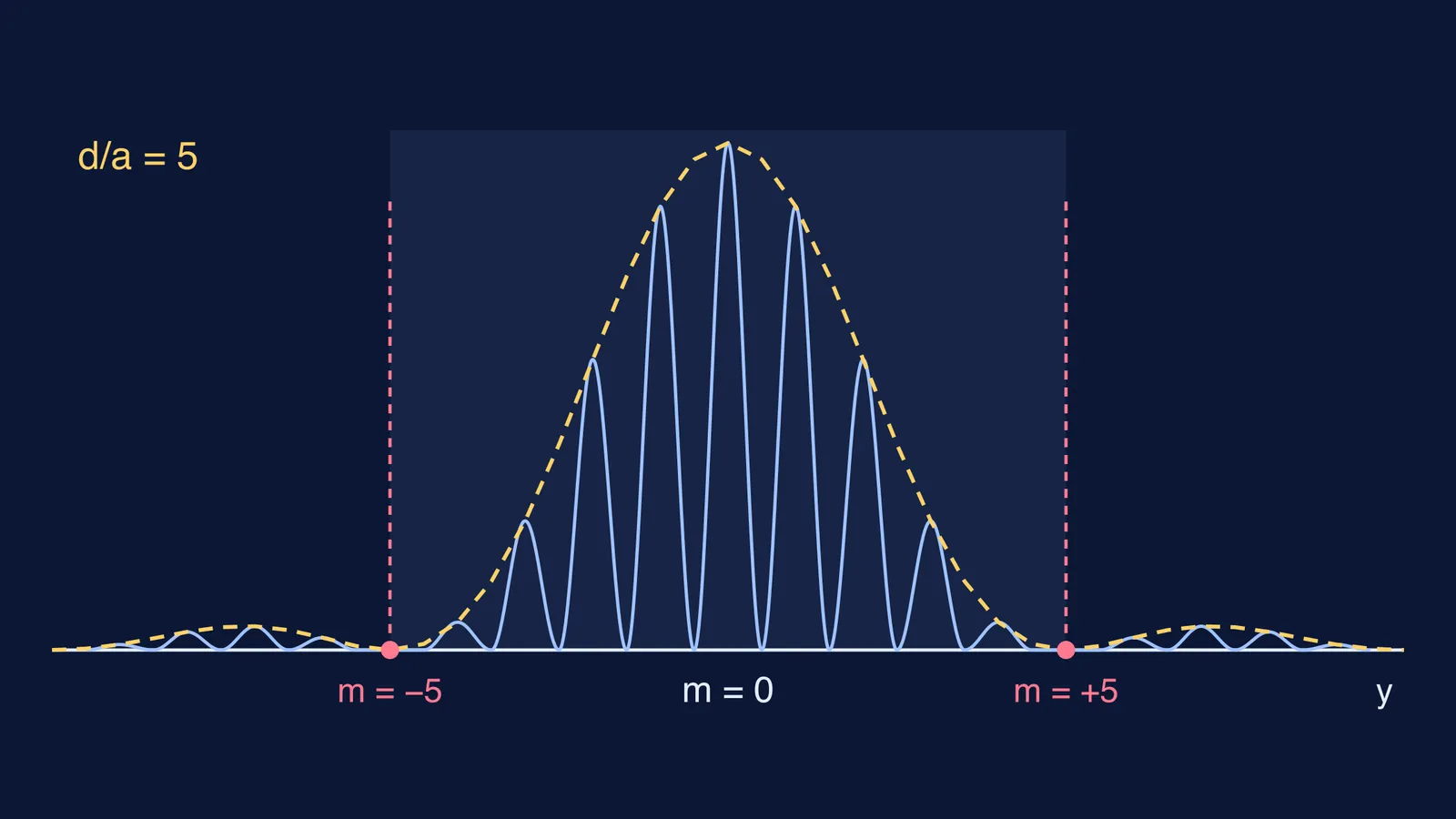
Shine light through two slits and you expect a row of evenly spaced bright fringes. In a real pattern they are not equally bright. They sit under a broad hump, and some vanish completely. That hump is the single-slit diffraction pattern of each slit, and it decides how many interference fringes you see.
Why does the single-slit envelope limit the double-slit pattern?
Each slit has a finite width a, so on its own it spreads light into a single-slit diffraction pattern. The two slits also interfere, which makes fine fringes set by the slit separation d. The double-slit pattern is the interference pattern multiplied by the single-slit factor (sin β/β)², where β = πa sin θ/λ, as OpenStax University Physics Volume 3 shows.
Two conditions do all the work:
Bright interference fringes appear where the path difference d sin θ equals mλ, with m = 0, ±1, ±2 and so on (OpenStax, Young's double-slit interference).
Single-slit dark points appear where a sin θ = nλ, with n = ±1, ±2 and so on (OpenStax, single-slit diffraction).
Because d is larger than a, the fringes are narrow and the diffraction hump is wide. The hump acts like a window: fringes inside the central maximum are bright, and fringes outside it are faint. Our explainer on the width of the central maximum in single-slit diffraction derives 2λD/a.
How many fringes fit inside the central diffraction maximum?
On a screen at distance D, with small angles, the central maximum runs between the first dark points on either side. Its width is 2λD/a. The interference fringe width is λD/d. Divide one by the other:
N = (2λD/a) ÷ (λD/d) = 2d/a
So the central diffraction maximum holds 2d/a fringe widths, whatever the wavelength or screen distance.
Now the detail that costs marks. At the edges of the central maximum, a sin θ = λ. If d/a is a whole number, the interference maximum of order m = d/a lands exactly on that diffraction zero, so it is missing. OpenStax puts the rule plainly: some maxima are missing "if the maximum of the interference is in the same direction as the minimum of the diffraction." In its example with d = 0.20 mm and a = 0.020 mm, so d/a = 10, the orders m = ±10 vanish and the central peak holds 19 bright fringes, not 20.
So check which count the question wants:
Number of fringe widths, often worded as "number of fringes": 2d/a.
Bright fringes strictly inside, when d/a is a whole number: 2d/a − 1.
Bright fringes when d/a is not a whole number: 2 × (whole-number part of d/a) + 1.
How do you solve a JEE-style numerical with missing orders?
Question. Light of wavelength 600 nm falls on two slits, each 0.030 mm wide, with centres 0.15 mm apart. The screen is 1.2 m away. Find the fringe width, the width of the central diffraction maximum, the bright fringes inside it, the missing orders and the relative intensity of the first-order fringe.
Fringe width: λD/d = (600 × 10⁻⁹ × 1.2) ÷ (0.15 × 10⁻³) = 4.8 mm.
Central maximum width: 2λD/a = (2 × 600 × 10⁻⁹ × 1.2) ÷ (0.030 × 10⁻³) = 48 mm.
Ratio: 48 ÷ 4.8 = 10, which matches 2d/a = 2 × 0.15 ÷ 0.030 = 10.
Missing orders: d/a = 5, so m = ±5, ±10, ±15 and so on vanish.
Bright fringes inside the central maximum: m = −4 to +4, which is 9, or 2d/a − 1.
Intensity of m = 1: β = πa sin θ/λ = πma/d = π/5. So I₁ = I₀ (sin 36° ÷ (π/5))² ≈ (0.588 ÷ 0.628)² ≈ 0.875 I₀.
The same steps give about 0.573 I₀ for m = 2, 0.255 I₀ for m = 3 and 0.055 I₀ for m = 4. Test your method on the OpenStax example with a = 2λ and d = 6λ: there β = π/3 for m = 1, and (sin 60° ÷ (π/3))² gives the book's 0.684 I₀.
What mistakes do students make with this question?
Swapping a and d. Slit width a sets the envelope; slit separation d sets the fringes.
Forgetting the missing orders at the edge and writing 2d/a when the question asks for bright fringes.
Halving the central maximum by accident. Its full width is 2λD/a; its half-width is λD/a.
If interference and diffraction still blur together, our post on the difference between interference and diffraction separates them. The Fermi Simulation Lab has interactive simulations for ideas that are easier to see than to read.
For more problems like this one, the Fermi Problem Library has worked problems with a step-by-step solver that explains the reasoning, so you can see where a missing-order count went wrong.