On this page
A bag, some balls, "three are drawn", and options that look like ⁿCᵣ pʳ qⁿ⁻ʳ. Before you reach for the binomial formula, check whether the question allows it. One phrase decides most cases: with or without replacement.
What are the four conditions for a binomial distribution?
The OpenStax textbook Introductory Statistics defines a binomial experiment by a fixed number of trials, only two outcomes per trial, and trials that are independent and repeated under identical conditions. The same page adds that on each trial the probability of success, p, and of failure, q, stay the same. Split that into four checks you can tick:
Fixed n. You know the number of trials before you start.
Two outcomes. Each trial is a success or a failure. You may merge outcomes, such as "a six" against "not a six".
Independent. One trial's result does not change another's.
Same p. The probability of success is identical on every trial.
OpenStax calls a single trial with two outcomes, run under these conditions, a Bernoulli trial. When all four checks pass, the number of successes X follows P(X = x) = ⁿCₓ pˣ (1 − p)ⁿ⁻ˣ, with mean np, as listed in the NIST/SEMATECH e-Handbook of Statistical Methods.
Is drawing without replacement a binomial distribution?
No, because conditions 3 and 4 fail together. OpenStax works through a committee of ten staff and six students, with two names drawn without replacement: the chance of a student on the first draw is 6/16, but on the second it is 5/15 or 6/15 depending on who came out first (OpenStax, Example 4.16). The second draw depends on the first, and p has moved.
The right model is the hypergeometric distribution, which gives the probability of k successes in n draws without replacement from a population of N items that contains K successes (hypergeometric distribution). Its formula, P(X = k) = ᴷCₖ × ᴺ⁻ᴷCₙ₋ₖ ÷ ᴺCₙ, is the combination counting you already use for card problems.
Five exam scenarios: binomial or not?
Run each one through the four checks.
Guessing 10 MCQs with four options each, counting correct answers. n = 10, right or wrong, each guess independent, p = 1/4 every time. Binomial. P(exactly 3 right) = ¹⁰C₃ (0.25)³ (0.75)⁷ ≈ 0.250.
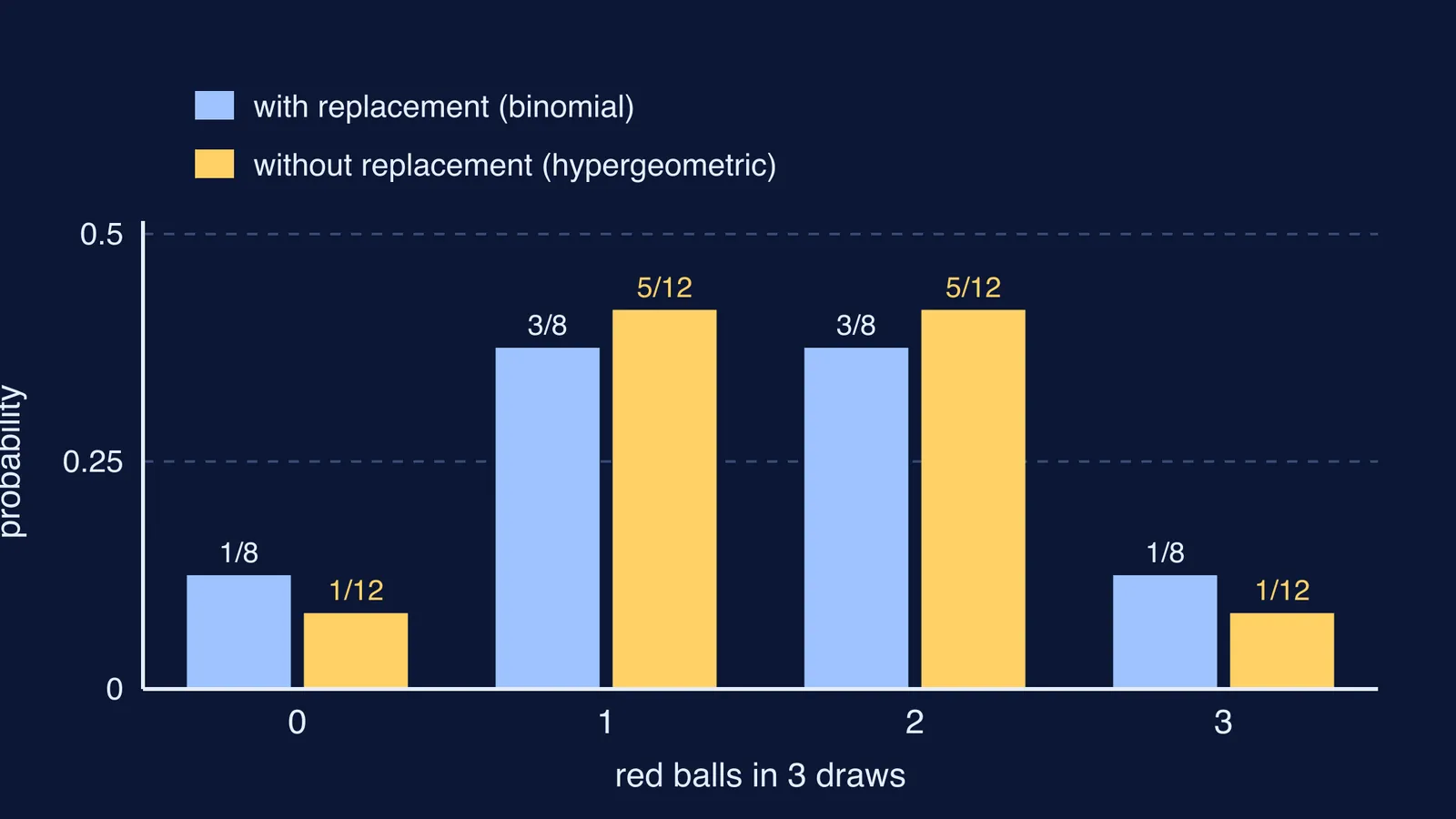
A bag of 5 red and 5 black balls; draw 3 without replacement and count red. p changes after every draw. Not binomial. P(all 3 red) = ⁵C₃ ÷ ¹⁰C₃ = 10/120 = 1/12.
The same bag, but each ball goes back before the next draw. The bag resets, so p = 1/2 on every draw. Binomial. P(all 3 red) = (1/2)³ = 1/8, which is 1.5 times the answer to scenario 2.
Roll a die until the first six and count the rolls. Two outcomes, independent rolls, p = 1/6 each time, but n is not fixed: the number of rolls is the thing you are counting. Not binomial. OpenStax treats this as a geometric distribution.
A batch of 10,000 bulbs, 500 of them faulty; test 10 without replacement and count faulty ones. Strictly hypergeometric. But 10 bulbs is 0.1% of the batch, far under the rule of thumb that sampling without replacement behaves like sampling with replacement when the sample is no more than 5% of the population (Freie Universität Berlin, SOGA). Binomial with p = 0.05 gives P(none faulty) = 0.95¹⁰ ≈ 0.5987; the exact count gives about 0.5986.
When is binomial the wrong model? A checklist
Before you write ⁿCₓ pˣ qⁿ⁻ˣ, ask:
Is the number of trials fixed in advance? "Until the first six" means no.
Do only two outcomes matter? Tracking red, blue and green separately needs a different model.
Are you drawing without replacement from a small group? If the sample is over about 5% of the group (SOGA rule of thumb), count with combinations.
Does p drift? A student whose chance of solving rises with each mock test is not repeating identical trials.
Watch the wording: "without replacement", "one after another", "drawn together" and "until" are warning signs. Three balls drawn together is the same as three drawn one by one without replacement.
How do you practise spotting the right model?
Take five problems from your probability chapter. Before solving, write one line for each: n, p, and which check could fail. Then solve. Next, read our posts on with and without replacement problems compared, why the binomial mean and variance are np and npq, and the 1 − qⁿ shortcut for at least one success.
If the gap is in the idea itself, such as what independence means, the Fermi Concept Library has a lesson for every concept in mathematics, each with its place in the map. If your answer keeps missing the key, the Fermi Problem Library has worked problems with a step-by-step solver that explains the reasoning rather than printing an answer.