On this page
Picture a small stone tied to a string, whirled in a horizontal circle. Freeze the motion and draw two arrows on the stone: one for velocity, one for acceleration. Then decide what happens the moment the string snaps. The first arrow is usually the easy one; the other two questions are where predictions tend to go wrong.
Below are three cases. Make each prediction before reading the answer.
What direction is velocity in circular motion?
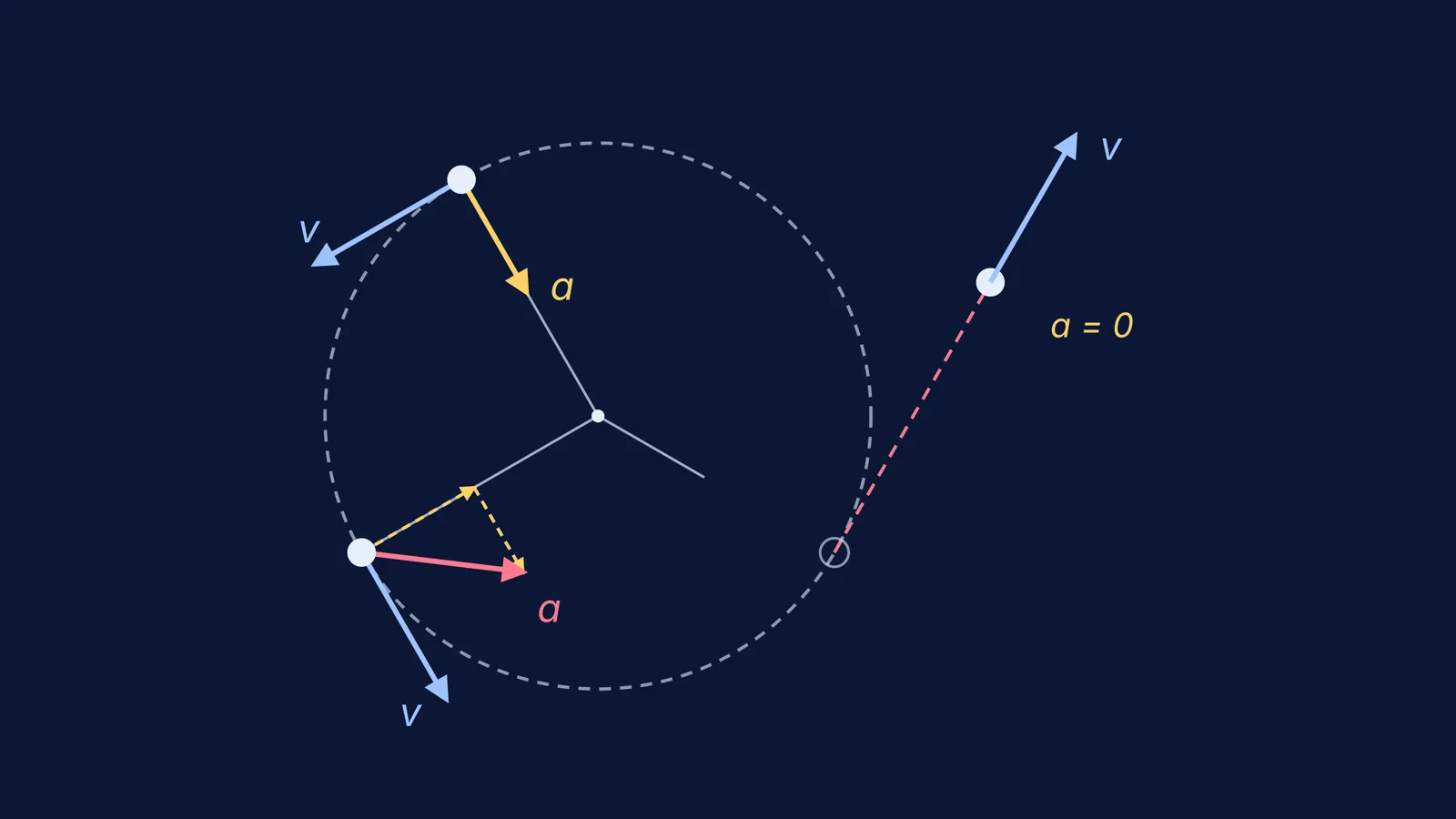
Velocity is always tangent to the circle at the point where the object is. OpenStax University Physics, section 4.4 shows that the velocity vector is perpendicular to the position vector, so it lies along the tangent. This holds whether the speed is constant, rising or falling.
What direction is acceleration in circular motion at constant speed?
Prediction 1: the stone moves at a steady speed. Is there any acceleration? If so, which way does it point?
There is, and it points to the centre. Uniform circular motion is motion in a circle at constant speed, and its acceleration is directed toward the centre with magnitude a = v²/r, according to OpenStax University Physics.
The reason is that acceleration measures change in velocity, and velocity is a vector. The speed stays the same, but the direction keeps turning, so the velocity keeps changing. At constant speed the two arrows stay at 90°, so the acceleration has no part along the motion to change the speed.
What changes when the speed is increasing?
Prediction 2: now the stone is being swung faster and faster. Does the acceleration arrow still point at the centre?
No. It now has two parts. OpenStax describes the total acceleration in this case as the vector sum of the centripetal acceleration (toward the centre) and a tangential acceleration (along the line of motion), and the two parts are perpendicular, in the same OpenStax section.
So when speed is increasing, the acceleration arrow tilts forward, between the centre and the direction of motion. When speed is decreasing, the tangential part points backwards, and the arrow tilts behind the radius instead.
Worked example: a stone moves in a circle of radius 0.5 m. At one instant its speed is 2 m/s, and its speed is increasing at 6 m/s².
Centripetal part: a_c = v²/r = (2)²/0.5 = 8 m/s², toward the centre.
Tangential part: a_t = 6 m/s², along the velocity.
These are perpendicular, so the total is √(8² + 6²) = √100 = 10 m/s².
Direction: tan θ = 6/8, so θ ≈ 37° measured from the radius, tilted forward toward the direction of motion.
Keep the two jobs separate: one part turns the velocity, the other changes its size. For more problems of this type, see our guide to tangential and radial acceleration in non-uniform circular motion.
What happens when the string is cut?
Prediction 3: the string snaps at the instant the stone is at the right of the circle, moving upward on your page. Sketch its path for the next second, seen from above.
The stone flies off along the tangent, in a straight line. It does not fly radially outward, and it does not keep curving. With the string gone there is no inward force, so the inward acceleration drops to zero and the velocity stays what it was at that instant (ignoring gravity and air drag). OpenStax makes the same point about a merry-go-round: without hanging on, you would go in a straight line, right off it, in keeping with Newton's first law (OpenStax University Physics, section 6.3).
If you drew a curved path, you are in good company. In a 1980 study in Science, Michael McCloskey, Alfonso Caramazza and Bert Green asked university students to draw the path a moving object would follow in several situations; over half, including many who had taken physics courses, showed striking misconceptions, and many believed objects would keep moving in curved paths even with no external force. Questions like this also appear in the Force Concept Inventory, which we cover in common misconceptions about force.
How do you check your predictions?
Use this three-row check on any circular-motion question before you write equations.
Constant speed: velocity along the tangent; acceleration toward the centre; the two at 90°.
Speeding up or slowing down: velocity along the tangent; acceleration tilted forward (speeding up) or backward (slowing down) from the radius; find its size with Pythagoras.
Inward force removed: acceleration zero (ignoring gravity); motion continues in a straight line along the last tangent.
Arrows are easier to trust once you have watched them move. The Fermi Simulation Lab has interactive simulations for the ideas that are easier to see than to read, so you can test predictions like these against the motion. For the same habit on another topic, try learning projectile motion with a simulation.
Tonight, draw the arrows for one case on paper, then check them against the motion.