On this page
Two cousins sit on the same balcony; one goes inside covered in bites, the other untouched. A female mosquito (only females drink blood, as we explain in why only female mosquitoes bite) uses several senses to find a host, and some people send a much stronger signal than others.
How do mosquitoes find you in the first place?
A hungry mosquito combines three kinds of cue: carbon dioxide from your breath, heat from your body and chemicals from your skin.
Carbon dioxide acts like a switch. In a 2014 study in the journal Cell, researchers bred Aedes aegypti mosquitoes without Gr3, one part of their carbon dioxide receptor. These mutants did not respond to carbon dioxide and also lost the carbon dioxide-triggered response to heat and lactic acid (a chemical humans give off). Yet in a large semi-field test they were only slightly worse at finding people; the authors suggest heat and odour working together were likely enough.
Heat is tuned to you, not just to warmth. A 2015 eLife study found that host-seeking Aedes aegypti are most attracted to temperatures close to human body temperature and avoid things hotter than that. Mosquitoes lacking a heat-sensing channel called TRPA1 could not tell a target at body temperature from a hotter one.
Everyone breathes and everyone is warm, so researchers have looked hard at smell to explain why one person gets bitten far more than another.
Why do mosquitoes bite some people more than others?
The clearest answer so far comes from a 2022 study in Cell led by Maria Elena De Obaldia and Leslie Vosshall at Rockefeller University. Volunteers wore nylon stockings on their forearms for six hours a day, and Aedes aegypti mosquitoes were then offered a choice between two people's stockings, according to the university's release.
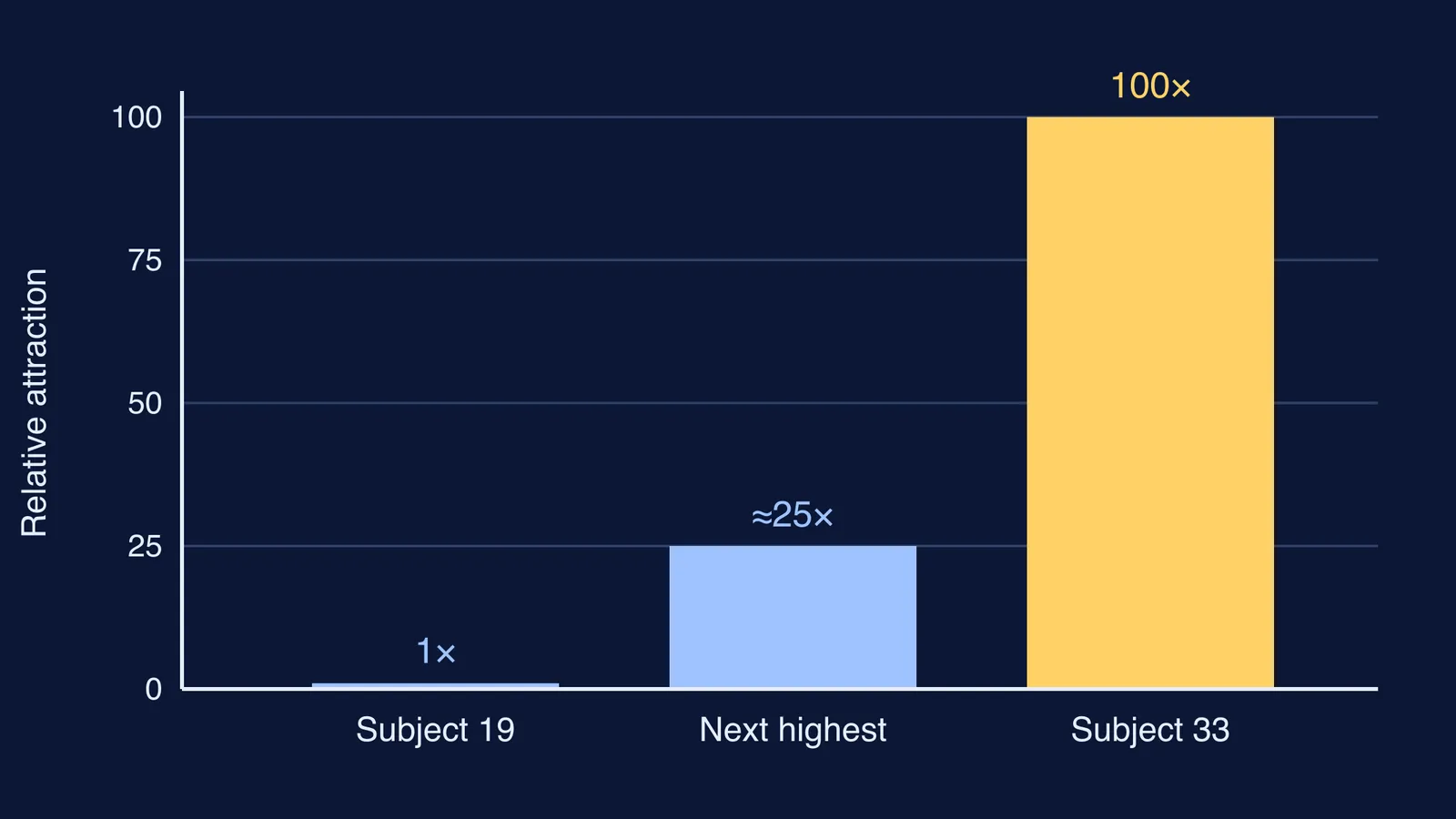
The most attractive volunteer, Subject 33, was 4 times more attractive than the next most attractive person and 100 times more attractive than the least attractive, Subject 19 (Rockefeller University).
The differences were stable over several years: a mosquito magnet stayed a mosquito magnet. Chemical analysis showed that highly attractive people produced significantly more carboxylic acids in their skin emanations (Cell, 2022).
Carboxylic acids are organic compounds that carry a -COOH group; the ones in this study are found in sebum, the oily coating that skin bacteria use to make each person's body odour (Rockefeller University).
Mosquitoes bred without the smell co-receptors Ir8a, Ir25a or Ir76b were badly impaired at finding human scent, yet could still tell strong and weak attractors apart (Cell, 2022). Mosquitoes lacking another co-receptor, Orco, also stayed attracted to people and could still tell mosquito magnets from low attractors (Rockefeller University).
If carboxylic acids are new to you, the Fermi Concept Library has a lesson on every concept in chemistry and biology.
Is being a mosquito magnet in your genes?
Partly. A 2015 twin study in PLOS ONE offered Aedes aegypti hand odours from twins: identical twins were closely matched in how attractive they were, while non-identical twins were matched significantly less closely.
The study estimated a strong narrow-sense heritability of 0.62 for relative attraction, a sign that genes account for a sizeable part of the differences between people (PLOS ONE, 2015).
Your skin bacteria matter too. A 2011 PLOS ONE study on the malaria mosquito Anopheles gambiae found that people who were highly attractive had more bacteria on their skin but a less diverse mix than people who were poorly attractive.
What can you actually do about it?
You cannot stop sending the signal, so stop it turning into a bite:
Carbon dioxide: you cannot stop breathing, so put a barrier between you and the mosquito. Window screens and a bed net help, and the WHO dengue fact sheet recommends nets if you sleep during the day.
Body heat: you cannot change it, so cover it. WHO advises clothes that cover as much of the body as possible.
Skin odour: mostly fixed. Changing skin bacteria through diet has not been tested, the Rockefeller team says, so skip food tricks; WHO lists repellents containing DEET, picaridin or IR3535.
Timing: WHO notes that the mosquitoes that spread dengue are active during the day, so protection is not only a night-time job.
Breeding sites: WHO advises covering, emptying and cleaning household water containers every week. Here is why desert coolers breed dengue mosquitoes.
How would you test this yourself, without getting bitten?
Here is the 2022 design as a fair-test plan you can write up for a project:
Variable: whose odour is offered (a worn stocking, not a person).
Controls: same mosquitoes, room and time of day, with two samples side by side.
Repeats: test the same people on different days; one test proves little.
Worked check: in the study, Subject 33 scored 100 times Subject 19 and 4 times the runner-up. If those ratios combine simply, the runner-up scored about 100 / 4 = 25 times Subject 19.
Scent drifting through the air is easier to see than to read about; the Fermi Simulation Lab has interactive simulations for ideas like this. And if you have already been bitten, read why mosquito bites itch.