On this page
In a survey of homes in Delhi, researchers checked 3,240 desert coolers and found young *Aedes aegypti*, the mosquito that spreads dengue, in 145 of them (Prasad et al., Epidemiology and Health, 2023). That is roughly one cooler in every 22. The fix is a weekly habit, and the reason it has to be weekly comes straight from the mosquito's biology.
Why do dengue mosquitoes breed in air coolers?
*Aedes* is a container breeder that needs stagnant fresh water in and around homes, according to India's National Center for Vector Borne Diseases Control (NCVBDC) guidelines. The same guidelines list household water containers and coolers among its breeding sites. A cooler tank suits it well: still water, shade, and nobody looks inside for days.
The female does not drop eggs into the water. She lays them singly on damp surfaces just above the waterline, says the NCVBDC. *Aedes* eggs can survive drying out for up to 8 months, according to the US Centers for Disease Control and Prevention. When the tank is refilled and the water reaches them, they can hatch.
In the Delhi study, coolers made up 12.1% of all water-holding containers checked, and their breeding preference ratio was 2.07; a value above 1 means mosquitoes found that container type more attractive than the others (Prasad et al., 2023).
How fast does an Aedes mosquito go from egg to adult?
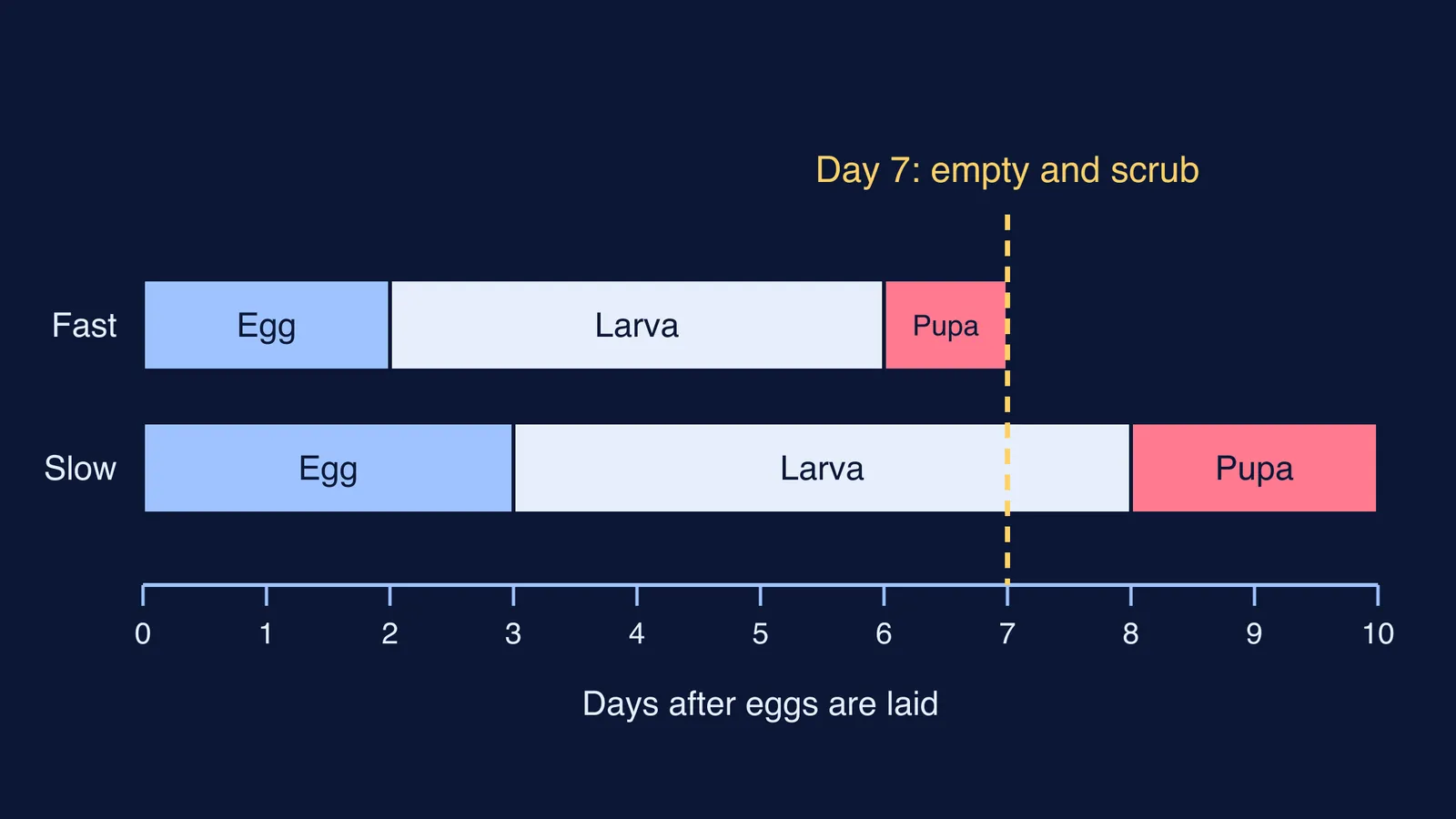
The Health Ministry's Handbook on Prevention and Control of Dengue in School (2019) gives the timings stage by stage:
Egg: hatches into a larva in 2-3 days.
Larva: four larval stages lasting 4-5 days in total.
Pupa: a non-feeding stage that becomes an adult in about 1-2 days.
Adult: rests on the container wall until its wings harden, and females seek a blood meal about 24 hours after emerging.
The handbook's conclusion is direct: *Aedes* completes its life cycle from egg to adult in one week, so premises need checking every week. The CDC gives a range of 7-10 days.
What does a seven-day deadline look like at home?
Say a mosquito lays eggs on the tank wall on Sunday. On the fastest timings in the Health Ministry handbook, the eggs hatch by Tuesday (2 days), the larvae feed until Saturday (4 days), and the pupae can turn into flying adults by the next Sunday (1 day). If you empty and scrub the cooler every Sunday, you reach the tank just as the fastest batch could emerge. Skip one week and that batch is already flying, and its females may soon be laying the next batch. Pick a fixed day, and never let the gap stretch past seven days.
How should you clean a cooler every week?
The handbook's rule is to empty, scrub and dry coolers every week before refilling. A simple routine:
Switch off and unplug the cooler before touching the water.
Drain the tank completely onto open ground or into a drain, not into another bucket.
Scrub the inside walls with a brush or rough cloth, especially the band just above the old waterline.
Let the tank dry, or wipe it dry, before you refill it.
While you are there, change the water in flower vases, plant pots and bird baths too, which the handbook also asks for every week.
Before summer starts, the handbook adds two more steps: paint the inside of the cooler before use, and do not reuse last season's cooler grass.
Why does one cooler matter for the whole street?
*Aedes* bites during the daytime, the school handbook notes, and most of these mosquitoes stay within 100 metres of where they emerged, according to the NCVBDC hospital guidelines. The mosquitoes from your cooler mostly bite your family and your neighbours.
India recorded 233,519 dengue cases in 2024, according to NCVBDC's dengue data. Worldwide, the World Health Organization says over 14.6 million cases were reported in 2024, and advises covering, emptying and cleaning household water storage containers every week.
How can a student turn this into a biology lesson?
This is the life cycle from your textbook, with a deadline. If the four stages still feel abstract, start with our walk-through of the mosquito life cycle from egg to adult, then read which mosquito spreads malaria, dengue and filariasis to see why a vector matters as much as the virus.
A timeline is easier to see than to read. The Fermi Simulation Lab has interactive simulations for ideas like that, and the Fermi Concept Library gives each biology concept its own lesson and its place in the map, so you can follow vectors and disease from one idea to the next.
This Sunday, set a phone reminder, unplug the cooler, and scrub that line above the water.