

On this page
On a warm evening anywhere in India, every mosquito that bites your arm is female. Male mosquitoes hover over garden plants, sipping nectar. They never pierce human skin, never draw blood, and never transmit pathogens.
For students preparing for NEET-UG, this sexual dimorphism is not just natural history trivia. It connects insect morphology directly to cellular biochemistry and vector disease control.
Why do female mosquitoes need blood to reproduce?
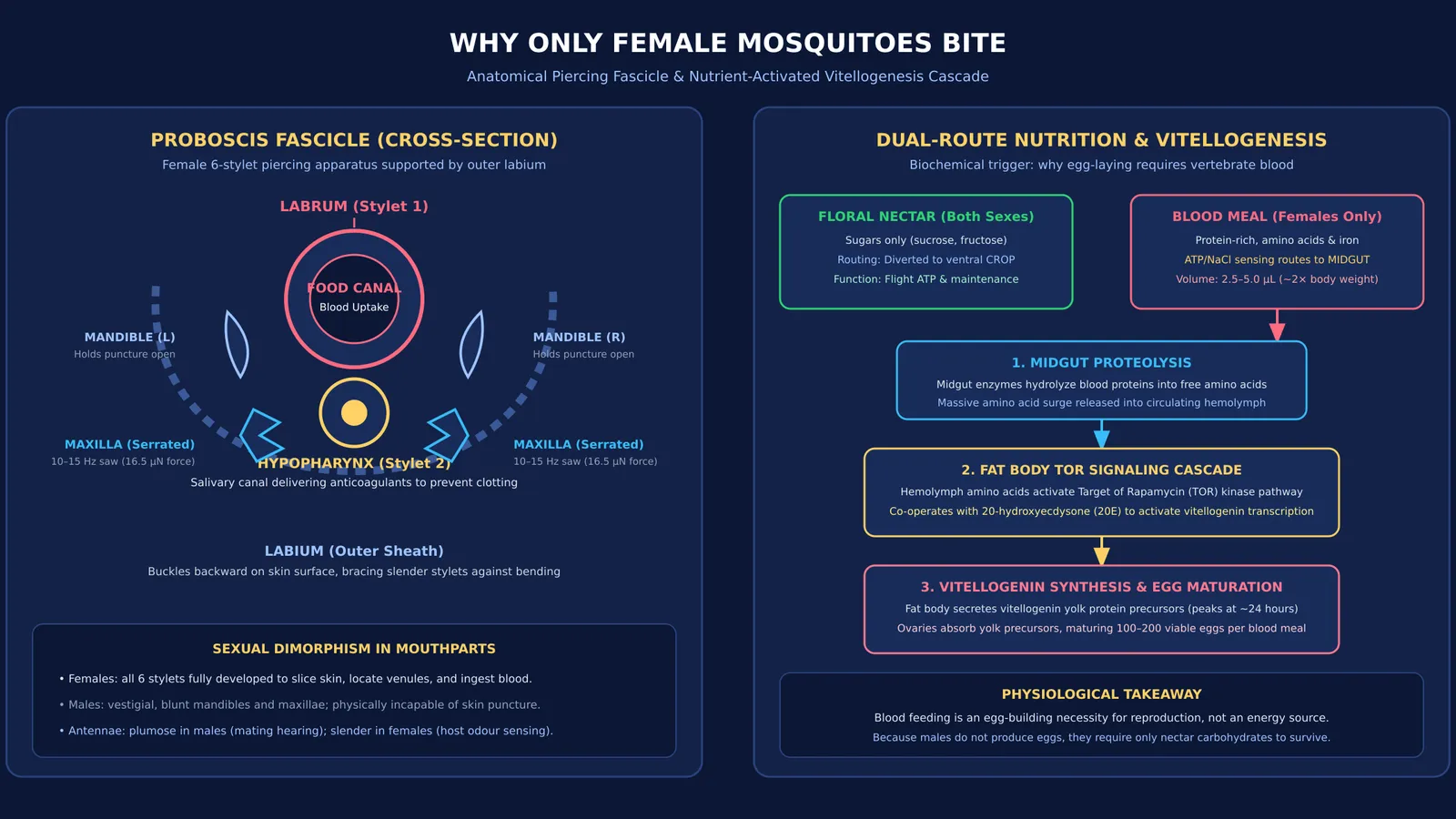
Most mosquito species are anautogenous, meaning females cannot produce viable eggs without a vertebrate blood meal. While adult mosquitoes of both sexes feed on floral nectar for flight energy, nectar is almost entirely sugar and water, containing virtually no protein.
Egg development requires vitellogenin, the primary yolk protein precursor. A study in the *Proceedings of the National Academy of Sciences* by Immo A. Hansen and colleagues showed that digesting blood releases amino acids into the hemolymph. These amino acids activate the Target of Rapamycin (TOR) signaling pathway in the fat body. Working alongside the steroid hormone 20-hydroxyecdysone, TOR stimulates vitellogenin gene transcription. Because males do not lay eggs, they have no biological need for this protein surge.
How do female and male mosquito mouthparts differ?
This behavioural divide stems from head anatomy. As documented in *Physical Review E* by Xiangqing Kong and Chengwei Wu, a female's proboscis houses six piercing stylets bundled into a fascicle and protected by an outer labium. Their biomechanical measurements showed that a female penetrates skin with an average force of only 16.5 μN. Her two serrated maxillae oscillate like microsaws at 10 to 15 Hz to slice through tissue, while two mandibles hold the puncture open. The labium buckles backward on the skin surface, bracing the slender stylets against bending. Blood flows up the central labrum, while the hypopharynx pumps saliva containing anticoagulants to prevent clotting.
Male mosquitoes possess vestigial mandibles and maxillae, leaving them physically unable to pierce skin. They use a blunt proboscis to sip nectar. Males also have bushy, plumose antennae to detect female wingbeats, whereas females have slender antennae tuned to carbon dioxide and host odors.
What happens to blood inside the mosquito's body?
Mosquitoes do not swallow nectar and blood into the same internal chamber.
A study in *Neuron* led by Veronica Jové and colleagues found that sensory neurons inside the female stylet recognize blood by tasting ATP, sodium chloride, and bicarbonate. Tasting ATP flips an internal switch. Nectar is diverted to the crop for gradual flight energy, while blood bypasses the crop and enters the midgut directly.
A female *Aedes aegypti* ingests 2.5 to 5.0 microlitres of blood in one feeding, as quantified in the *Journal of Medical Entomology* by Rui-De Xue and colleagues. This meal weighs roughly twice her unfed body weight. Within 48 to 72 hours, midgut enzymes complete protein digestion, the fat body synthesizes vitellogenin, and the ovaries mature 100 to 200 eggs.
Why does this sex difference matter for disease control?
Because only females take blood meals, vector-borne pathogens are transmitted exclusively by female mosquitoes during their gonotrophic cycles:
Female *Anopheles* mosquitoes transmit *Plasmodium*, as detailed in our guide to the Plasmodium life cycle in malaria and its discovery by Ronald Ross tracing malaria transmission to mosquitoes.
Female *Aedes* mosquitoes spread dengue, chikungunya, and Zika viruses.
Female *Culex* mosquitoes transmit filarial worms and Japanese encephalitis virus, linking to concepts of human health, pathogens, and immunity.
Modern vector control exploits this dimorphism. In the Sterile Insect Technique and *Wolbachia*-based programs, laboratories rear and release only male mosquitoes. A field study in *Nature* by Xiaoying Zheng and colleagues showed that releasing sterile, *Wolbachia*-infected males in Guangzhou reduced wild female populations by 83% to 94%. Releasing millions of non-biting males poses zero biting nuisance and zero disease risk to humans.
How do biology exams test mosquito vector concepts?
Examiners frequently test the functional logic behind disease vectors. When tackling vector questions, follow this diagnostic checklist:
Match genus to pathogen: pair *Anopheles* with malaria, *Aedes* with dengue and chikungunya, and *Culex* with filariasis.
Verify host status: the female mosquito is the definitive host for *Plasmodium* because sexual reproduction occurs in its gut; humans are intermediate hosts.
Trace internal routing: nectar enters the crop for flight ATP, whereas blood enters the midgut for vitellogenesis.
Track the incubation path: ingested pathogens must breach the midgut wall and reach salivary glands before transmission can occur.
The Fermi Concept Library covers every concept in physics, chemistry, biology, mathematics and computing, each with its own lesson and its place in the map. To practice applying these ideas, the Fermi Problem Library provides worked problems with a step-by-step solver that explains the reasoning rather than just printing an answer.


