

On this page
When a female mosquito bites, she injects saliva containing specialized enzymes and anticoagulants to disable platelets and block the blood clotting cascade (Peng and Simons, 2004). The resulting swollen bump and sharp itch are not mechanical injuries from the puncture. Instead, they are the hallmarks of a localized allergic response mounted by your immune system against foreign proteins in that saliva.
What happens under your skin when a mosquito bites?
Mosquito saliva contains more than 20 distinct proteins, including apyrases, vasodilators, and odorant-binding D7 proteins (Peng and Simons, 2004). While these proteins help the insect feed by widening capillaries and preventing clotting, your immune system identifies them as foreign antigens.
Skin-resident mast cells sit clustered along dermal microvessels. In anyone previously exposed to bites, the immune system has already manufactured specific Immunoglobulin E (IgE) antibodies that bind to high-affinity receptors on these mast cells (Peng and Simons, 2004).
When injected salivary antigens cross-link adjacent IgE antibodies on the mast cell surface, the cell membrane destabilises within seconds. Laboratory models confirm that mosquito bites rapidly trigger cutaneous mast cell degranulation, causing vascular leakage and fluid extravasation (Demeure et al., 2005).
Why does your immune system release histamine?
Mast cell degranulation pours chemical mediators into surrounding tissue, chief among them histamine. Histamine acts through two primary pathways:
Vascular permeability and swelling: Histamine binds to H1 receptors on endothelial cells lining local capillaries, causing cells to contract and widen intercellular gaps. Fluid seeps into the dermal tissue space, forming a pale, raised wheal. Simultaneously, arteriolar dilation increases local blood flow, creating the surrounding red flare.
Nerve stimulation and itching: Histamine binds to H1 receptors on pruriceptive C-fibre sensory nerve endings in the skin (Vander Does, Labib, and Yosipovitch, 2022). These nerve endings fire impulses through the spinal cord to the brain, registering an acute itch sensation.
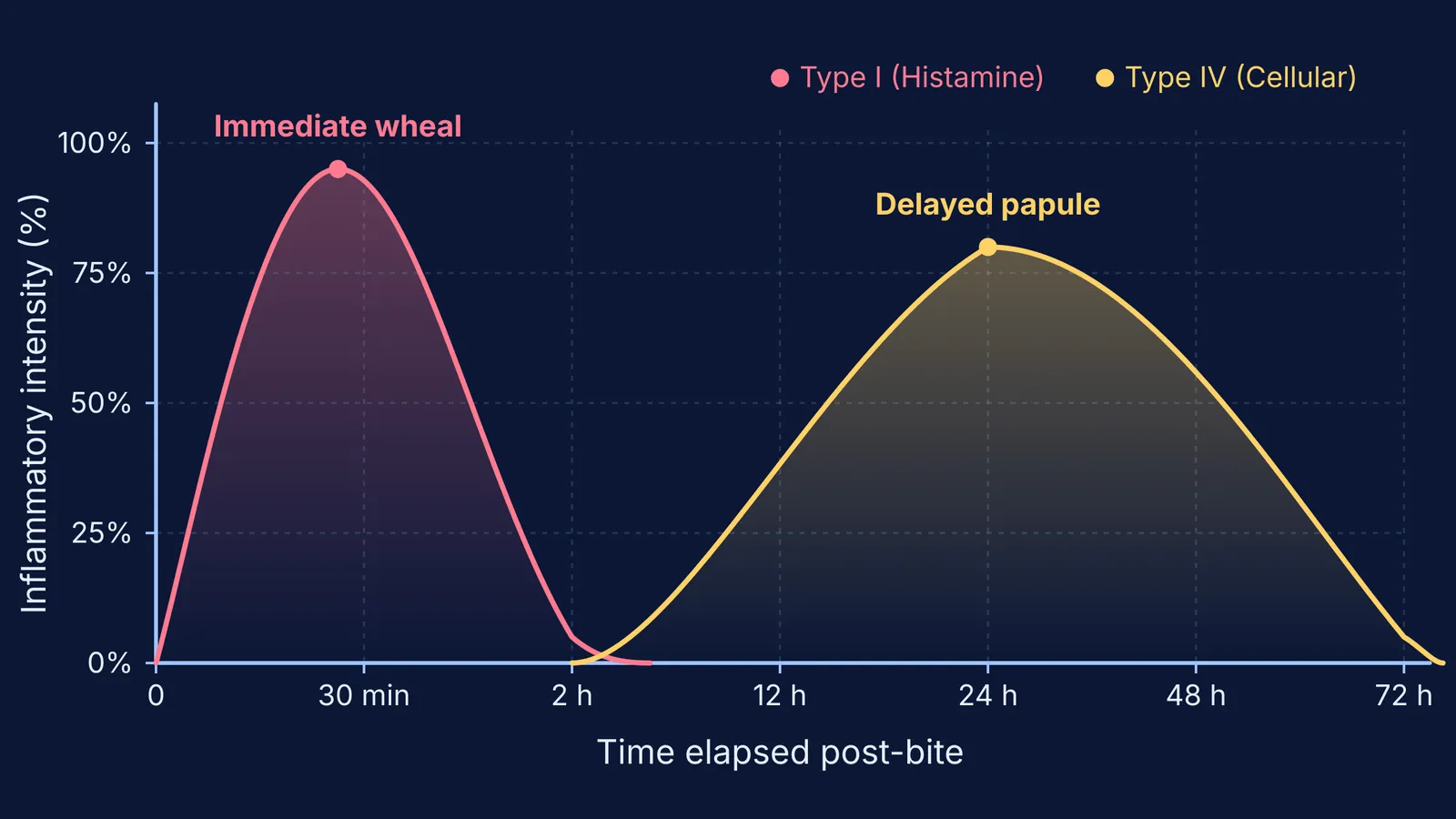
In sensitized individuals, this histamine wheal peaks 20 to 30 minutes after the bite and subsides within two hours (Vander Does, Labib, and Yosipovitch, 2022). A secondary wave of inflammation often follows: a firm, itchy papule peaking 24 to 36 hours later (Vander Does, Labib, and Yosipovitch, 2022). This delayed reaction is driven by T lymphocytes and eosinophils recruited from the formed elements of blood.
Why do mosquito bite reactions change over time?
Bite reactions vary widely with age and exposure. In 1946, entomologist Kenneth Mellanby showed that human bite responses progress across five distinct immunological stages (Mellanby, 1946):
Stage I (No reaction): Unexposed individuals show no immediate or delayed reaction, having no primed lymphocytes or specific antibodies.
Stage II (Delayed reaction only): Initial exposure sensitizes cell-mediated pathways, producing an itchy papule 24 to 48 hours later.
Stage III (Immediate and delayed reaction): As IgE antibodies develop, bites trigger an immediate histamine wheal within 20 minutes, followed a day later by the delayed papule. Most children and travellers are in this stage.
Stage IV (Immediate reaction only): With repeated bites over years, cell-mediated hypersensitivity wanes, leaving only the short-lived histamine wheal.
Stage V (Tolerance): Prolonged, frequent exposure over decades can lead to natural desensitisation, producing no visible reaction.
This progression reflects the balance of humoral and cell-mediated pathways detailed in human health and immunity.
When studying cellular pathways like immune signalling or receptor activation, interactive visuals make dynamic interactions much clearer. The Fermi Simulation Lab provides interactive simulations for ideas that are easier to see than to read, helping you explore cellular processes directly.
How do cooling and antihistamines counteract the bite reaction?
Counteracting mosquito bite inflammation involves blunting histamine activity and calming peripheral nerve firing. Public health guidance from the Centers for Disease Control and Prevention emphasizes that washing the skin with soap and water removes residual salivary antigens, while refraining from scratching prevents physical disruption of the stratum corneum.
Applying an ice pack wrapped in cloth for 10 minutes curbs inflammation through two biophysical mechanisms (Centers for Disease Control and Prevention). Local hypothermia triggers arteriolar vasoconstriction, decreasing hydrostatic capillary pressure and fluid leakage. Concurrently, cooling stimulates cold-sensing TRPM8 ion channels on cutaneous afferents, which cross-inhibits itch transmission along pruriceptive C-fibres (Vander Does, Labib, and Yosipovitch, 2022).
Pharmacological management targets these pathways directly. Second-generation oral antihistamines, such as cetirizine or loratadine, function as inverse agonists that compete with endogenous histamine at H1 receptors, dampening both endothelial permeability and neural depolarization (Vander Does, Labib, and Yosipovitch, 2022). For localized dermal symptoms, topical hydrocortisone suppresses cellular cytokine production, reducing delayed leukocyte infiltration (Centers for Disease Control and Prevention).
When mastering biology topics across immunology, genetics, or physiology, Fermi's AI tutor can work out what you already know and build a plan for the session, guiding your problem-solving step by step.


