On this page
In June 2018, a dust storm on Mars grew until it wrapped around the planet, and NASA's solar-powered Opportunity rover went silent underneath it. NASA's last signal from the rover came on 10 June 2018, and NASA declared the mission over on 13 February 2019, after the storm cut the energy reaching its solar panels (NASA Opportunity mission page). The physics behind it is school physics: uneven heating, convection and pressure differences.
What causes dust storms on Mars?
The engine is sunlight. NASA explains it in one line: "As sunlight hits the ground, it warms the air closest to the surface, leaving the upper air cooler" (NASA, The Fact and Fiction of Martian Dust Storms). Warm air near the ground is less dense, so it rises, and it carries dust up with it.
The heating is never even: day and night, poles and equator, and the seasons all get different sunlight. Where air warms more, it rises, pressure near the ground changes, and cooler air flows in. That flow is wind. It is the same reason a sea breeze blows from sea to land during the day, and the same rising-and-sinking loop you can watch in this convection currents simulation.
Why does thin air make Martian storms different?
The Martian atmosphere is about 1 percent as dense as Earth's (NASA).
Mars has a mean surface pressure of 6.36 millibars, varying from 4.0 to 8.7 millibars with the season, and its air is 95.1% carbon dioxide (NASA Mars Fact Sheet). In other words, there is very little air above each square metre of Martian ground to heat, move or push.
Thin air pushes weakly. Even the strongest Martian storm winds top out at about 60 miles per hour, less than half the speed of some hurricane winds on Earth (NASA). So how does such weak air lift so much dust?
Not by blowing it straight off the ground: NASA says Martian dust particles are very small and slightly electrostatic, so they stick to surfaces (NASA). Sand does the lifting. In a 2010 paper in Physical Review Letters, Jasper Kok calculated that wind-blown sand grains on Mars, once moving, keep bouncing at wind speeds about an order of magnitude below the speed needed to start them, and those hopping grains kick fine dust into the air (Kok 2010, arXiv version; journal record). A strong gust starts the process, and gentler winds can keep it going.
Why do some storms cover the whole planet?
Dust does not just ride the wind; it feeds it. NASA's Jet Propulsion Laboratory notes that during southern summer, "sunlight warms dust particles, lifting them higher into the atmosphere and creating more wind" (NASA JPL). More wind lifts more dust, which absorbs more sunlight, which drives more wind. That loop is positive feedback.
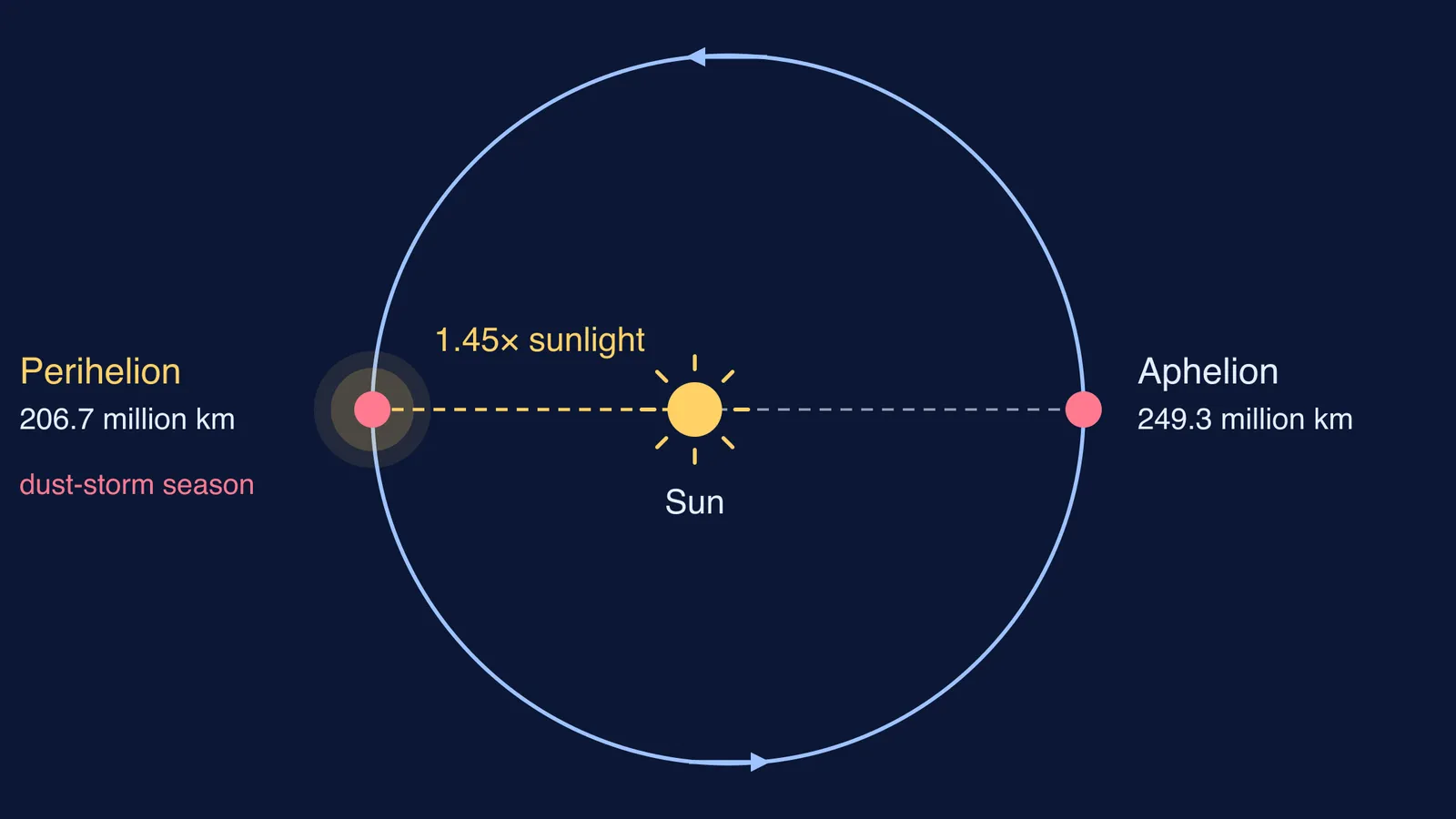
Timing matters too. The larger storms happen in southern-hemisphere summer, when Mars is closer to the Sun and significantly hotter (NASA). On average, once every three Mars years, about 5½ Earth years, ordinary storms grow into planet-encircling ones. NASA lists global storms in 1971, 1977, 1982, 1994, 2001 and 2007 before the 2018 event (NASA, 10 things about the 2018 storm). JPL reported that the 2018 storm covered more than 18 million square kilometres, an area greater than North America (NASA JPL).
Worked example: how much more sunlight near the Sun?
Mars's orbit has an eccentricity of 0.0935, with perihelion at 206.650 million km and aphelion at 249.261 million km (NASA Mars Fact Sheet). Sunlight intensity falls as 1/r², so:
Ratio of distances: 249.261 / 206.650 = 1.206
Square it: 1.206² = 1.45
So Mars receives about 45% more sunlight at perihelion than at aphelion.
On Mars, that closest approach falls in southern summer, adding energy just when the southern hemisphere already tilts towards the Sun.
How to explain Martian dust storms in an exam answer
Write it as a chain of four links. Each link is a cause of the next:
Uneven heating: sunlight warms the ground, which warms the thin air just above it more in some places than others.
Convection and pressure: warm air rises, pressure differences form, and air flows in as wind.
Lifting: winds set sand hopping, and the hopping grains throw very fine dust upward.
Feedback: airborne dust absorbs sunlight, warms the air further and strengthens the winds, most of all near perihelion in southern summer.
Connect it to why Mars looks red: the same fine dust is part of that story.
Watch convection in the simulation linked above before you write the four links from memory. The Fermi Simulation Lab has more interactive simulations for ideas that are easier to see than to read.