On this page
Someone switches on the AC and the tube light blinks dimmer for a moment. Nothing is broken. You are watching Ohm's law and back emf, the same ideas that turn up in Class 12 current electricity and JEE circuit problems.
Why does a motor draw so much current when it starts?
An AC's compressor is driven by an electric motor. A spinning motor coil also acts as a generator, producing a voltage called back emf that opposes the supply. The faster it spins, the bigger the back emf and the smaller the current.
At the moment you switch it on, the motor is not spinning yet. The OpenStax College Physics textbook puts it plainly: back emf is zero when the motor is first turned on, so the coil gets the full supply voltage and the motor draws its maximum current while it is on but not yet turning.
Writing in Electrical Construction and Maintenance, Mark McGranaghan of EPRI Solutions and Fred Kinder of Dranetz-BMI noted that even small and medium horsepower motors can have inrush currents six to 10 times their normal steady-state current. AC nameplates list this starting figure as compressor LRA, locked rotor amperes, which an IAEI Magazine article defines as the maximum current flowing to the motor when it is locked, or not turning.
As the motor speeds up, back emf builds and the current falls, so the dimming lasts only a moment.
Why do the other lights dim, and not just the AC?
Your lights and the AC share one path to the supply: the wires in your walls, the service cable and the transformer down the road. Each has a small resistance, just as a battery has internal resistance. OpenStax defines it as the resistance to the flow of current within the voltage source, and notes that terminal voltage falls as current rises, following V = ε − Ir.
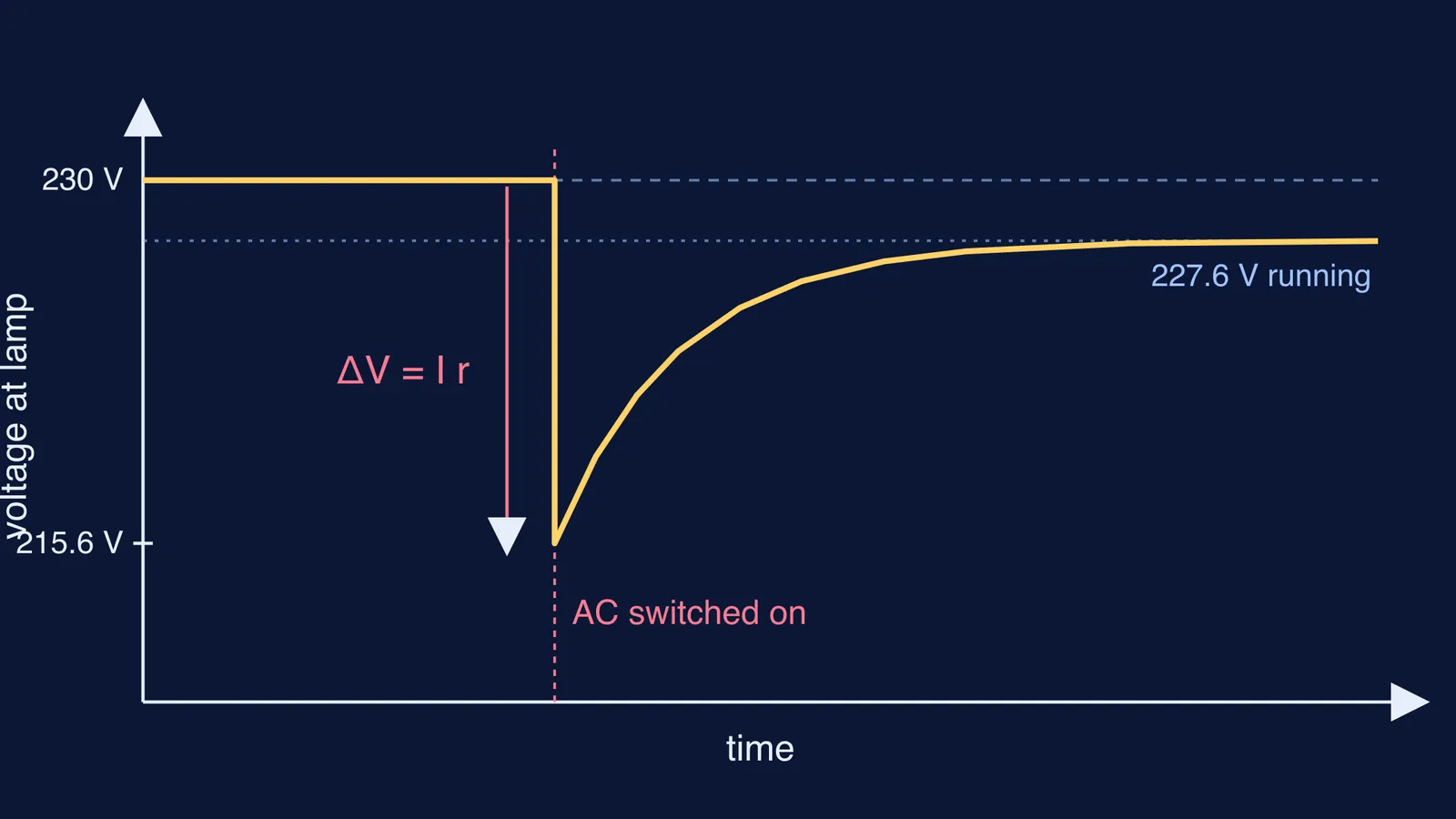
Treat the shared path as one small resistance r. By Ohm's law, V = IR, a current I through it uses up I × r before reaching your sockets. Usually that loss is tiny. When the compressor starts, I jumps, the I × r loss jumps with it, and the voltage left for your lamps drops.
The same OpenStax back emf page describes exactly this: when a refrigerator or washing machine is first turned on, lights in the same circuit dim briefly due to the IR drop in the feeder lines caused by the large motor current.
How much does the voltage actually drop? A worked example
Assume these illustrative numbers:
supply voltage with nothing on: 230 V
total resistance of the shared supply path, r: 0.4 Ω
AC running current: 6 A
starting current: six times that, 36 A, at the low end of the six to 10 times range reported for motor inrush
Work through it in four steps:
While the AC is running: drop = 6 × 0.4 = 2.4 V, so your lamps get 227.6 V.
At the instant the AC starts: drop = 36 × 0.4 = 14.4 V, so your lamps get 215.6 V.
A simple resistive bulb's power goes as V²/R, so its power falls to (215.6/230)², about 0.88 of normal. That is roughly 12% less power, and your eye notices it.
Once the motor is up to speed, the current falls back to 6 A and the bulb runs at (227.6/230)², about 98% of normal, which you will not notice.
Double r, as a long, thin or loose connection does, and the dip doubles. That is the same reasoning as our worked example on voltage drop in a long extension wire. For the battery version, see how to find internal resistance from two voltmeter readings.
If you find it easier to watch current and voltage change than to read about them, the Fermi Simulation Lab has interactive simulations for ideas that are easier to see than to read. If you get stuck on an exam version with numbers, the Fermi Problem Library has a step-by-step solver that explains the reasoning rather than printing an answer.
When is dimming lights a sign of a problem?
A quick dip that recovers within a second, every time the compressor starts, is the normal physics described above. These are signs it is worth asking a licensed electrician to check:
the lights stay dim for several seconds, or flicker while the AC keeps running
the dip is getting worse over weeks
switch boards or plugs feel warm, smell of burning, or buzz
the MCB trips when the AC starts
A large dip points to a high resistance somewhere, such as a loose joint or undersized wire, and that resistance also makes heat. Do not open the distribution board yourself. Low or unsteady supply voltage is also why many families fit stabilisers; our explainer on why fridges and ACs need a voltage stabiliser covers that side.
Next time the lights blink, try explaining it out loud in one sentence using I, r and back emf.