On this page
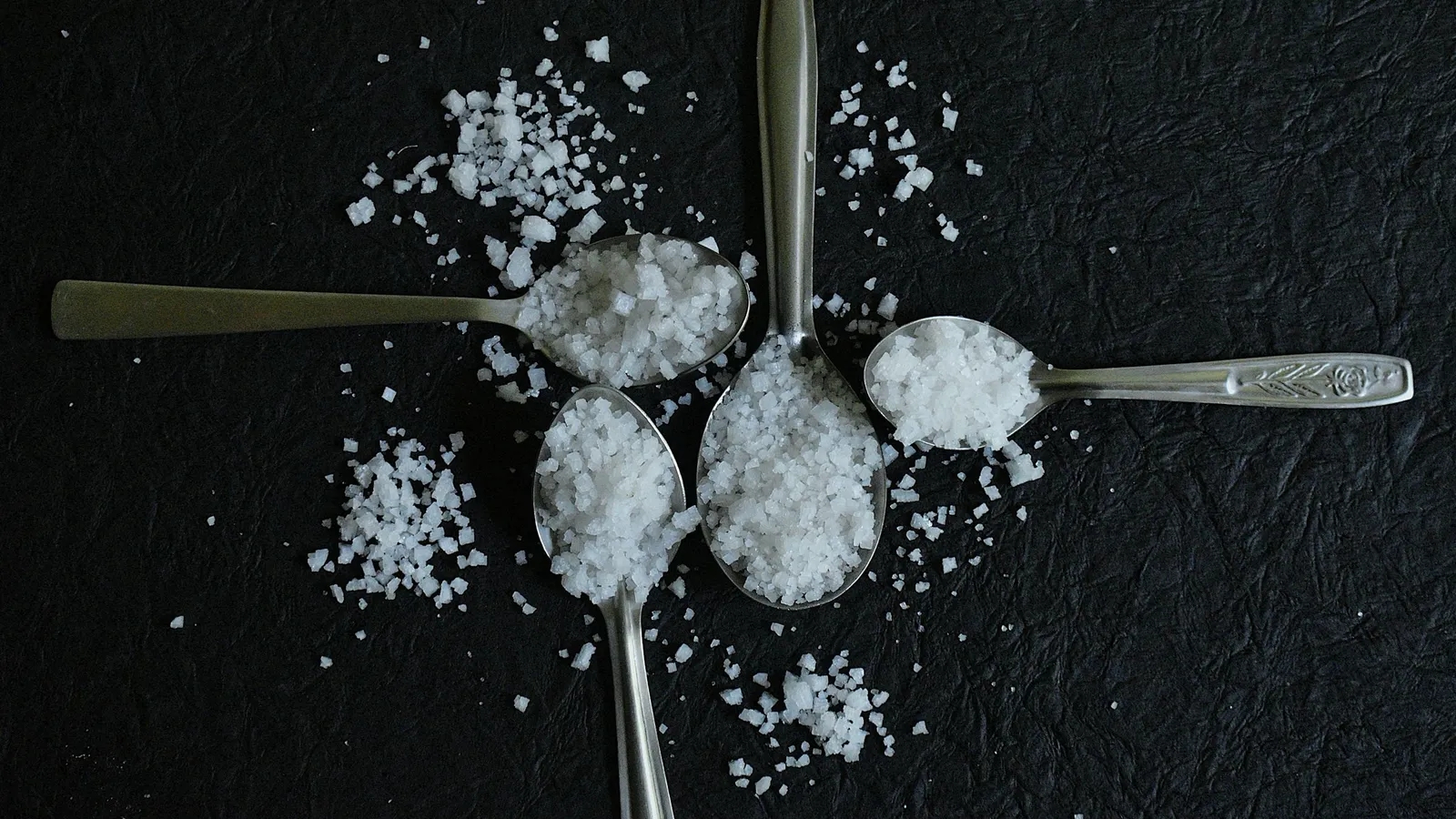
Open a jar of kala namak and the kitchen smells faintly of boiled eggs. In a 2003 assessment, Germany's Federal Institute for Risk Assessment (BfR) described black salt as giving food a sulphurous taste like an older boiled egg. It noted that black salt contains hydrogen sulphide (H2S), the gas that smells of rotten eggs at low concentrations. That gas comes from a kiln, a lot of heat and the redox chemistry you meet in Class 11.
What is kala namak made of?
Kala namak is mostly sodium chloride. It also carries traces of sodium sulphate (Na2SO4), sodium bisulphate, sodium bisulphite, sodium sulphide (Na2S), iron sulphide (FeS) and hydrogen sulphide, according to a 2023 paper by researchers at ICAR-CIPHET in The Pharma Innovation Journal. The same paper says iron sulphide gives the salt its dark violet colour and that hydrogen sulphide is the most prominent contributor to the smell.
Black salt contains 0.3 to 0.65 g of sulphur per 100 g, in a 2011 analysis the paper reproduces. That is little by weight, but your nose is very sensitive to sulphur gases.
How does heating turn white salt into black salt?
The ICAR-CIPHET team logged a firing at a rural kiln in Meerut district, Uttar Pradesh, where white salt is packed into clay pots with harad seeds, amla, bahera and babul bark, then fired with coal. In their log, the temperature rose from 20 °C to a peak of 955 °C after 3.5 hours and fell to 105 °C after 15.5 hours (paper, Table 2). The paper notes that salt melts near 801 °C, and in this log the kiln stayed at or above about 800 °C for roughly six hours.
Inside the hot pot, a reductive process turns some of the salt's natural sodium sulphate into sodium sulphide and hydrogen sulphide, the paper explains. The classic textbook version is the first step of the old Leblanc process for making soda, where carbon reduces sulphate at about 1000 °C (Leblanc process):
Na2SO4 + 2C → Na2S + 2CO2
The paper does not spell out the kiln's own reactions, but carbon from the plant material and fuel could play the same role.
Worked example: track the electrons
Sulphur in Na2SO4: sodium is +1 (two of them, +2) and oxygen is −2 (four of them, −8), so sulphur is +6.
Sulphur in Na2S: two sodiums give +2, so sulphur is −2.
Each sulphur gains 8 electrons. It is reduced.
Carbon goes from 0 to +4 in CO2, losing 4 electrons. Two carbons lose 8.
8 gained, 8 lost: the equation balances, and carbon is the reducing agent.
For practice, see how to tell if a reaction is redox by tracking every element.
Why does sulphide smell like rotten eggs?
Sulphide ions grab hydrogen ions. In water or acid, S2− becomes HS− and then H2S, which escapes as a gas. The BfR notes that sulphides reaching the stomach react with hydrochloric acid to form hydrogen sulphide. H2S is a gas at room temperature, unlike water, which is why it drifts up to your nose (why water is a liquid but H2S is a gas).
The rotten-egg smell of H2S is first noticeable to some people at 0.01 to 1.5 ppm, according to the US safety agency OSHA. Eggs smell similar for a related reason: the BfR estimates that one egg can contain about 0.5 to 1.2 mg of H2S.
How much hydrogen sulphide is in a serving of black salt?
One black salt sample tested by a German food laboratory held about 200 mg of H2S per kg, a rough estimate the BfR was then asked to assess. The BfR worked through an assumed 2 g per meal:
2 g = 0.002 kg
0.002 kg × 200 mg/kg = 0.4 mg of H2S
that is less than the 0.5 to 1.2 mg the BfR estimates for one egg
Some of it also escapes as gas while you cook. The BfR concluded that black salt used as intended in Indian cooking poses no health hazard. If you have a medical reason to watch your salt intake, ask your doctor.
Try it: a 10-minute smell test at home
Predict before each step, then waft the air gently towards your nose.
Put half a teaspoon each of black salt and white salt in two cups. Sniff both.
Add warm water and stir. Does the black salt smell grow?
Squeeze lemon into the black salt cup. More H+ should push S2− and HS− towards H2S. Is it stronger?
Sniff again after five minutes. If it seems weaker, your nose may have adapted: here is why you stop noticing a smell after a while.
Equilibria like S2− ⇌ HS− ⇌ H2S are hard to picture from equations alone. The Fermi Simulation Lab has interactive simulations for ideas that are easier to see than to read. If oxidation states still feel shaky, the Fermi Concept Library gives each concept its own lesson and shows where it fits in the map.