

On this page
Oxygen and sulphur are neighbours in Group 16 of the periodic table, so you might expect their compounds to behave similarly. Their hydrides — water (H₂O) and hydrogen sulphide (H₂S) — share a similar bent molecular shape with two lone pairs of electrons on the central atom. However, while water is the liquid essential for life, hydrogen sulphide is a highly toxic, rotten-smelling gas at room temperature.
The reason for this dramatic difference lies in the strength of the intermolecular forces holding their molecules together. This difference ultimately comes down to two atomic properties: atomic size and electronegativity.
Why does oxygen form hydrogen bonds but sulphur cannot?
Electronegativity is an atom's ability to attract shared electrons in a covalent bond. On the Pauling scale, oxygen has an electronegativity of 3.44, making it the second most electronegative element after fluorine. Sulphur's electronegativity is significantly lower, at 2.58.
When oxygen bonds with hydrogen to form a water molecule, the highly electronegative oxygen atom pulls the shared electrons strongly towards itself. This unequal sharing leaves the oxygen atom with a partial negative charge and the two hydrogen atoms with a partial positive charge. Because the oxygen atom is very small (being in Period 2 of the periodic table), this partial charge is highly concentrated in a small volume of space.
Sulphur, sitting just below oxygen in Period 3, is less electronegative and has an extra shell of electrons. This makes the sulphur atom much larger than the oxygen atom. Its pull on the shared electrons in the S–H bond is weaker to begin with, and the partial negative charge it does accumulate is spread over a much larger surface area.
What holds water molecules together?
Because of oxygen's concentrated negative charge and the hydrogen atoms' exposed positive charge, the oxygen atom of one water molecule strongly attracts the hydrogen atoms of its neighbours.
This specific type of strong dipole-dipole attraction is known as intermolecular hydrogen bonding. In water, these bonds have a typical energy of about 21 kJ/mol. In a sample of liquid water, each water molecule can form hydrogen bonds with up to four neighbouring molecules, creating a strong, constantly shifting three-dimensional network.
For comparison, the O–H covalent bonds inside a water molecule have an average bond energy of 461.5 kJ/mol. While a hydrogen bond is roughly 20 times weaker than a true covalent bond, having millions of them pulling together makes a massive difference to the physical properties of the liquid.
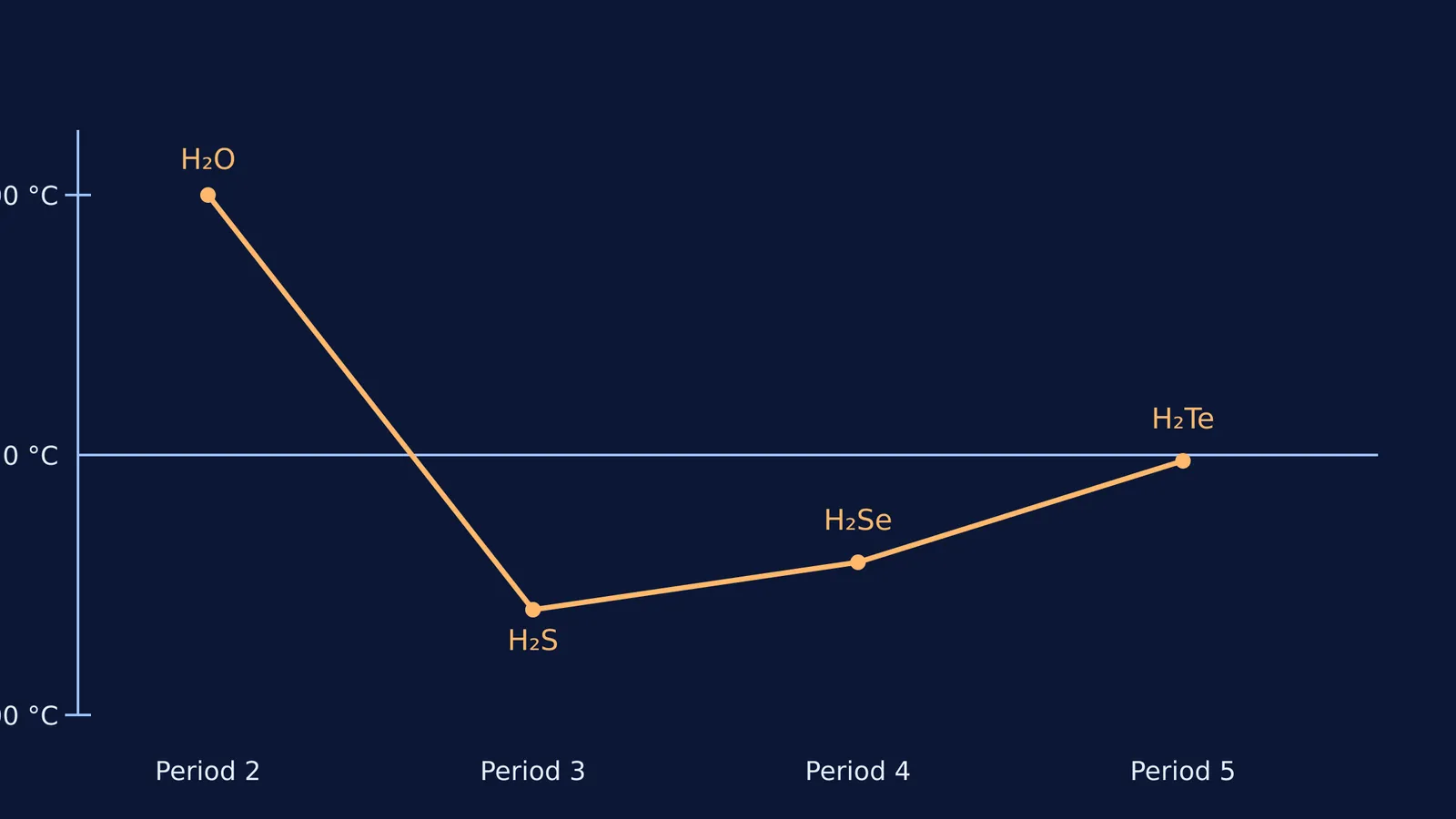
Breaking this extensive network of intermolecular bonds takes a massive amount of thermal energy. This is why water remains a liquid at room temperature and requires heating to 100 °C before it boils and transitions into a gas. When water boils, only the hydrogen bonds are overcome; the strong internal O–H covalent bonds remain completely intact, which is why steam is still H₂O.
Why is H2S a gas at room temperature?
Hydrogen sulphide molecules cannot form hydrogen bonds. Because sulphur is larger and less electronegative, its partial negative charge is simply not concentrated enough to form that strong attraction with neighbouring hydrogen atoms.
Without the ability to form hydrogen bonds, H₂S molecules are held together only by weak van der Waals forces, specifically weak dipole-dipole interactions. These interactions are a fraction of the strength of a hydrogen bond.
These weak forces are easily overcome by the ambient thermal energy present in a standard room. As a result, hydrogen sulphide boils at −59.55 °C. By the time it reaches room temperature, the molecules have long since broken apart from each other to become a gas. For comparison, heavier hydrides like hydrogen selenide (−41.25 °C) and hydrogen telluride (−2.2 °C) also have low boiling points.
How to predict if a molecular hydride is a gas or a liquid?
When you encounter a new compound in an exam, use this three-step checklist to predict its physical state and compare its boiling point to similar molecules:
Check the central atom's electronegativity. Look for the most electronegative elements on the periodic table: nitrogen, oxygen, and fluorine. If one of these is bonded directly to hydrogen, the molecule is capable of forming hydrogen bonds.
Check the atomic size. Small atoms (like those in Period 2) concentrate their charge, making hydrogen bonding possible. Larger atoms (Period 3 and below, like sulphur or phosphorus) diffuse their charge over a larger area, weakening the dipole and preventing hydrogen bonds.
Identify the dominant intermolecular force. If the molecule can form hydrogen bonds (like H₂O, NH₃, or HF), it will have an unusually high boiling point compared to heavier molecules in its group. If it relies only on weak van der Waals forces (like H₂S, PH₃, or HCl), it will have a much lower boiling point and is likely a gas at room temperature.
Understanding these periodic trends prevents you from having to memorise isolated facts. You can find every concept in chemistry in the Concept Library, each with its own lesson and its place in the map. Fermi's AI tutor can work out what you already know and build a plan to teach you the rest.
Check out how to understand the structures of SO₂, SO₃, ClO₂ and Cl₂O₇ or read about whether AI analogies for chemical bonding can help you learn faster.


