On this page
Pinch an ice cube straight from the freezer with damp fingers and it can cling to your skin. Leave the same cube on a plate until it is wet and shiny, and it slides off. Only its temperature has changed, and that decides whether the water on your skin freezes.
Why does ice from the freezer stick to your fingers?
Your skin carries a thin film of moisture, and wet fingers carry more. When that film touches ice well below 0 °C, the ice draws heat out of it fast enough to freeze it. The new ice forms in the tiny ridges of your skin and joins onto the cube, locking them together.
The US Food and Drug Administration says a home freezer should be at -18 °C (0 °F) (FDA). A study of 500 adolescents aged 15 to 18 measured a resting middle-finger temperature of about 28.6 °C while sitting (International Journal of Adolescent Medicine and Health, 2019). So the water on your skin starts near 29 °C and the ice starts at -18 °C, a gap of about 47 degrees.
How do latent heat and conduction freeze the water?
Latent heat. Water must give up 334 J per gram to freeze, with no change in temperature (Engineering ToolBox, latent heat). First it must cool to 0 °C, releasing 4,184 J per kilogram per degree (USGS Water Science School), about 120 J per gram from 28.6 °C. So each gram of skin water must lose about 454 J to become ice.
Spare cold. Ice below 0 °C absorbs heat just by warming up. The specific heat of ice is 2.05 kJ per kilogram per degree at 0 °C and 1.94 at -20 °C (Engineering ToolBox, ice). Warming one gram of freezer ice from -18 °C to 0 °C therefore absorbs about 36 J without melting any of it. If the terms blur, see our explainer on specific heat vs heat capacity.
Conduction. Ice conducts heat about four times better than liquid water: 2.22 W/m·K for ice at 0 °C (Engineering ToolBox, ice) against 0.56 W/m·K for water at 0.01 °C (Engineering ToolBox, water). So heat leaving the film spreads quickly into the cold cube, and once part of the film freezes, that layer carries heat away even better.
Why doesn't melting ice stick?
Melting ice sits at 0 °C with water on its surface. Heat from your finger cannot warm it above 0 °C; it just melts more ice. The boundary stays at 0 °C or a little above, so the film on your skin never loses its latent heat and stays liquid. Nothing freezes, so nothing sticks. (Pressure is a separate way to melt ice: see the water phase diagram and triple point.)
Worked example: how much skin water can one gram of ice freeze?
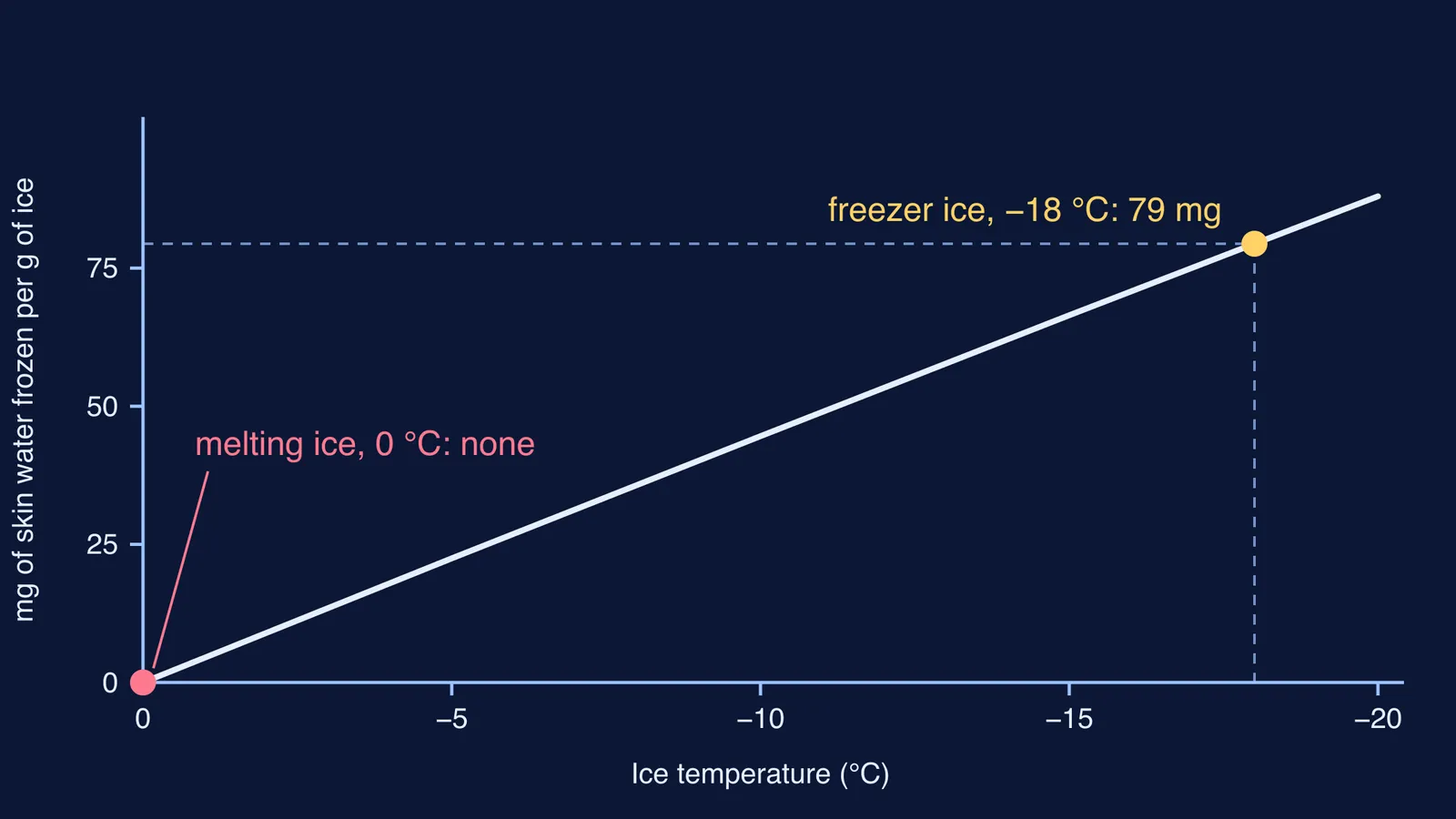
Heat 1 g of freezer ice absorbs warming from -18 °C to 0 °C: about 36 J.
Heat 1 g of skin water at 28.6 °C must lose to freeze: 120 J + 334 J = 454 J.
Divide: 36 ÷ 454 ≈ 0.079. One gram of freezer ice can freeze about 79 mg of skin water before any ice melts.
For melting ice at 0 °C, step 1 gives 0 J, so the answer is zero.
A fingertip's film weighs a tiny fraction of a gram, so a freezer cube has spare cold to burn. Your finger keeps supplying warmth, though, so the frozen film soon melts again.
A safe test: freezer ice vs melting ice
You need two ice cubes, a plate, a spoon and a glass of tap water. First, write down which cube you think will stick and why.
Put one cube on the plate and wait until its surface is wet and glossy. This is your melting ice.
Dip one fingertip in the water and shake off the drips.
Lift a fresh freezer cube with the spoon. Touch it with the damp fingertip for two seconds, then lift your finger. Does the cube come too?
Re-wet your fingertip and touch the melting cube for two seconds.
Dry your fingertip and repeat step 3 with another freezer cube.
Expect freezer ice to grip the wet finger, grip the dry finger less, and melting ice not to grip at all. Your freezer's cold walls freeze water from the air in a similar way, as our post on why frost builds up inside your freezer explains.
Keep it safe:
Use fingertips only. Never touch freezer ice, ice trays or frozen metal with your tongue or lips.
If the ice sticks, do not pull. Run tap water over it and it lets go as the frozen film melts.
Keep each touch short. If skin stays white, numb or blistered after cold contact, tell an adult and see a doctor.
If heat flow is hard to picture, the Fermi Simulation Lab has interactive simulations for ideas easier to see than to read, and the Fermi Concept Library gives every physics concept its own lesson.