On this page
If your grandparents talk about sparrows hopping into the kitchen and nesting behind the photo frames, they are not imagining it. Many city children today rarely see one. The surprising part is that the bird has not disappeared from India. It has become scarcer in the big cities.
Are house sparrows really disappearing from India?
Not across the country. The State of India's Birds 2020 summary, built from data shared by thousands of birdwatchers, says the house sparrow "does not seem to be declining in the country as a whole despite the popular perception."
The city picture is different. As PTI reported from the 2020 report, data from the six largest metros (Bengaluru, Chennai, Delhi, Hyderabad, Kolkata and Mumbai) showed a gradual decline in sparrow abundance, even though the species was fairly stable overall across the past 25-plus years.
The latest numbers are worth watching. The State of India's Birds house sparrow page (2025 update) lists its current annual trend as a decline of about 2.76% a year, rates its long-term trend as inconclusive, and places it in the Moderate Priority group for conservation.
Why are there fewer house sparrows in cities?
No single cause has been proven, and researchers are careful about that. But three clues keep turning up in studies.
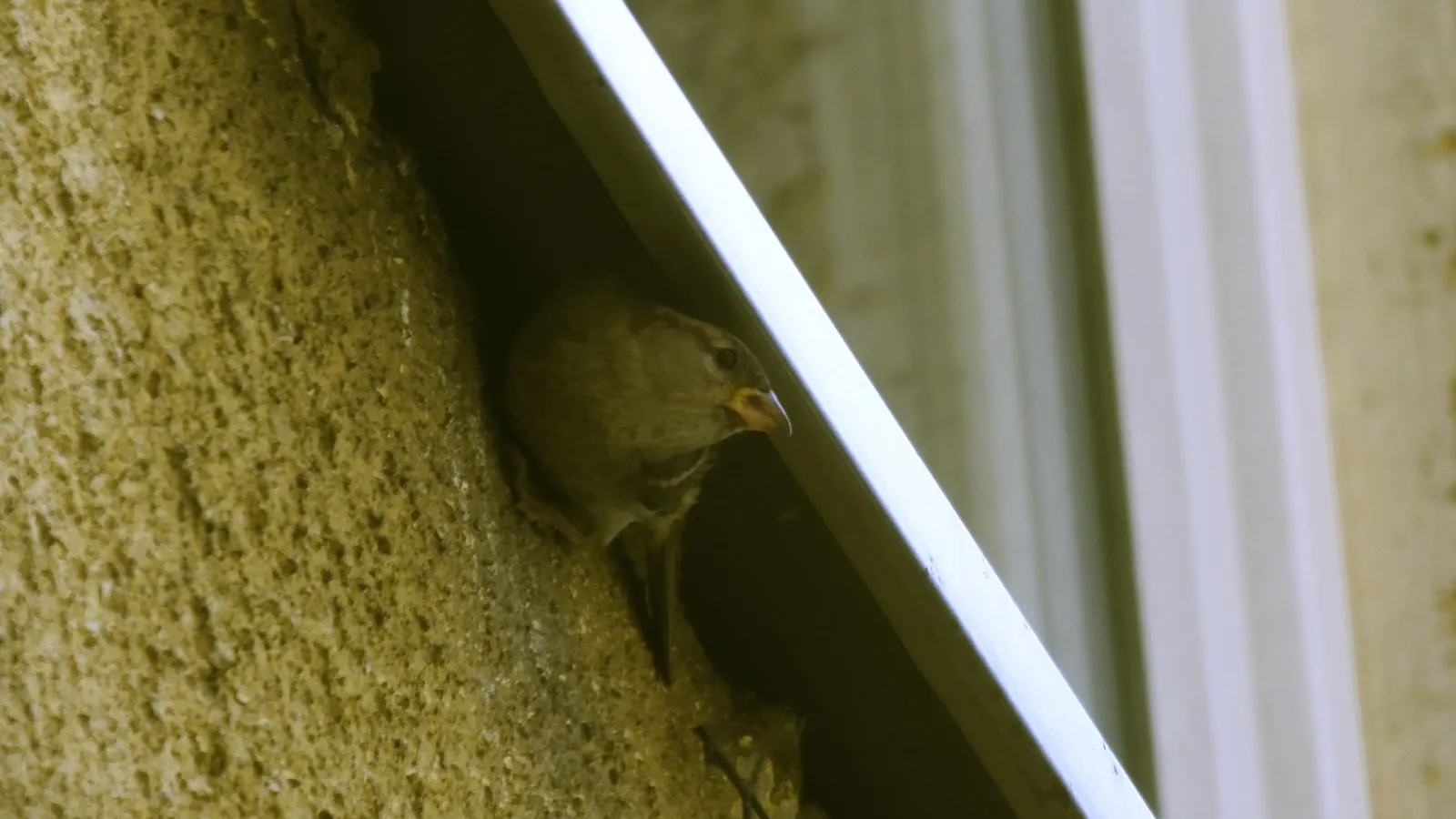
Clue 1: fewer holes to nest in. House sparrows nest in cavities: gaps under roof tiles, cracks in walls, spaces behind signboards. Sealed, smooth modern facades can offer few of these.
A 2023 survey on Rameswaram Island in Tamil Nadu by M. Pandian counted 2,988 adult sparrows and 407 active nests. About 60% of the nests were in concrete buildings, 39% in artificial nest boxes and 35% in cavities and crevices within buildings. So concrete itself is not the problem. What matters is whether a building leaves a gap a sparrow can use, and where people put up boxes, the birds used them.
Clue 2: too few insects for the chicks. Adult sparrows eat a lot of seeds and grain, but their chicks need insects. A study of declining sparrow populations in Leicester, England, by Peach and colleagues in Animal Conservation (2008) found that in 2 of 3 years, the birds did not raise enough young to keep the population stable. Poor breeding was linked to fewer aphids, more plant material in the diet and higher traffic pollution. The authors concluded that "inadequate invertebrate availability provides a plausible demographic mechanism" for declines in urban and suburban sparrows.
Clue 3: less green cover. Insects need plants, and sparrows need shrubs to shelter in. A study in Bhavnagar, Gujarat, by Patel, Dodia and Mehta (2024) found that shrubby vegetation, cowsheds and traditional structures were key predictors of where sparrows occurred, especially in built-up areas. These are features that often go when a neighbourhood is rebuilt and paved.
How does this connect to habitats and ecosystems?
The sparrow is a neat example of a habitat having several parts that must all be present: a place to nest, food for the young, and cover. Lose any one and breeding can suffer, even if the other two remain. That is habitat loss in miniature, the first of the four causes in the evil quartet of biodiversity loss.
It is also a food-web story. Plants feed insects, insects feed chicks, and fewer plants ripple upward. If you sketch this as a chain, you can see why paving a lawn affects a bird whose chicks depend on the insects living there. Our guide on how to draw a food web with arrows and trophic levels shows how to set it out for an exam answer.
The Fermi Simulation Lab has interactive simulations for the ideas that are easier to see than to read, and the Fermi Concept Library gives each biology concept its own lesson if you want to revise ecosystems.
How can you check sparrow habitat in your neighbourhood?
Turn the three clues into a two-week project. It works for a school assignment or a weekend activity with a parent.
Map your block. Walk a fixed route of about 15 minutes. Note every building type: old tiled or mud homes, newer concrete homes, glass offices.
Score nest sites. At each building, mark whether you see gaps, ledges, holes or nest boxes a small bird could enter.
Score food and cover. Note shrubs, hedges, unpaved soil, potted plants and spots where grain is spilled or fed.
Count sparrows. Walk the same route at the same time of morning on several days. Record how many sparrows you see and where.
Compare. Do sparrows cluster near old buildings, shrubs or nest boxes? Write one sentence on what you found and one on what you could not rule out.
If you enjoy this, you can share counts with real researchers. Our list of citizen science projects in India your kids can join is a good next step.