On this page
A shop egg is one egg cell with its food store and packaging, not a chick that failed to form. Penn State Extension puts it simply: "Roosters are not necessary in a flock for hens to lay eggs." The rooster's only job is fertilisation, and that is a separate event from laying.
Why do hens lay eggs without a rooster?
Laying is driven by the hen's ovary, not by mating. According to Mississippi State University Extension, a hen has only one ovary, on her left side, holding several thousand yolks at different stages, like a bunch of grapes. The same bulletin says a developing yolk takes about 19 days to grow into a large yolk about 35 mm across.
When a yolk is mature, the ovary releases it. This release is ovulation, and it happens whether or not any sperm are waiting. What sets the pace is light and hormones. A 1966 University of Idaho Extension bulletin explains that light passing through the eye triggers the pituitary gland to release hormones that stimulate the ovaries. Penn State Extension advises that laying hens get 14 to 16 hours of light a day.
Humans work the same way. The NHS explains that one egg is released during each menstrual cycle, and pregnancy happens only if sperm fertilise it. Our menstrual cycle hormone graph explainer shows the hormones day by day. The difference is speed: a laying hen can release a new yolk roughly once a day.
How does a hen turn a yolk into an egg in about 25 hours?
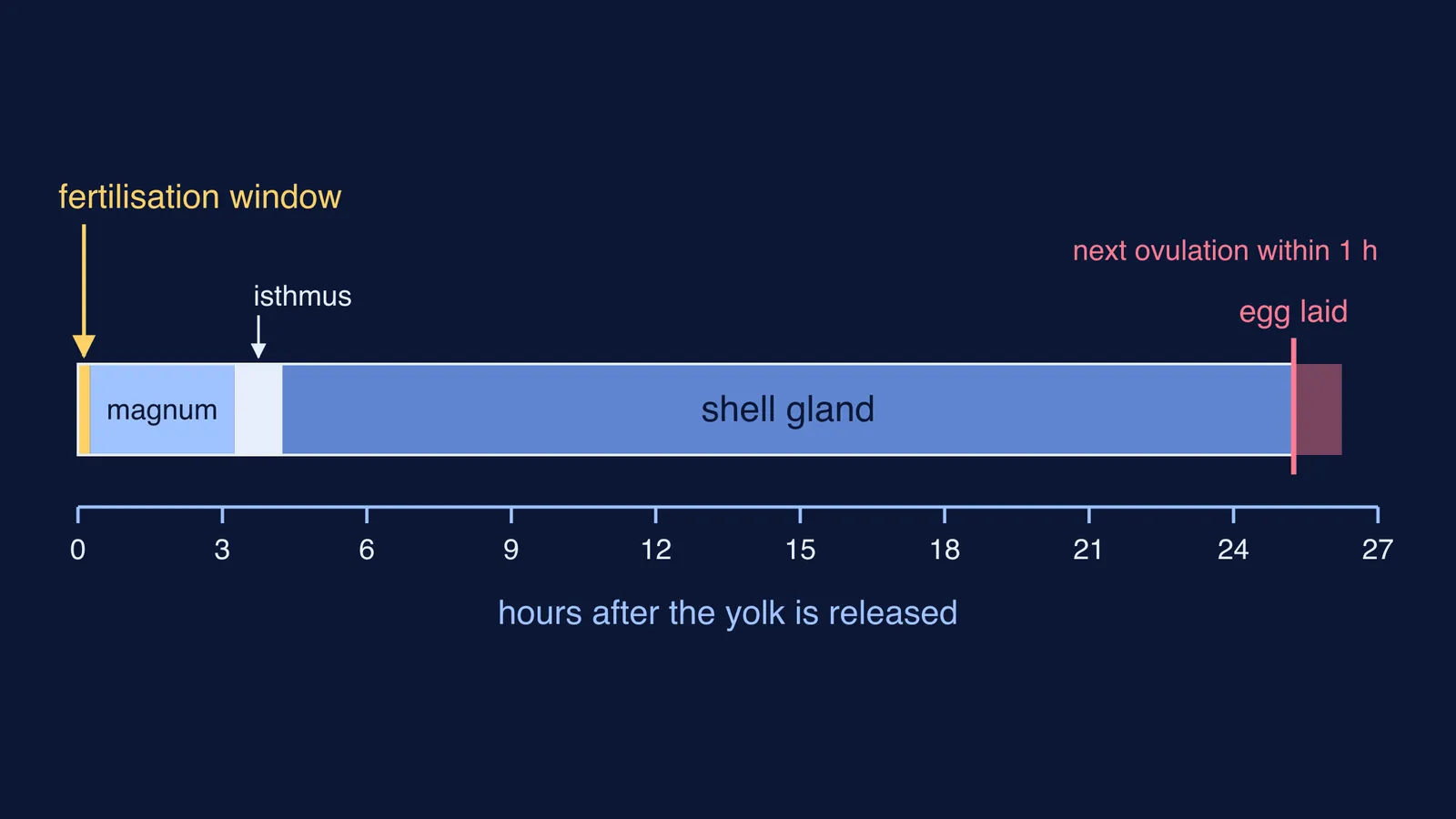
After release, the yolk travels down a tube called the oviduct, picking up layers as it goes. The Egg Quality Handbook, published by the Queensland government's Department of Primary Industries and Fisheries with DSM Nutritional Products, gives these times:
Funnel (infundibulum): about 15 minutes. If live sperm are present, fertilisation happens here.
Magnum: about 3 hours. The egg white (albumen) is added.
Isthmus: about 1 hour. The shell membranes go on.
Shell gland (uterus): about 21 hours. The hard shell forms.
Vagina and cloaca: less than a minute, and the egg is laid.
Add those up and you get roughly 25 hours. Mississippi State Extension notes that because egg formation takes more than 24 hours, even the best hens cannot lay an egg every day in succession throughout their laying lives. Hendrix Genetics, a poultry breeding company, says the next mature yolk is released within 1 hour after the hen lays, so the cycle restarts almost at once. It adds that today's commercial hens run on a cycle of around 24 hours.
Where does fertilisation happen, and why are shop eggs unfertilised?
In chickens, fertilisation is internal: sperm meet the yolk inside the hen's body. Our comparison of internal and external fertilisation shows how this differs from frogs and fish. After mating, Mississippi State Extension says sperm are stored in glands in the oviduct and can fertilise eggs for up to 3 weeks. A 2013 review in the Journal of Reproduction and Development describes these stores as sperm storage tubules, which keep sperm alive at a bird's high body temperature of about 41 °C.
Stored sperm swim up to the funnel and enter the yolk near the germinal disc, a small white spot on its surface. A fertilised egg already holds an embryo when laid: Mississippi State Extension says about 20,000 cells.
The Egg Quality Handbook states plainly that commercially produced table eggs are not fertilised. Humans share the rule: the fallopian tube is where a human egg can meet sperm, and if none arrive, no embryo forms.
How do you explain this in a biology answer?
Here is a four-step answer you can adapt for a short-answer question, with times from the Egg Quality Handbook:
Ovulation: the hen's single ovary releases a mature yolk (the egg cell) on its own cycle, set by light and hormones.
Fertilisation window: the yolk spends about 15 minutes in the infundibulum, and is fertilised only if stored sperm are present.
Egg formation: the oviduct adds albumen, membranes and shell over about 25 hours, fertilised or not.
Result: with no rooster, the egg is laid unfertilised and cannot develop into a chick.
Then check yourself against the common mix-ups:
"An egg is a chick that didn't grow." No: an unfertilised egg is one egg cell plus its food store and packaging.
"Sperm get in through the shell." No: sperm travel up the oviduct to the yolk before the shell exists.
"Hens need a rooster to lay." No: laying follows ovulation, which needs light and hormones, not mating.
If these mix-ups come from a fuzzy idea of what a gamete is, the Fermi Concept Library has a lesson for every concept in biology. For ideas that are easier to see than to read, the Fermi Simulation Lab has interactive simulations.
Next time you crack an egg, find the small white spot on the yolk: the germinal disc, where a rooster's sperm would have arrived.