On this page
Every Class 11 and 12 chemistry student meets the line "all halogens are coloured", usually with a list of colours to memorise. The reason fits in one idea: a halogen molecule soaks up one slice of the light falling on it, and your eye sees what is left.
Why are halogens coloured at all?
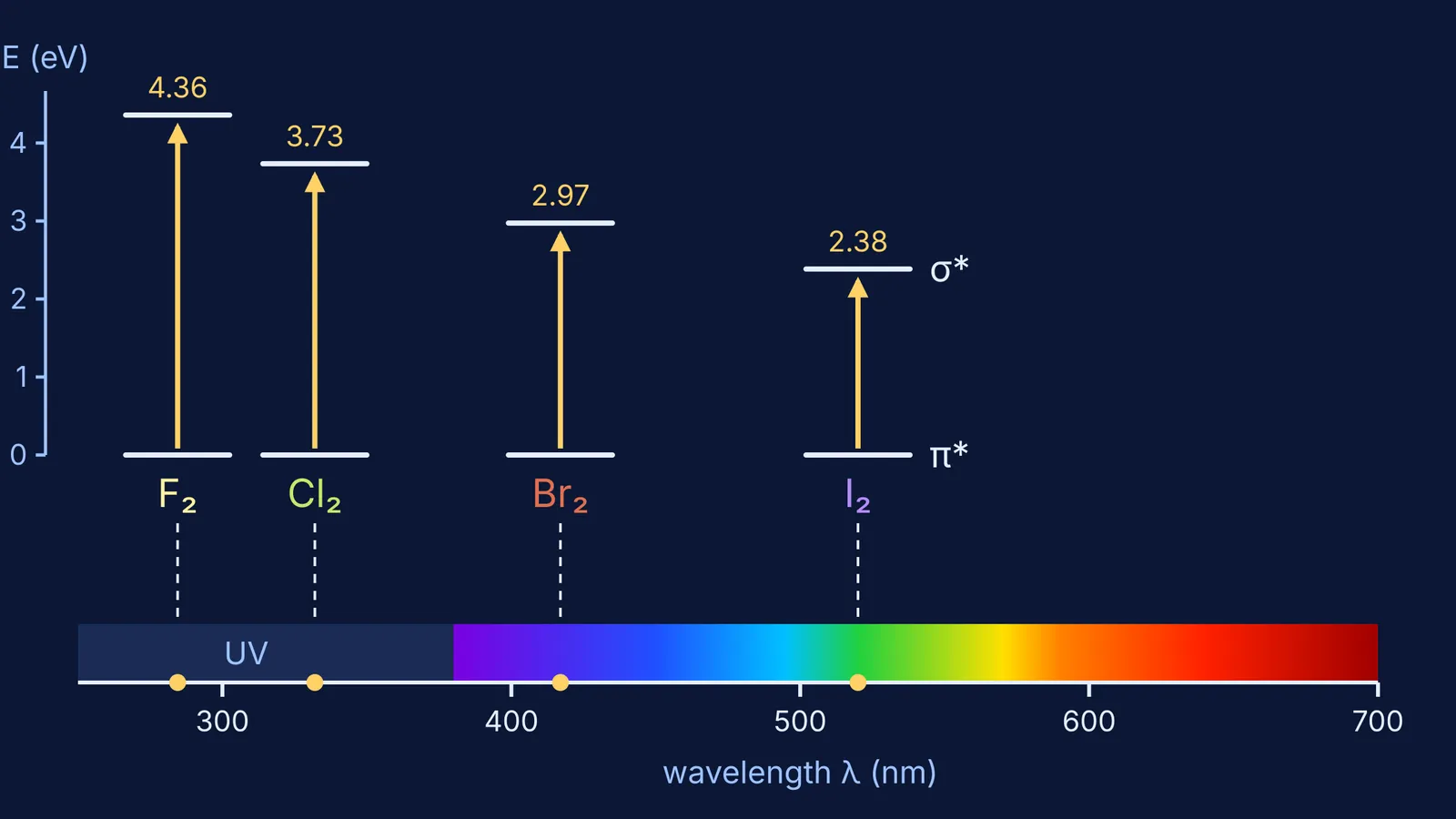
The colour of a halogen molecule comes from one electron jump. According to LibreTexts' inorganic chemistry text/08%3A_Chemistry_of_the_Main_Group_Elements/8.13%3A_The_Halogens/8.13.01%3A_Physical_Properties_of_the_Halogens), the colour stems from excitation from the highest occupied π* molecular orbital to the lowest unoccupied σ* molecular orbital.
A photon of wavelength λ carries energy E = hc/λ; when that energy matches the π* to σ* gap, the molecule absorbs it. The human eye detects wavelengths from about 380 to 700 nm, according to NASA. If the absorption band overlaps that range, some colours are missing from the light that reaches you, and the substance looks coloured.
The same LibreTexts page lists fluorine as a pale yellow gas, chlorine as a yellow-green gas, bromine as a red-brown liquid and iodine as a blue-black solid, and it says iodine appears dark violet.
Why does the colour deepen from fluorine to iodine?
The π* to σ* gap shrinks down the group, in the order F₂ > Cl₂ > Br₂ > I₂, as LibreTexts explains/08%3A_Chemistry_of_the_Main_Group_Elements/8.13%3A_The_Halogens/8.13.01%3A_Physical_Properties_of_the_Halogens). Fluorine is the smallest atom, its nucleus holds the outer electrons tightly, and so it needs a large excitation energy. Iodine is much bigger, holds its outer electrons loosely, and needs far less.
The measurements show the shift clearly. In 1929 A. E. Gillam and R. A. Morton measured halogens dissolved in carbon tetrachloride and reported absorption maxima of 332 nm for chlorine, 417 nm for bromine and 520 nm for iodine (Proceedings of the Royal Society A). For fluorine gas, R. K. Steunenberg and R. C. Vogel found the peak deep in the ultraviolet, at 284.5 nm, with absorption fading away through the 400s (J. Am. Chem. Soc., 1956; data in the MPI-Mainz UV/VIS Spectral Atlas_298K_210-500nm.txt)).
Put those numbers side by side and the colours follow:
Fluorine: peak at 284.5 nm in the ultraviolet; only the weak tail touches violet, so it looks pale yellow.
Chlorine: peak at 332 nm; more of the band reaches violet and blue, so it looks yellow-green.
Bromine: peak at 417 nm, right in the violet-blue, so it looks red-brown.
Iodine: peak at 520 nm, the middle of the visible range, so its solution in carbon tetrachloride looks violet.
Why does iodine look violet if it absorbs yellow-green light?
LibreTexts describes iodine as absorbing low-energy yellow light, which is why it appears dark violet. Take the middle out of white light and the red and blue ends remain; together they look purple-violet. That is the complementary colour, a pairing you can test at home with our post on why staring at red gives a green afterimage.
Transition metal complexes follow the same logic with a different electron jump, as in our explainer on why transition metal complexes are coloured.
How do you write this answer in a board exam or JEE?
Use this three-step answer for a short board question or an assertion-reason item.
Halogens absorb visible light, which excites an outer electron (π* to σ*) to a higher energy level.
Down the group, atomic size increases, outer electrons are held less tightly, and the energy gap decreases.
So the absorbed wavelength increases and the transmitted (seen) colour changes: F₂ pale yellow, Cl₂ yellow-green, Br₂ red-brown, I₂ violet.
Worked example. How much smaller is iodine's gap than chlorine's? Take Gillam and Morton's peaks (Proceedings of the Royal Society A, 1929) and use E = hc/λ with the exact NIST values h = 6.62607015 × 10⁻³⁴ J s, c = 299792458 m/s and e = 1.602176634 × 10⁻¹⁹ C.
Iodine, λ = 520 nm: E = (6.626 × 10⁻³⁴ × 2.998 × 10⁸) / (520 × 10⁻⁹) = 3.82 × 10⁻¹⁹ J, or 2.38 eV.
Chlorine, λ = 332 nm: E = 5.98 × 10⁻¹⁹ J, or 3.73 eV.
Iodine's photon carries about two-thirds of chlorine's energy (2.38 / 3.73 = 0.64). These are solution peaks, so treat them as a measure of the trend rather than an exact gap.
Two traps: halogens do not emit their colour (emission is the flame test), and fluorine does not absorb yellow; it absorbs violet and ultraviolet and looks yellow.
If π* and σ* orbitals feel shaky, the Fermi Concept Library gives every chemistry concept its own lesson, so you can revisit molecular orbitals first. For E = hc/λ practice, the Fermi Problem Library has worked problems with a step-by-step solver that explains the reasoning rather than printing an answer.
The same small, tightly held fluorine atom shows up again in why fluorine is the strongest oxidising agent among the halogens, which is a good next read.