On this page
Every winter, flamingos gather on the mudflats of Mumbai's Thane Creek. Citing an environmental assessment, Mongabay India reported that lesser and greater flamingos have arrived at Sewri each November, with a 2008 study counting roughly 10,000 to 15,000 birds a day; many later move on to Kutch. None of them was pink when it hatched. The colour comes from the bottom of a food chain.
Why are flamingos pink?
Flamingos are pink because of what they eat. The Smithsonian's National Zoo states that the American flamingo's pink or red colour comes from its food, including algae and shrimp.
The pigments are carotenoids, the family of yellow, orange and red molecules that also makes carrots orange with beta-carotene.
Birds cannot build carotenoids themselves. A study of wild house finches in Proceedings of the Royal Society B put it plainly: carotenoids "cannot be synthesized; they must be ingested" (Hill, Inouye and Montgomerie, 2002).
In the feathers, one pigment dominates. Canthaxanthin makes up more than 60% of the carotenoids in greater flamingo feathers, and up to six types of carotenoid are found in flamingo plumage and tissues (Chiale and colleagues, Ecology and Evolution, 2021).
How does the colour travel up the food chain?
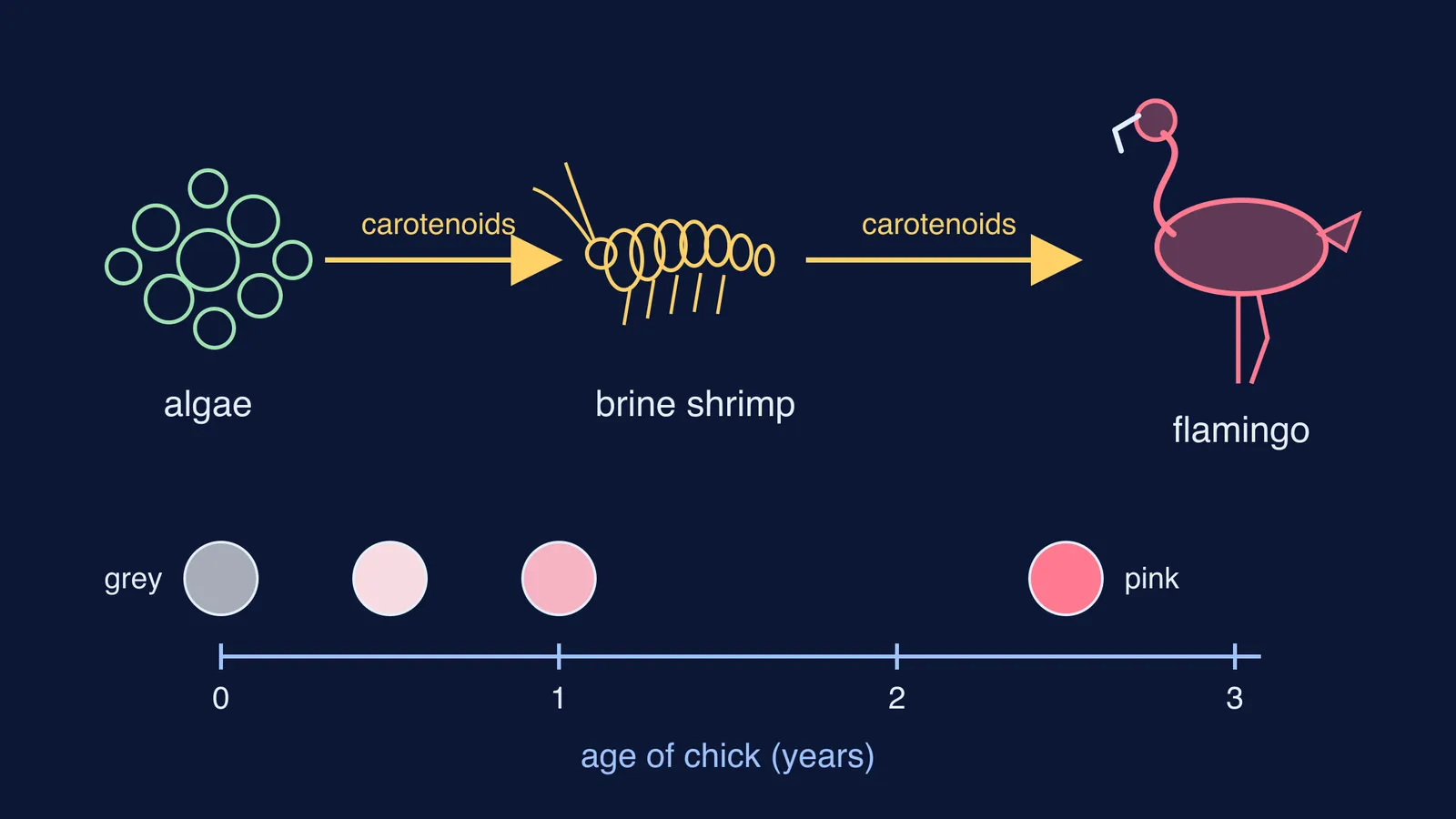
Producers make it. Algae and other photosynthetic microbes make carotenoids, which help them gather light. Our post on what carotenoids do in photosynthesis explains that job.
Small consumers pick it up. Small animals such as brine shrimp eat the algae and carry the pigment in their bodies.
The flamingo collects it. The National Zoo lists the flamingo diet as algae, small seeds and small water animals such as shrimp, fly larvae and molluscs (Smithsonian's National Zoo). So a flamingo eats at two levels of the chain at once: it is a primary consumer when it swallows algae and a secondary consumer when it swallows shrimp.
Feathers display it. The bird lays the eaten pigment into feathers as they grow.
Zoos show that the food really is the cause. The Los Angeles Zoo notes that zoo flamingos are fed a special diet containing canthaxanthin to keep their colour.
Why are baby flamingos grey?
A chick has not eaten enough pigment yet. Hellabrunn Zoo in Munich says newly hatched flamingo chicks have grey or white down and gain adult pink plumage only after two years.
The Smithsonian's National Zoo gives a timeline for one of its chicks: some pink at about 6 months, light pink by the first birthday, and darker pink at two to three years.
The first pigment comes from the parents. Hellabrunn explains that for the first few months both parents feed the chick crop milk, a secretion from the upper digestive tract that is rich in fats and proteins and coloured bright red by carotenoids and red blood cells (Hellabrunn Zoo).
That gift costs the parents. A 2026 Ecoticias report on the National Zoo's chicks says producing crop milk can leave both mothers and fathers pale pink or nearly white by the end of the nesting period.
Do flamingos keep their pink by themselves?
Partly, yes, and with a surprising habit. Greater flamingos of both sexes rub carotenoid-tinted oil from a gland near the tail onto their feathers, like make-up. In the 2021 study, researchers used feathers from 30 greater flamingos found dead after a cold spell in the Camargue, France, in 2012. Feathers left in direct sun with no fresh make-up lost 57.8% of their redness in 40 days, while feathers kept out of the sun faded only 11.4%, a change that was not statistically significant (Chiale and colleagues, 2021).
How do you write this as an exam answer?
A question like "Explain why flamingo chicks are grey but adults are pink" is a classic short-answer question. Here is a four-line answer you can adapt:
Algae, the producers, make carotenoid pigments such as beta-carotene during photosynthesis.
Brine shrimp and other small animals eat the algae, and flamingos filter both algae and shrimp from the water, so the pigment passes up the food chain.
Animals cannot make carotenoids, so flamingos deposit the eaten pigment, mainly canthaxanthin, into growing feathers.
Chicks hatch with grey or white down and turn pink over two to three years of moults as pigment builds up.
Three slips that cost marks:
Saying flamingos are pink "because of their genes" alone. Genes let them use the pigment; the pigment itself must be eaten.
Starting the chain at shrimp. The pigment begins with the algae.
Drawing arrows from eater to eaten. In a food chain, arrows point the way energy and material flow, from algae to shrimp to flamingo. Our guide on how to draw a food web covers the rules.
If food chains still feel like a list of names, it helps to watch material move. The Fermi Simulation Lab has interactive simulations for ideas that are easier to see than to read.
Next time you see a pink flock on the Thane mudflats or in Kutch, you are looking at sunlight, algae and shrimp, stored in feathers.