On this page
Your textbook gives the role of accessory pigments in two lines, and exams test those lines. Behind them is real physics: which colours each pigment catches, and how a carotenoid stops light from damaging the leaf. Here are both, from measured spectra, plus why leaves turn yellow in autumn.
What are accessory pigments in photosynthesis?
The NCERT Class 11 Biology chapter on photosynthesis (section 11.4) lists four pigments that paper chromatography separates from a green leaf: chlorophyll a (bright or blue green), chlorophyll b (yellow green), xanthophylls (yellow) and carotenoids (yellow to yellow-orange). You can see the bands yourself in our walk-through of leaf pigment chromatography with spinach extract.
Chlorophyll a is the chief pigment; NCERT calls chlorophyll b, xanthophylls and carotenoids accessory pigments because they absorb light and transfer the energy to chlorophyll a. The same paragraph gives their two jobs: they let a wider range of wavelengths be used for photosynthesis, and they protect chlorophyll a from photo-oxidation.
NCERT section 11.5 adds that every pigment in a photosystem except one chlorophyll a molecule forms the antenna; that molecule is the reaction centre, P680 in PS II and P700 in PS I. What the electrons do next is in our explainer on the Z-scheme of photosynthesis.
How do carotenoids capture extra wavelengths?
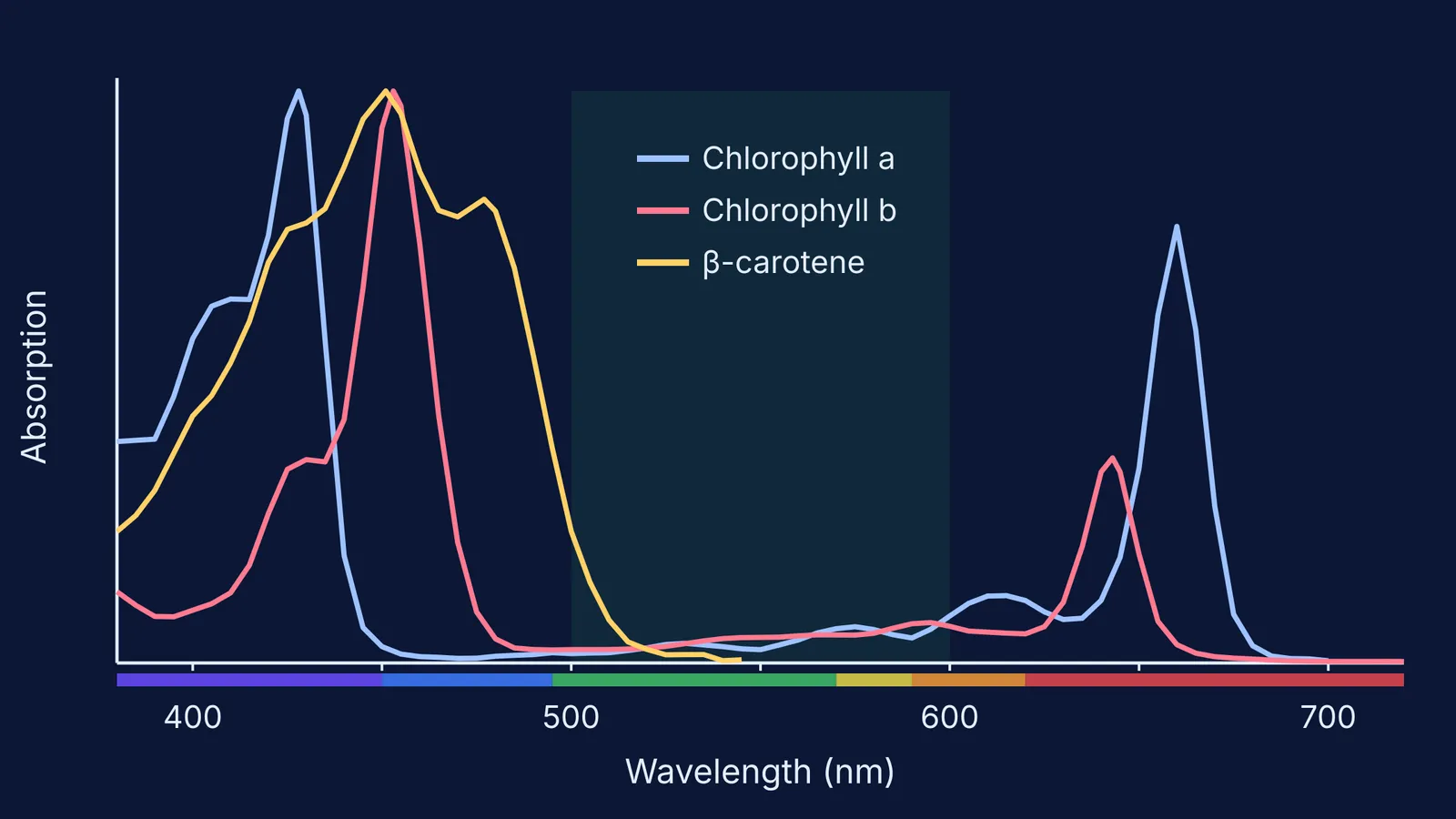
The chart above plots measured spectra from the PhotochemCAD database hosted by the Oregon Medical Laser Center: chlorophyll a in diethyl ether, chlorophyll b in diethyl ether and beta-carotene in hexane.
Chlorophyll a peaks at about 428 nm (violet-blue) and 660 nm (red).
Chlorophyll b peaks at about 453 nm and 643 nm.
Beta-carotene absorbs strongly from about 420 to 500 nm, with peaks near 451 nm and 477 nm, and falls below 4% of its peak by 515 nm.
Worked example: at 470 nm (blue), the data give chlorophyll a a molar extinction coefficient of about 900 per molar per cm, under 1% of its own peak. Beta-carotene there is about 109,000, roughly 120 times higher. Blue light that mostly passes chlorophyll a by is caught by the carotenoid instead.
The chemist Harry Frank's overview Carotenoids in Photosynthesis puts it the same way: carotenoids harvest light where chlorophyll is not an efficient absorber, then pass the energy to chlorophyll and on to the reaction centre. The shaded green band in the chart is poorly absorbed by all three pigments, which is why leaves look green.
How do carotenoids protect chlorophyll from photo-oxidation?
When chlorophyll absorbs more light than photosynthesis can use, some molecules end up in a long-lived excited triplet state. A triplet chlorophyll can turn ordinary oxygen into singlet oxygen, a reactive form that attacks chlorophyll. That is photo-oxidation.
Frank lists three ways carotenoids prevent it: quenching chlorophyll triplet states before singlet oxygen forms, scavenging singlet oxygen directly, and dissipating excess excitation energy as heat. A 2022 study by Carbonera and colleagues in the International Journal of Molecular Sciences describes carotenoids as "the first line of defence of photosystems" against singlet oxygen toxicity, because they can quench the chlorophyll triplet state.
Think of the carotenoid as a fuse next to each chlorophyll: it takes the dangerous extra energy and releases it harmlessly, so the expensive part survives.
Why do leaves turn yellow in autumn?
Carotenoids are in leaves all season, but green chlorophyll overwhelms their colour. Penn State Extension explains that increasingly long nights signal the end of the growing season; as chlorophyll breaks down, the yellows and oranges that were there all along become visible. Most red and purple anthocyanins, by contrast, are made fresh in autumn.
A study of one free-growing aspen by Umeå University researchers in Sweden, A Cellular Timetable of Autumn Senescence (Keskitalo and colleagues, Plant Physiology, 2005), adds nuance. Lutein and beta-carotene were broken down in parallel with chlorophyll, while neoxanthin and the xanthophyll cycle pigments were kept longer. About 80% of the leaves' nitrogen and phosphorus was remobilised, so yellowing is not just decay: the tree recovers nutrients before the leaf falls.
How should you write this in an exam answer?
A three-mark answer on the role of accessory pigments can follow this frame:
Name them: chlorophyll b, xanthophylls and carotenoids; chlorophyll a is the chief pigment and the reaction centre.
Light harvesting: they absorb wavelengths chlorophyll a absorbs poorly (mainly blue-green for carotenoids) and transfer the energy to chlorophyll a, widening the range of light used.
Protection: they protect chlorophyll a from photo-oxidation by removing excess energy.
Example, if asked: in autumn chlorophyll breaks down, unmasking yellow carotenoids.
Before your test, check that you can explain why the action spectrum and the chlorophyll a absorption spectrum do not overlap one-to-one (NCERT figure 11.3c). Our guide to NCERT photosynthesis figures and exam traps walks through it. If antenna complexes or spectra still feel shaky, the Fermi Concept Library has a lesson for each biology concept and shows where it sits in the map.
Try the frame on a past paper question this week, then check your wording against NCERT section 11.4.