

On this page
When you bite into a crunchy orange carrot today, you are tasting the result of centuries of deliberate plant breeding. The wild ancestor of the cultivated carrot (*Daucus carota*) was a thin, woody, bitter white root found across temperate Eurasia. Early domestication took place during the 9th and 10th centuries in Central and Western Asia, particularly across historical Persia and Afghanistan. These early domesticated roots looked nothing like the uniform supermarket staple: they were predominantly deep purple or pale yellow.
The purple hue of ancestral carrots was driven by water-soluble anthocyanins stored in vacuoles, while yellow varieties accumulated lutein. In a 2023 study published in Nature Plants, researchers led by Kevin Coe and Massimo Iorizzo resequenced 630 carrot accessions, confirming that orange cultivars were later selected in Renaissance Europe. Popular legend claims Dutch growers bred orange carrots solely to honour William of Orange during the Dutch Revolt; however, 16th-century paintings by Pieter Aertsen depict orange carrots before the revolt began. European growers favoured orange roots because they tasted sweeter, lacked woody cores, and avoided turning cooked dishes purple.
What gives modern carrots their bright orange color?
The intense orange colour of modern carrots comes from fat-soluble carotenoids, predominantly beta-carotene and alpha-carotene. Unlike anthocyanins dissolved in vacuoles, carotenoids reside inside specialised cellular organelles called chromoplasts. You can explore how these organelles differentiate from green chloroplasts in our guide to types of plastids like chromoplasts and chloroplasts.
The genetic mystery was how underground roots accumulate massive pigment reserves without sunlight. The same 2023 Nature Plants study found that orange coloration requires three recessive genetic switches at the *REC*, *Or*, and *Y2* loci. These mutations relieve repression on carotenoid accumulation and coordinate pigment storage with plastid development. An earlier assembly in Nature Genetics mapped candidate genes across 9 chromosomes, revealing that carrots repurpose light-sensing photomorphogenesis pathways to store carotene underground.
Students revising cell biology and biochemistry can review these cellular pathways through the Fermi Concept Library, which covers every concept in physics, chemistry, biology, mathematics and computing, each with its own lesson and its place in the map.
How does beta-carotene absorb and reflect light?
To understand why beta-carotene appears orange to the human eye, you have to examine its chemical structure. Beta-carotene (C40H56) is a tetraterpene hydrocarbon built from eight isoprene units, featuring 11 conjugated double bonds. In organic chemistry, alternating double and single bonds allow p-orbitals to overlap, producing delocalised pi molecular orbitals that extend across the polyene backbone.
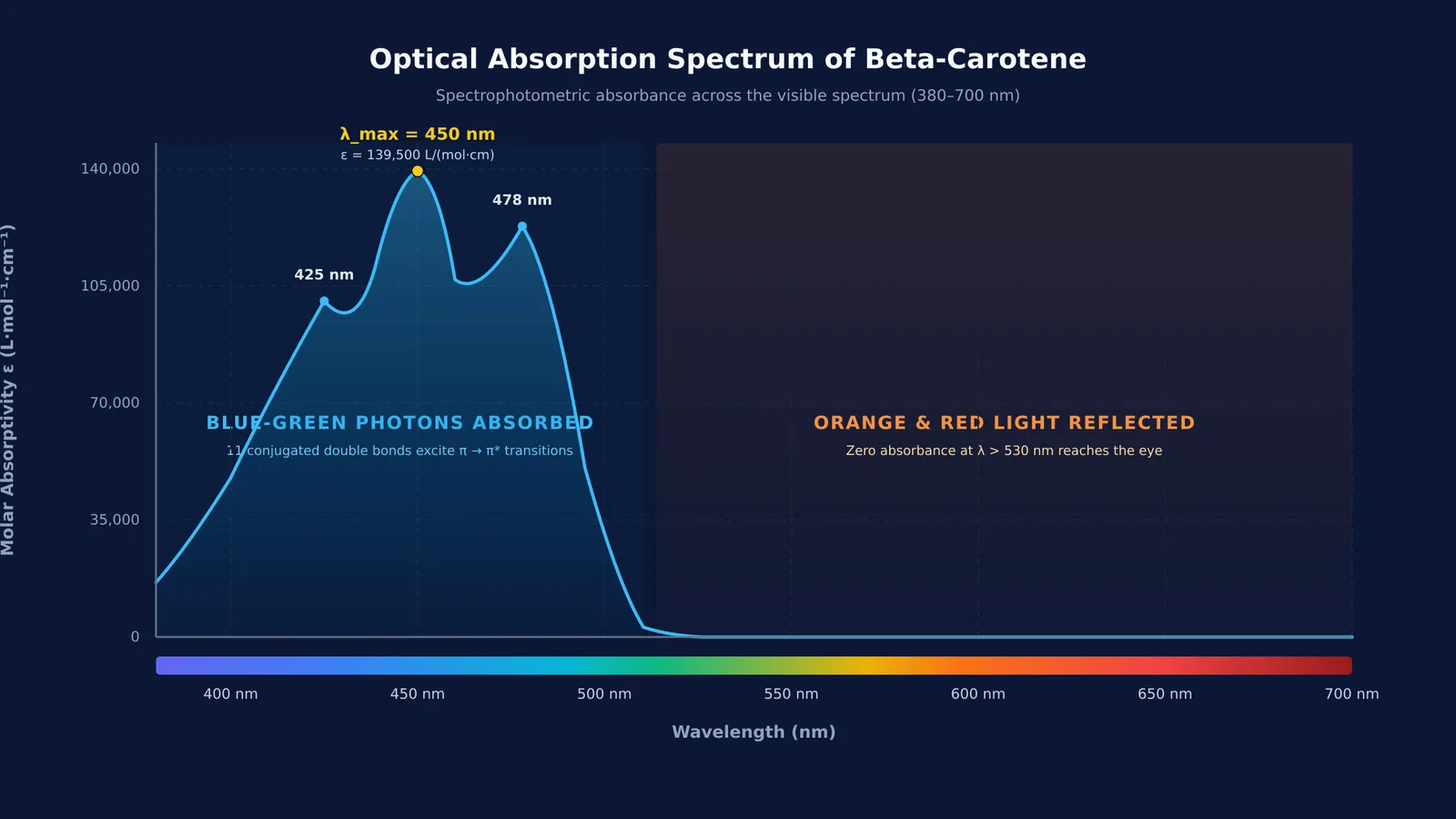
As conjugation increases, the energy gap between the Highest Occupied Molecular Orbital (HOMO) and the Lowest Unoccupied Molecular Orbital (LUMO) narrows. In beta-carotene, this HOMO-LUMO gap corresponds to blue-violet photons (400–500 nm). Spectrophotometric measurements show absorption peaks at 425 nm, 450 nm, and 478 nm, with peak molar absorptivity reaching 139,500 L/(mol·cm) at 450 nm in hexane as documented in classic carotenoid spectroscopy studies. Because wavelengths between 530 nm and 700 nm are not absorbed, reflected light appears orange. This reflected light stimulates retinal cone cells, a mechanism explained in how retinal cone cells detect colours. You can separate these pigments in class via paper chromatography of leaf pigments.
Visualising how molecular orbitals absorb visible light can be difficult from static formulas. The Fermi Simulation Lab provides interactive simulations for ideas that are easier to see than to read, helping students test wavelengths and observe how light absorption governs perceived colour.
How does the human body turn carrot pigments into vitamin A?
Carrots provide provitamin A carotenoids that the body converts into retinol. When consumed with dietary fats, bile salts emulsify beta-carotene into intestinal micelles. Clinical findings in The American Journal of Clinical Nutrition demonstrate that the intestinal conversion efficiency of beta-carotene to vitamin A varies widely among individuals, mediated by the enzyme beta-carotene 15,15'-oxygenase (BCO1) which symmetrically cleaves the pigment into two molecules of retinal.
Retinal is reduced to retinol, which enters the bloodstream. In the retina, 11-cis retinal binds to opsin to form rhodopsin inside rod photoreceptors. Absorbing a photon isomerises retinal to all-trans retinal, initiating an electrical nerve impulse for night vision. Insufficient vitamin A impairs rhodopsin regeneration, causing nyctalopia (night blindness).
How much vitamin A do you actually get from a carrot?
The body does not convert beta-carotene into vitamin A at a 1:1 ratio. International nutrition standards measure provitamin A in Retinol Activity Equivalents (RAE). Here is a worked calculation of what a fresh carrot delivers based on official Indian standards:
Identify carotene content: A medium raw carrot (~100 g) provides approximately 8,285 µg of dietary beta-carotene.
Apply the bioconversion ratio: Under the 12:1 ratio set by the ICMR-NIN 2020 Recommended Dietary Allowances, 12 µg of dietary beta-carotene yields 1 µg of RAE:
8,285 µg ÷ 12 ≈ 690.4 µg RAE
Compare with daily requirements: Under ICMR-NIN guidelines, the Recommended Dietary Allowance is 1,000 µg RAE for adults, while the Estimated Average Requirement is 840 µg RAE. One 100 g carrot meets roughly 69% of an adult's daily RDA and approximately 82% of the daily EAR.
Co-ingest with fat: Consuming carrots with healthy fats (such as curd, nuts, or a teaspoon of ghee) aids micelle formation, maximising carotenoid absorption.


