On this page
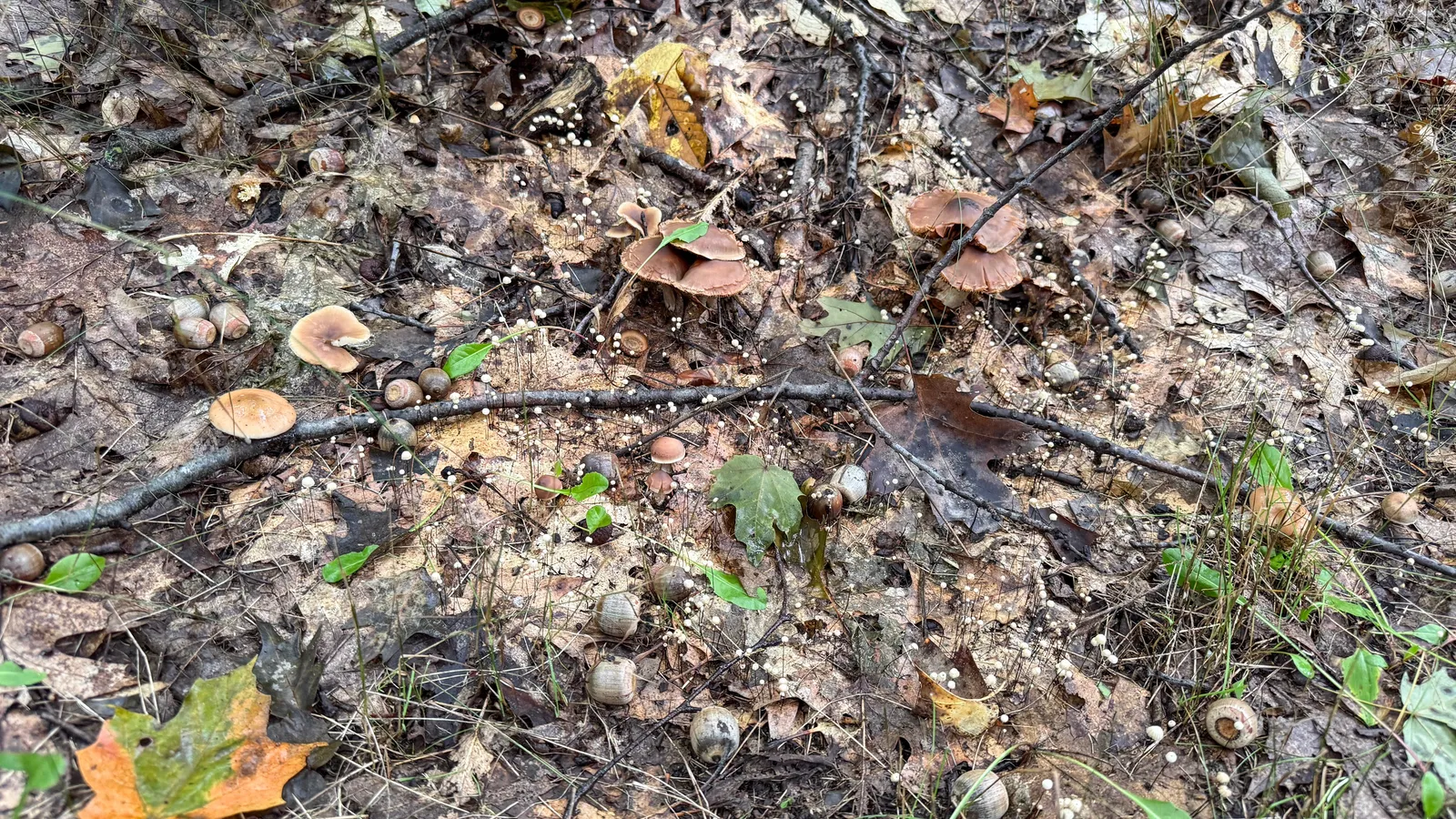
Walk through any forest after leaf fall, from a sal forest in central India to an oak wood in Europe, and the ground is covered. Months later most of that layer is gone, and the floor has not piled up year after year. The leaves did not vanish. They were eaten, digested and turned into raw material for next year's leaves.
This idea joins three Class 12 ecology topics students often learn separately: decomposers, the detritus food chain and nutrient cycling.
Where do fallen leaves go in a forest?
They become food for decomposers. The NCERT Class 12 Biology chapter on ecosystems defines decomposition as decomposers breaking down complex organic matter into inorganic substances like carbon dioxide, water and nutrients.
Dead leaves, bark, flowers and dead animals together make up detritus, the raw material for decomposition, according to the same NCERT chapter.
NCERT lists five steps, and notes that the steps operate at the same time on the detritus:
Fragmentation: detritivores such as earthworms break detritus into smaller particles.
Leaching: water carries soluble inorganic nutrients down into the soil, where some settle out as salts plants cannot use.
Catabolism: bacterial and fungal enzymes break detritus down into simpler inorganic substances.
Humification: a dark, amorphous substance called humus builds up. It resists microbes, breaks down very slowly and holds nutrients.
Mineralisation: some microbes break down humus further, releasing inorganic nutrients.
The last step closes the loop. Those released nutrients sit in the soil where roots take them up, and the tree builds new leaves from them. For more on who does this, see our explainer on the role of decomposers in an ecosystem.
Who actually eats a dead leaf?
NCERT's decomposition diagram shows the sequence: insects and other animals eat part of the fallen leaf, fungi and bacteria partly consume what is left until it loses its form and becomes litter, and earthworms, soil mites, bacteria and fungi carry it into organic-rich soil (NCERT, Figure 12.1).
The animals matter more in some places than others. A global experiment led by Diana Wall, published in Global Change Biology in 2008, left the same grass litter at 30 sites on six continents, in normal plots and in plots where soil animals were reduced. Soil animals sped up decomposition in temperate and wet tropical climates, but made no difference where cold or dryness held back biological activity.
Why do some leaves disappear faster than others?
Decomposition is slower when detritus is rich in lignin and chitin, and faster when it is rich in nitrogen and water-soluble substances like sugars, according to NCERT. The same chapter says warm, moist conditions speed decomposition, while low temperature and a lack of oxygen slow it down, so organic matter builds up.
A 2008 study in Ecology Letters by William Cornwell and colleagues pooled leaf and litter data on 818 plant species from 66 decomposition experiments on six continents. They found that differences between species in how fast their litter broke down were greater than the variation caused by climate.
How do nutrients from leaves get back into trees?
Through mineralisation, and nitrogen shows it most clearly. A 10-year experiment by William Parton and colleagues, published in Science in 2007, followed decomposing litter at 21 sites across seven biomes. The paper notes that litter decomposition is the primary source of mineral nitrogen for biological activity in most land ecosystems. In the experiment, how much nitrogen leaf litter released depended mainly on how nitrogen-rich it was at the start and how much of it was left, largely regardless of climate or soil. Dry grasslands under strong ultraviolet light were the exception.
The same nutrients go round again, soil to leaf to litter to soil, with no fertiliser added. Our post on how humus builds soil fertility picks up this part of the story.
Worked example: follow one leaf from branch to root
Use this sequence for a question such as "Describe the process of decomposition."
Start: a leaf falls. It is now detritus.
Eaten: insects and earthworms chew it into fragments (fragmentation).
Washed: rain dissolves soluble nutrients and carries them down (leaching).
Digested: fungal and bacterial enzymes break the fragments into simpler substances (catabolism).
Stored: what resists digestion becomes dark humus (humification).
Released: microbes slowly mineralise humus into inorganic nutrients.
Reused: roots absorb those nutrients and the tree grows new leaves.
Then add one line on rate: warm and moist means fast, cold or short of oxygen (as in waterlogged soil) means slow, and nitrogen-rich leaves rot faster than tough, lignin-rich ones.
The full method is in our leaf-litter decomposition experiment. If you would rather see the cycle move before you try it, the Fermi Simulation Lab has interactive simulations for ideas that are easier to see than to read. If a step such as mineralisation still feels fuzzy, the Fermi Concept Library gives each biology concept its own lesson and shows where it fits on the map.