

On this page
When leaves fall to the forest floor, they do not stay there forever. They are constantly being broken down by a complex web of soil organisms. To figure out exactly *who* is doing the work, ecologists use a simple but effective tool: the leaf litter mesh bag experiment.
By burying leaves in bags with different-sized holes, researchers can act like bouncers at a microscopic club, letting some decomposers in while keeping others out.
How do mesh bags separate decomposers?
The entire method relies on physical size. Researchers typically compare two types of bags to isolate the effects of different soil creatures:
Fine-mesh bags (often 0.1 mm to 0.15 mm): The holes in these bags are so microscopic that they exclude almost all insects and worms. Only microorganisms like bacteria, fungi, and tiny nematodes can get inside.
Coarse-mesh bags (usually 2 mm to 10 mm): These holes are large enough to let in the "macrofauna" and "mesofauna"—larger soil animals like earthworms, millipedes, mites, and springtails.
This setup is the modern ecological equivalent of the experiment conducted by Francesco Redi and the covered jars of rotting meat, where a physical barrier proved that insects, not spontaneous generation, were responsible for maggots.
What is the typical difference in mass loss percentage?
By weighing the bags before they are buried and again after several months, researchers can see how much leaf mass has vanished. The results are often clear, particularly in warm, wet environments.
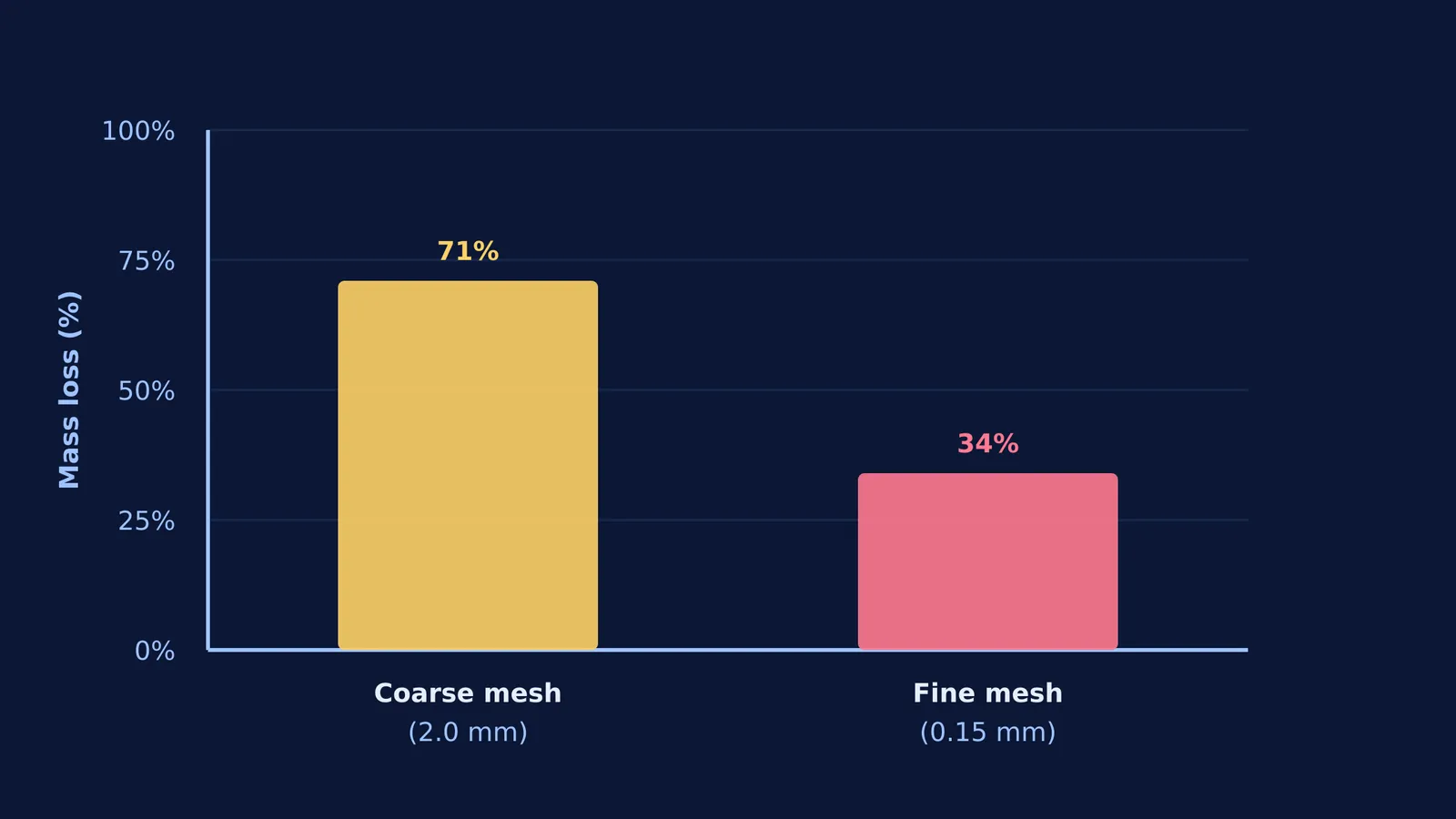
In one major study in a tropical seasonal rainforest in China (Yang and Zou, 2006), researchers found that coarse-mesh bags (2.0 mm) experienced a 71% mass loss over the study period. In contrast, the fine-mesh bags (0.15 mm) saw only a 34% mass loss.
Because the fine-mesh bags excluded larger insects and earthworms, the 34% decomposition was solely the work of microbes. The jump to 71% in the coarse bags proved that larger soil animals—the shredders and digesters—were responsible for roughly half of the total leaf breakdown in that ecosystem. (A similar microbial breakdown happens in human waste systems, using bacteria to digest organic matter, as detailed in Sewage treatment and BOD: the stages and the numbers behind them).
The hidden variable: Does mesh change the microclimate?
While the logic of the experiment seems straightforward, ecology is rarely that simple. A 2013 study in *Soil Biology and Biochemistry* (Bokhorst and Wardle, 2013) pointed out an important detail: the mesh itself changes the environment inside the bag.
Fine-mesh bags restrict airflow and trap moisture. This creates a tiny, damp "greenhouse" inside the bag, fundamentally altering the microclimate. Because bacteria and fungi thrive in damp, stable conditions, the microbial decomposition in a fine-mesh bag might actually be artificially boosted compared to the open air. This means researchers must be careful not to take the mass loss percentages entirely at face value, as the physical bag itself becomes a confounding variable.
A checklist for your own litterbag experiment
If you are designing an ecology project for school, a leaf litter experiment is a great way to test hypotheses about your local environment. Here is a framework to keep your experiment rigorous:
Standardise your litter: Collect leaves from the exact same tree species, dry them completely, and weigh out identical amounts (e.g., exactly 5.0 grams per bag).
Choose contrasting mesh sizes: Use a fine mesh (like thick tights or a 0.1 mm window screen) for microbes, and a coarse mesh (like a plastic onion sack, around 5 mm) to invite insects.
Control your placement: Bury all bags at the exact same depth in the soil, or pin them securely to the surface so wind does not blow them away.
Schedule your retrievals: Pull up a subset of bags every few weeks, rather than waiting until the end. This lets you plot the rate of mass loss on a graph.
Wash and dry carefully: When you retrieve a bag, gently wash off the mud, then dry the remaining leaf fragments in an oven before weighing. Mud adds weight and will ruin your data!
Thinking like a scientist
Understanding how variables interact is a core skill for any science student, whether you are preparing for biology exams or running your own field studies. If you are struggling to track multiple variables or conceptualise complex ecological relationships, the Fermi Problem Library can help. Instead of just printing an answer to a homework question, Fermi's AI tutor works through the problem with you step-by-step, explaining the reasoning behind the scientific method so you understand *why* an experiment behaves the way it does. You can also explore the Fermi Concept Library to see how nutrient cycles and decomposition fit into the larger map of biology.
By questioning everything—even the bags we put the leaves in—we get closer to the truth of how the forest floor works.


