On this page
Test cricket has a problem after sunset. The ball is dark red, the players wear white, and the sightscreens are white too. Cricket's answer was a pink ball, and the reasons make a neat lesson in colour, light and how your eyes work.
Why is a pink ball used in day-night Test cricket?
Pink is meant to stay visible against both the dark and the white parts of a floodlit ground. In a 2017 paper in i-Perception, vision scientists Joshua Adie and Derek Arnold took light readings of red, white and pink balls and of the sky, field, stands and sightscreen (plus the pitch, during breaks) at a floodlit first-class match at the Gabba in Brisbane in October 2016 (Adie and Arnold, 2017).
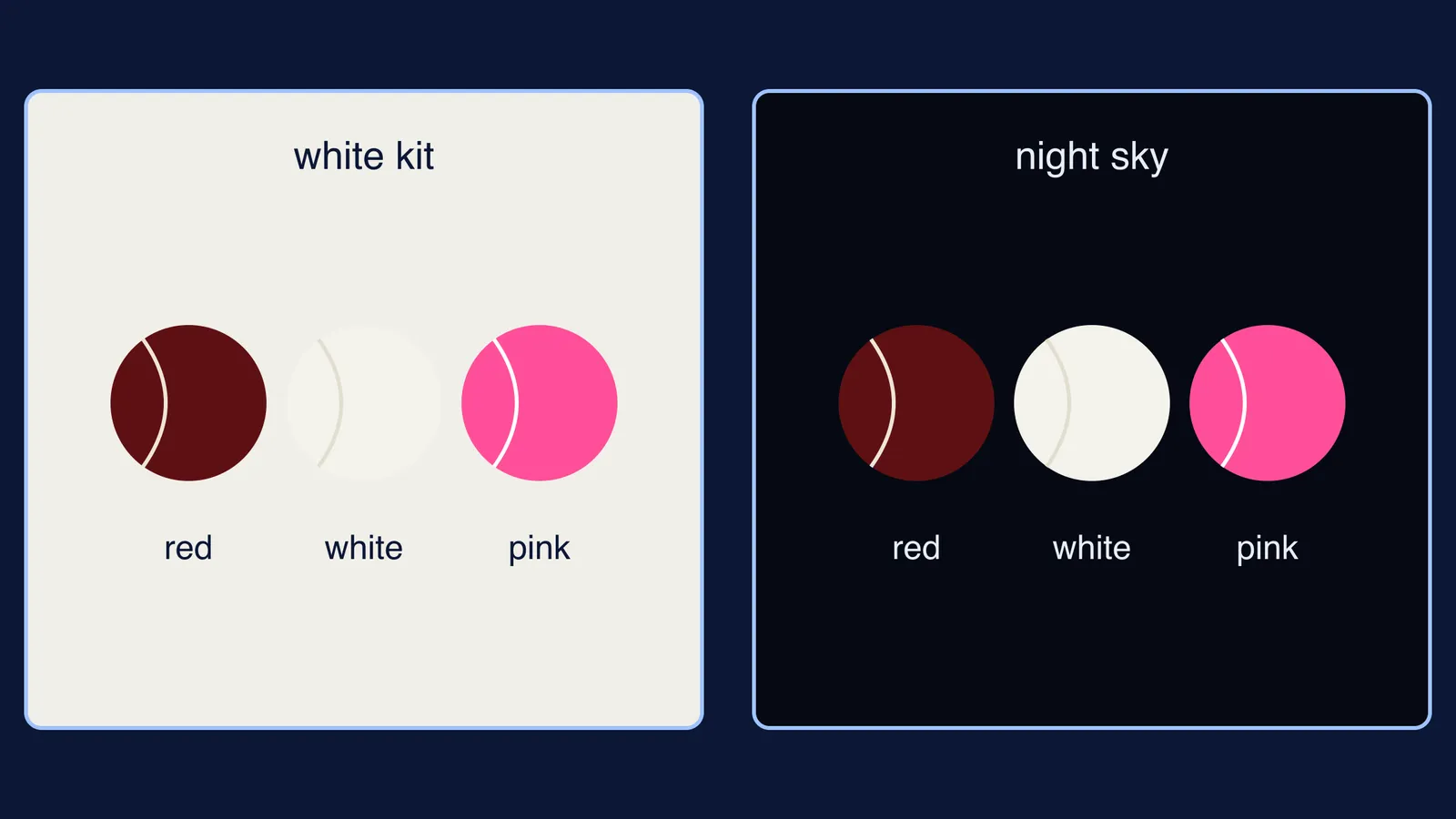
The red ball was "reliably darker" than the sky, field, stands and sightscreen, and the white ball was "reliably brighter" than all of them (Adie and Arnold, 2017). Each of those causes a different problem:
Red: a dark ball against dark stands and a night sky has little to separate it. Cricket Australia also says the red ball "flares" under floodlights, giving it a comet-like tail that makes it hard to see distinctly (cricket.com.au).
White: easy to see at night, which is why one-day cricket under lights uses a white ball with players in coloured clothing. In a Test, though, white cannot be used with white clothing (cricket.com.au).
Pink: the compromise that keeps the whites. Ball makers tried other bright colours, including optic yellow and bright orange, before settling on pink (Drishti IAS).
Why not just use a white ball in Tests?
Your eye finds an object by how much it differs from what is behind it, and a white ball against a white shirt or sightscreen gives the batter almost nothing to lock on to. One-day cricket changed the clothes; Test cricket kept its look and changed the ball.
That difference between an object and its background is called contrast, and it comes in two kinds: brightness contrast (one is lighter or darker) and colour contrast (they differ in hue, like pink against green). Derek Arnold of the University of Queensland explains that "a person's perception of motion relies on brightness contrast rather than colour" (University of Queensland). So a ball that differs from its background in colour but not brightness can be hard to track once it moves. For the basics of hue, see our explainer on how your eyes see so many different colours.
Is the pink ball hard to see at sunset?
Sometimes, yes. As the sun sets, its light passes through more air, which scatters shorter wavelengths and leaves the light redder (Adie and Arnold, 2017). At the Gabba, the pink ball switched from brighter to darker than the sky, outfield and stands during this period. The authors think the light itself changed: compared with the pitch, the pink ball was relatively well lit by the setting sun but less well lit by the floodlights after sunset. They wrote that at dusk, against the grandstands, they found it "entirely impossible to see a fast moving pink ball".
In follow-up work, Arnold's group found that viewing the ball through rose-tinted glasses, which made it look brighter, improved timing by around 10 per cent (University of Queensland).
Umpires see it a little differently. In a 2021 survey of 27 international and first-class umpires, the pink ball at night under floodlights was rated more visible than the red ball in natural light, with no significant difference at dusk (Maguire and colleagues, Journal of Science and Medicine in Sport).
Where is the pink ball used now?
The first day-night Test was played in Adelaide in 2015 between Australia and New Zealand, and India played its first at Eden Gardens, Kolkata, against Bangladesh from 22 November 2019, with a pink ball made by SG of Meerut (Drishti IAS). In June 2026, the ICC approved a trial that lets Test teams use pink balls in daytime Tests too, if both sides agree before the match, so less play is lost to bad light (Sky Sports).
How can you test ball colours at home?
Cut three coin-sized circles of paper or cloth: dark red, bright pink and white.
Lay out two backgrounds: a white school shirt and a dark blanket or cushion.
Before looking, predict for each of the six pairs whether the circle will be easy or hard to spot. Write it down.
Stand about 3 metres away in a bright room and check your predictions.
Turn off the main light, light the scene from the side with one lamp or a phone torch, and look again.
Photograph all six pairs and switch the photo to black and white.
If cricket's reasoning holds, red should be hardest on the dark background, white should vanish on the shirt, and pink should hold up on both.
If light and colour are hard to picture, the Fermi Simulation Lab has interactive simulations for the ideas that are easier to see than to read.
For more cricket physics, see why a cricket ball has a raised seam and how it swings, or the colour story behind why stop signals are red.